Your Store Changed Overnight. You Didn't Touch It.
In one month, four platform-level changes rewrote how thousands of online stores answer AI shopping agents. Nobody who owns those stores did anything.

Here is a small fact that should change how you think about the web right now: in the last month, tens of thousands of online stores quietly changed how they answer AI shopping agents, and not one of the people who own those stores lifted a finger.
An independent crawler called UCP Checker published its September census on 22 September, and it is the clearest outside picture yet of what agentic commerce actually looks like. The headline is not that agents are shopping. The headline is that the platforms, not the merchants, are the ones making the moves.
Four changes, one month, nobody asked
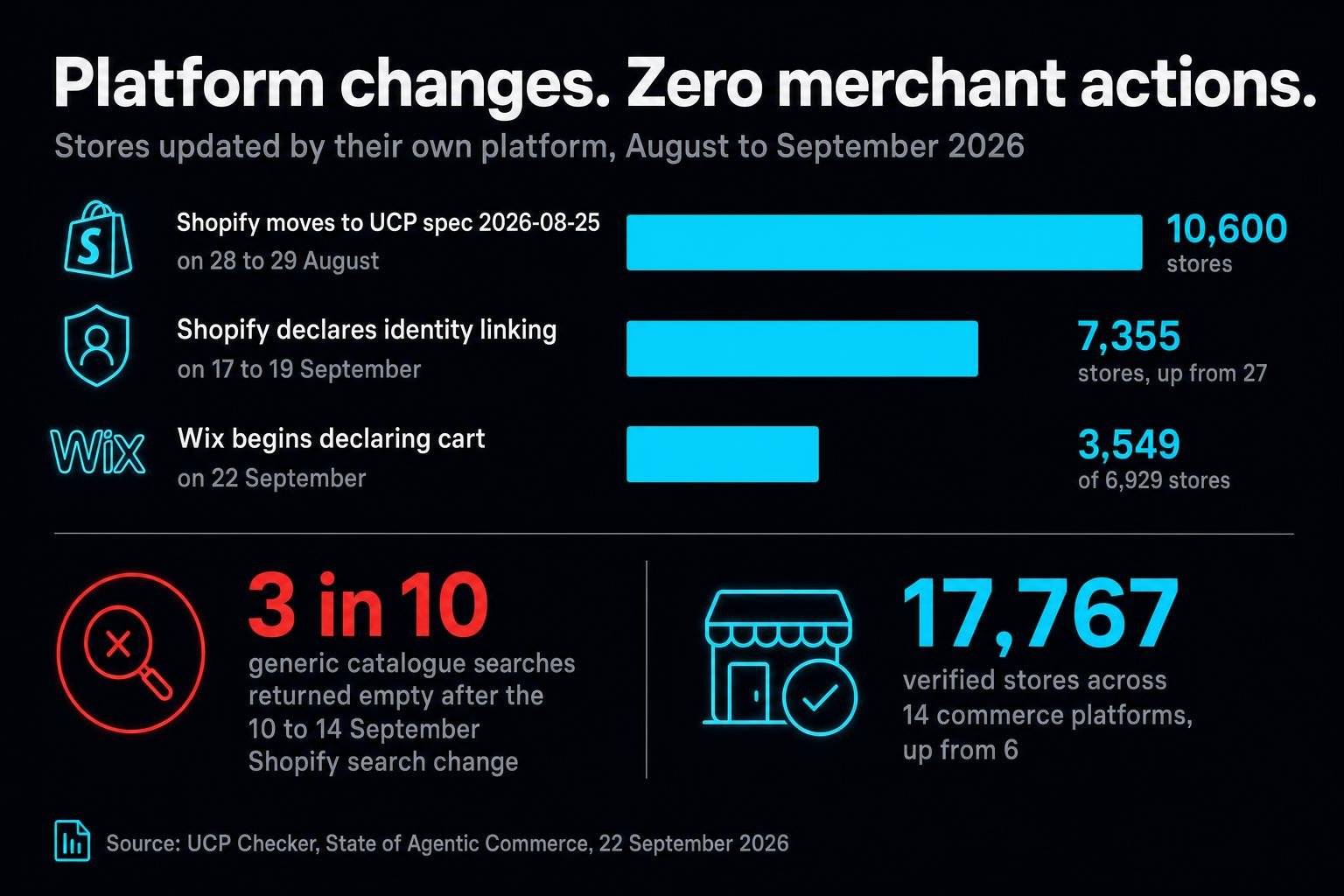
- 28-29 August: Shopify's template moved to the newer agent-commerce spec. About 10,600 stores in two days.
- 10-14 September: Shopify catalogue search began matching generic queries literally. Roughly 3 in 10 generic searches came back empty.
- 17-19 September: Shopify stores began declaring identity linking through Shop accounts. 27 stores became 7,355.
- 22 September: Wix began declaring cart support. 3,549 of 6,929 stores by mid-afternoon UTC.
Across the whole census: 17,767 verified stores, and 14 commerce platforms with at least one verified store, up from 6. Salesforce Commerce Cloud is due to go live with it in October. Exactly one production merchant, a Dutch perfumer running WooCommerce, currently declares a payment token. The next version of the spec is penciled in for December or January, with guidance on prompt injection.
Read that list again and notice what it is not. It is not a list of merchants upgrading. It is a list of four mornings on which the ground moved under thousands of businesses at once.
The empty shelf problem
The second row is the one I keep turning over. Picture a shop assistant who has memorised the exact name of every product in the store and nothing else. A customer walks in and says "I need something for energy." The assistant, with a full shelf directly behind them, says: we don't carry that.
That is roughly what happened between 10 and 14 September. Specific product words still returned results. Generic ones stopped working for a large share of stores. And "something for energy" or "popular products" is exactly the kind of query an AI shopping agent fires off when a human gives it a vague prompt, which is how humans mostly talk.
So this is not a plumbing failure. The pipes are fine. It is a vocabulary failure.
Agent visibility just stopped being an engineering problem and became a writing problem. The agent only knows the words that are actually sitting in your product titles and descriptions.
The other uncomfortable part: it landed overnight, with no announcement, and it could reverse the same way. A store that passed an agent-readiness check in August was not necessarily passing one in mid-September, and nothing in the admin panel would have said so. The only honest way to know whether a catalogue can answer an agent is to ask it again tomorrow.
The ad engine is looking at the same shelf
Now stack the second signal on top. In its 16 September announcement, OpenAI put a ChatGPT Ads app in the Shopify App Store, live in the US from that date, with international markets where ChatGPT Ads are available scheduled to begin on 23 September. Products flow in through Shopify Catalog, so a merchant does not rebuild a feed. HubSpot is the first CRM partner. Sponsored Agents, where clicking an ad opens a labelled chat with a business-sponsored agent, are in testing with select US advertisers. And an opt-in text customization feature adapts headlines to the conversation and auto-translates ad copy into the user's preferred language.
ChatGPT Ads have been self-serve in 31 European countries, including Germany and Austria, since 31 August. European ads are not personalised: selection runs on conversation topic, broad location and device.
Put the two signals together and the picture is simple. The same catalogue that answers an AI shopping agent is the catalogue the ad engine reads. One set of product words, several front doors. The copy is the product, in a way it has never quite been before.
The same move, in a very different room
If you want proof this is a pattern and not a Shopify quirk, look somewhere that could not be less like e-commerce. At the Falcon Peak 26.2 counter-drone exercise at Yuma Proving Ground, US Northern Command used Anduril's Lattice as the digital backbone and, as DefenseScoop reported, the baseline standard against which all commercial sensor-to-shooter counter-drone assets are measured. At least 20 vendors had to feed their sensor data and radar tracks directly into Lattice. It follows an $87 million contract selecting Lattice for tactical command and control in that mission.
Think about what that does to a sensor company. Its first engineering task is no longer a better sensor. It is a Lattice integration. That is the identical shape as a merchant whose store behaviour is set by a template they don't control: whoever owns the template owns the market, and everyone else is a plug-in.
What to do with this
Three things, and none of them require a platform team.
- Write for the words an agent will use. If your bestseller is titled with a brand-invented name and nothing else, a generic query cannot find it. Put the category, the use case and the plain-language benefit in the title and description.
- Treat readiness as a live reading, not a certificate. An audit that was true in August was a snapshot. Four platform events in one month is the actual cadence.
- Fix the catalogue once, benefit everywhere. Shopping agents, ChatGPT Ads through Shopify Catalog, and whatever ships in the next spec release all read the same source.
One honesty note: the census is a single crawler, though one that publishes its method and daily data rather than a vendor making claims. The international rollout date for the Shopify ads app is a stated date, not something I have watched happen. Both are worth checking against your own store rather than taking on faith. Which, given how the last month went, is rather the point.
One signal a day. No noise.
A 3-minute read when something genuinely shifts in AI, automation, or defense tech. Free, most weekdays.
Free, most weekdays. No spam, unsubscribe anytime.Sources
- UCP Checker - State of Agentic Commerce, September 2026 - https://ucpchecker.com/blog/state-of-agentic-commerce-september-2026
- OpenAI - Reimagining advertising with AI - https://openai.com/index/reimagining-advertising-with-ai/
- Search Engine Land - ChatGPT ads are expanding to 31 European countries - https://searchengineland.com/chatgpt-ads-are-expanding-to-31-european-countries-485468
- DefenseScoop - Northern Command's Falcon Peak 26.2 counter-drone exercise - https://defensescoop.com/2026/09/23/northern-command-falcon-peak-26-2-counter-drone-exercise/
Quick answers
What actually changed for online stores in September 2026?
According to the UCP Checker census published on 22 September, four platform-level events hit in one month: Shopify moved about 10,600 stores to a newer agent-commerce spec on 28 to 29 August, Shopify catalogue search began matching generic queries literally between 10 and 14 September, Shopify stores began declaring identity linking on 17 to 19 September (27 stores became 7,355), and Wix began declaring cart on 22 September (3,549 of 6,929 stores). No merchant action was required for any of them.
Why do generic searches now return nothing on many stores?
After the 10 to 14 September change, Shopify catalogue search began matching generic queries literally, and roughly 3 in 10 generic searches came back empty. Specific product words still work. That makes agent visibility a copywriting problem: the words an agent uses have to appear in the product title and description.
Is ChatGPT Ads available outside the United States?
OpenAI's 16 September announcement put the ChatGPT Ads app in the Shopify App Store in the US from that date, with international markets where ChatGPT Ads are available scheduled to begin on 23 September. ChatGPT Ads have been self-serve in 31 European countries, including Germany and Austria, since 31 August, with European ad selection based on conversation topic, broad location and device rather than personalisation.
What does a counter-drone exercise have to do with e-commerce?
The same structural move. At Falcon Peak 26.2, US Northern Command used Anduril's Lattice as the digital backbone and the baseline standard for measuring commercial counter-drone assets, so at least 20 vendors had to feed sensor data into Lattice to participate. Like a store whose behaviour is set by its platform template, the party that owns the integration layer sets the terms for everyone else.