The Price of Thinking Fell by Half
In one afternoon, Anthropic and OpenAI cut frontier AI prices against each other. In the forty eight hours around it, Shopify, Meta and PayPal finished wiring a checkout for AI agents. Neither event required anyone to invent anything.

Some weeks the technology gets better. This one, it got cheaper and it got closer. Those are different things, and the second kind moves markets faster.
Two price cuts, hours apart
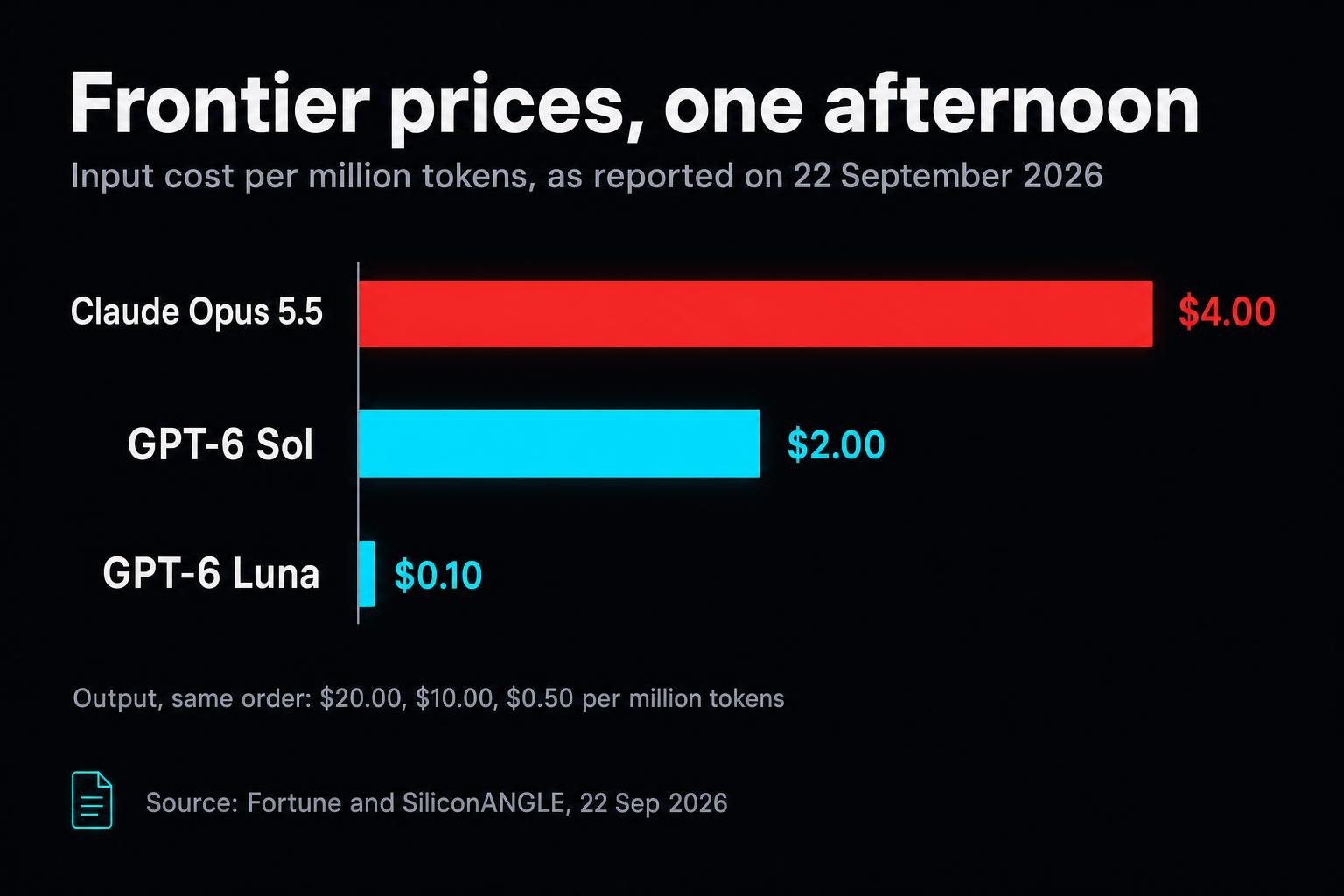
On 22 September 2026, Anthropic released Claude Opus 5.5, which it positions at the performance level of its Fable 5.1 flagship while costing roughly 40% less to run than Opus 5. Input runs $4 per million tokens, output $20, and cache reads dropped 60% to $0.20.
Within hours, OpenAI answered with two GPT-6 models, Sol and Luna, each priced at half the GPT-5.6 version it replaces. Sol lands at $2 in and $10 out. Luna lands at $0.10 in and $0.50 out.
Hours apart. That is the part worth pausing on. This was not two companies happening to finish their homework on the same day. This was two petrol stations facing each other across a road, repainting the price board within the same hour, each watching the other through the window.
The number that matters is ten cents
Luna at $0.10 per million input tokens is the headline nobody wrote. At that price, running a language model over every single record in a business stops being a budget decision and becomes a rounding error. Classify every inbound message. Summarise every support thread overnight. Tag every document in an archive. In 2025 those were pilot projects with a business case attached and a nervous finance person reading it. At ten cents they are cheaper than the text message you send to follow up.
Think of it like the moment photography went digital. Nothing about the camera got dramatically better that year. What changed is that the marginal cost of one more photo went to zero, and once it did, people stopped deciding whether a shot was worth taking. Behaviour changed because the meter stopped running, not because the lens improved.
A price cut is a confession
Both Fortune and SiliconANGLE frame these releases the same way: a fight for wallet share among cost-conscious businesses rather than a capability race. That framing is the real story.
When the two leading labs answer each other on price instead of on benchmarks, they are telling you what their customers are actually choosing on. And it is not raw intelligence any more.
The frontier cadence had gone quiet for a stretch. It restarted as a price move. That is what a market does when the capability gap between vendors is no longer the thing anyone is buying on, and it is a healthy sign for everyone downstream, even if it is an uncomfortable one for the labs.
Meanwhile, the shopping cart got wired up
The same week, in the same quiet way, the payment layer for AI shopping was finished.
On Monday 21 September, Shopify and Meta announced that Muse, Meta's personal AI agent, can complete purchases through Shop Pay's agentic checkout across Shopify stores. Muse searches Shopify's catalogue against a shopper's prompt and checks out through the Universal Commerce Protocol, with product data flowing from Shopify Catalog. Shopify shares rose roughly 7% on the news.
On Tuesday 22 September, PayPal announced the same capability across its own merchant network, worldwide. Meta's Alexandr Wang confirmed it publicly that day.
So: catalogue visibility on one day, working payment on the next. The gap between "an AI can see your products" and "an AI can buy your products" closed in about forty eight hours, and it closed for an enormous number of merchants without any of them lifting a finger.
Amazon said no, and that is the interesting half
Amazon has blocked Muse from its retail site, citing privacy and security risk from an agent capturing and storing customer credentials.
Amazon can say no. It has the traffic, the habit and the leverage, so letting somebody else's assistant stand between it and its customers is pure downside. Shopify sits on the opposite incentive: its merchants are individually small, so being reachable inside somebody else's agent is distribution they could not otherwise buy.
That split tells you where agentic commerce actually lands first. Not on the giants. On the long tail.
And here is the consequence that should keep any online seller up at night. When the agent does the choosing, the shopper never sees the product page. No reviews, no bundle logic, no carefully tuned upsell, no photography, no brand voice. Every bit of persuasion that normally happens after the click simply does not happen. What survives is catalogue data quality, because the data is the only surface the agent reads. Complete titles, correct variants, accurate inventory, honest categorisation. The boring fields became the storefront.
What I cannot tell you
I want to be straight about the limits here. The prices above are as reported by Fortune and SiliconANGLE. I have not checked the vendors' own pricing pages, so treat them as reported rather than confirmed at the source. The performance claims (Opus 5.5 matching a Fable 5.1 flagship) are vendor claims relayed through press, not independent evaluation.
On the commerce side, I looked specifically for a documented way for a Shopify merchant to opt out of appearing in Muse and found none. Coverage describes the integration as automatic. That is an absence of evidence in the reporting, not proof that no toggle exists. If you sell online, go and look in your own admin rather than taking my word or anyone else's.
The through-line
Neither of these was a capability event. Nobody demonstrated a new reasoning trick. Nobody crossed a threshold. Both were distribution events: intelligence got cheap enough to point at everything, and buying got wired into somewhere shoppers already are.
Capability stories make better headlines. Distribution stories change more businesses.
One signal a day. No noise.
A 3-minute read when something genuinely shifts in AI, automation, or defense tech. Free, most weekdays.
Free, most weekdays. No spam, unsubscribe anytime.Sources
- Fortune - What AI slowdown? OpenAI and Anthropic release dueling, more affordable models as AI price wars heat up - https://fortune.com/2026/09/22/what-ai-slowdown-openai-anthropic-release-dueling-moreaffordable-models-as-ai-price-wars-heat-up/
- SiliconANGLE - Anthropic releases Claude Opus 5.5 and OpenAI counters with two cheaper GPT-6 models - https://siliconangle.com/2026/09/22/anthropic-releases-claude-opus-5-5-and-openai-counters-with-two-cheaper-gpt-6-models/
- PYMNTS - Shopify brings Shop Pay checkout solution to Meta's Muse AI agent - https://www.pymnts.com/commerce/ecommerce/2026/shopify-brings-shop-pay-checkout-solution-to-metas-muse-ai-agent/
- American Banker - Shopify adds Meta Muse to agentic AI strategy - https://www.americanbanker.com/payments/news/shopify-adds-meta-muse-to-agentic-ai-strategy
- The Paypers - Meta partners with Shopify to bring Shop Pay checkout to Muse AI - https://thepaypers.com/payments/news/meta-partners-with-shopify-to-bring-shop-pay-checkout-to-muse-ai
- PYMNTS - Meta adds PayPal to Muse AI assistant global checkout - https://www.pymnts.com/news/artificial-intelligence/2026/meta-adds-paypal-muse-ai-assistant-global-checkout/
- Yahoo Finance - PayPal joins Meta Muse checkout - https://finance.yahoo.com/technology/ai/articles/paypal-joins-meta-muse-checkout-162220957.html
Quick answers
How much cheaper did frontier AI models get on 22 September 2026?
Anthropic's Claude Opus 5.5 is positioned as roughly 40% less costly to run than Opus 5, at $4 per million input tokens and $20 per million output tokens, with cache reads down 60% to $0.20. OpenAI's two GPT-6 models each launched at half the price of the GPT-5.6 version they replace: Sol at $2 in and $10 out, Luna at $0.10 in and $0.50 out.
Can an AI agent now buy things on my behalf?
On Shopify stores and across PayPal's merchant network, yes. Meta's Muse agent can complete purchases through Shop Pay's agentic checkout using the Universal Commerce Protocol, announced 21 September 2026, and PayPal extended the same capability worldwide on 22 September 2026.
Why did Amazon block Meta's Muse?
Amazon has blocked Muse from its retail site, citing privacy and security risk from an agent capturing and storing customer credentials. Amazon has enough direct customer traffic to refuse; smaller merchants generally treat agent distribution as upside instead.
Can Shopify merchants opt out of appearing in Muse?
No opt-out mechanism is documented in the available reporting, which describes the integration as automatic. That is an absence of evidence rather than confirmation that no opt-out exists, so merchants should check their own store admin directly.
Is this a capability breakthrough?
No. Both outlets covering the model releases frame them as a fight for wallet share among cost-conscious businesses rather than a capability race, and the commerce announcements connect existing systems. These are distribution events, not capability events.