Agents Ordered a Few Hundred Meals. DoorDash Does 3M a Day
On its Q3 call, DoorDash said third-party AI agents have placed "maybe several hundred orders in total" against about 3 million deliveries a day. The tiny number is the useful part: agents are finally countable.

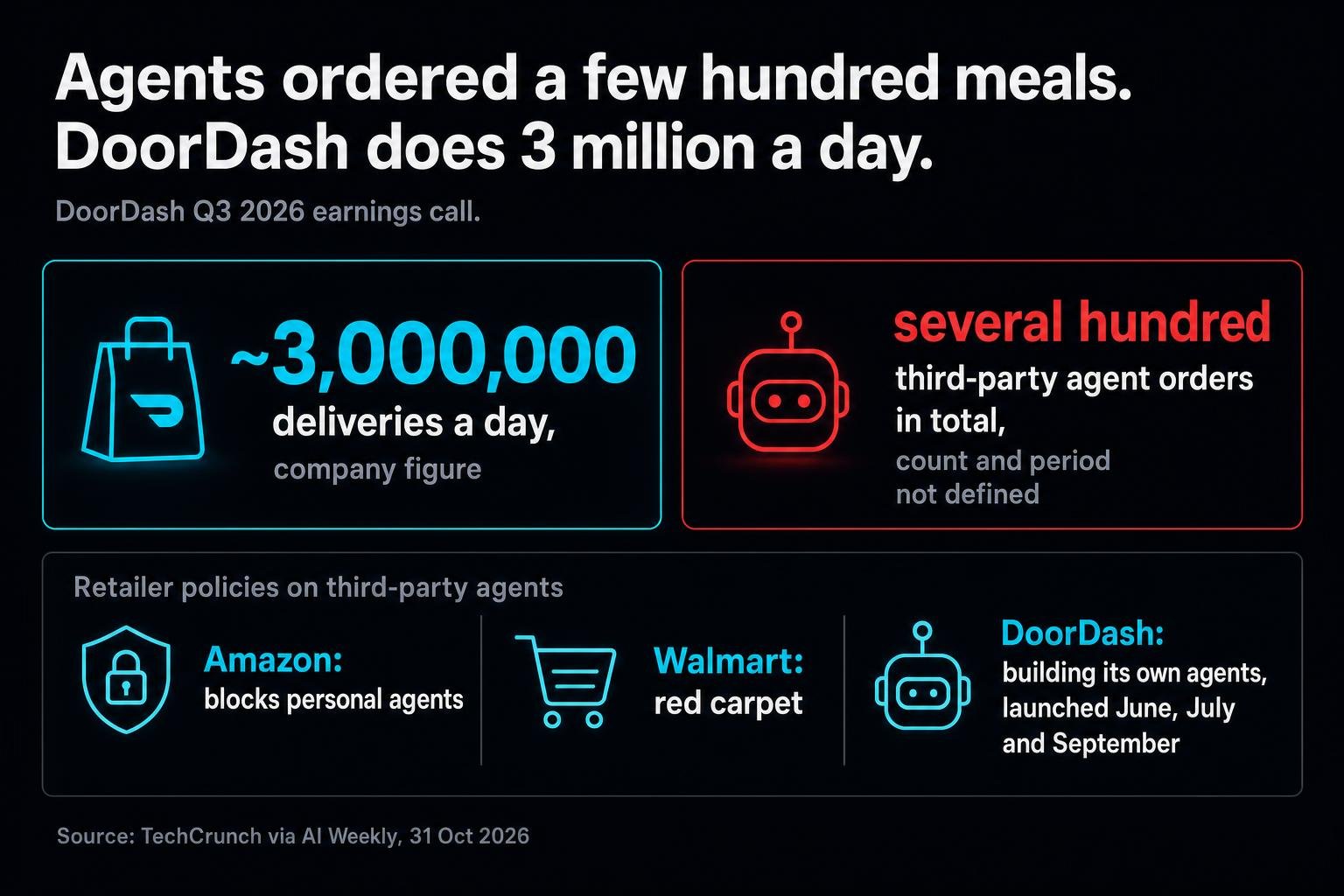
On DoorDash's third-quarter 2026 earnings call, CEO Tony Xu was asked about the AI agents that everyone says are about to reorder commerce. His answer, as reported by TechCrunch and summarised by AI Weekly, was that third-party agents including Muse, Instinct and Fo have placed "maybe several hundred orders in total."
Read that next to the other number DoorDash likes to share: the company says it completes about 3 million deliveries a day. Several hundred, total, against 3 million, daily. I find that gap more interesting than any launch announcement this week, because it is one of the first times a large consumer platform has put an actual count on agent-driven purchases instead of a forecast.
The number next to the number
Picture a stadium that fills 3 million seats every single day. Now picture a few hundred people, in total, across however many days, who got in through a new side door that a robot opened for them. Nobody at the gate wrote down exactly how many, or since when. That is roughly the state of agentic ordering at DoorDash right now.
Two caveats matter. DoorDash did not define "several hundred," and it did not say what period the figure covers. It could be lifetime, it could be the quarter, and the word "several" is doing a lot of work. So treat it as an order of magnitude, not a metric. But even as an order of magnitude it is telling. The agent economy, at one of the most agent-friendly use cases imaginable (ordering food you already know you want), is still a rounding error.
Three doors, three policies
What makes the DoorDash disclosure useful is the contrast it sits inside. Three big retailers have landed on three different answers to the same question: what do we do when a bot shows up acting on behalf of a real customer?
- Amazon blocks personal agents. The door is shut.
- Walmart has "laid out a red carpet" for them, in the words of the same report.
- DoorDash is building its own. Ask DoorDash arrived in June, a command-line agent in July, and a text-to-order agent in September. Third-party agents are tolerated, but the house concierge is clearly meant to win.
It is like three hotels on the same street. One has a doorman turning away anyone who is not the guest in person. One has rolled out carpet for personal assistants and valets. The third lets assistants in, but has hired its own concierge and would really prefer you talk to them. All three choices are rational. None of the three has much data yet about which approach guests actually prefer, because the guests sending assistants are still so few.
Several hundred orders is not a market. It is a baseline. And a baseline is the one thing you cannot forecast your way into.
Why a tiny number is the right number to publish
There is a temptation to read "several hundred" as proof that agents do not matter. I read it the opposite way. Every serious trend starts as a number small enough to be embarrassing, and the companies that win are usually the ones that started counting while it was embarrassing.
The ability to count is itself becoming a product. Cloudflare is reported to be launching analytics for personal-agent traffic along with finer access policies, so site owners can identify agents acting for a person and set different terms for them. I could not find a primary Cloudflare announcement, so treat that feature set as reported rather than confirmed. But the direction is clear: the infrastructure layer wants to let every site owner make the same three-way choice that Amazon, Walmart and DoorDash made, and make it with data instead of instinct.
That is the real story here. Not "agents are coming," which we have heard for two years, but "agents are now countable." Once an activity is countable, three things follow:
- Policy becomes a decision instead of a reflex. You cannot sensibly block or welcome traffic you cannot see.
- Trend beats snapshot. Several hundred today is meaningless on its own. Several hundred this quarter versus a much larger figure next quarter would be the most important slide in the deck.
- The first-party agent gets a scoreboard. DoorDash shipped three of its own agents between June and September. The honest question for its next call is whether those agents are placing more orders than Muse, Instinct and Fo combined, and by how much.
What to watch next quarter
The thing I will be listening for is not a bigger number. It is a defined one. If DoorDash comes back and says agent orders were a specific figure for the quarter, up from a specific earlier figure, the company will have turned a shrug into a metric, and every other consumer platform will be asked the same question by its own analysts within a week. If it stays at "maybe several hundred," that is also a signal: the count is too small to be worth instrumenting, which tells you how far the hype has run ahead of the behaviour.
Either way, the lesson travels well beyond food delivery. The agent question for most businesses is not whether to say yes or no. It is whether you would even know an agent had shown up.
What a small first number taught me
I once built a measurement harness that runs a fixed set of buyer questions against ChatGPT, Perplexity and Gemini, detects whether a target brand or domain is cited, and tracks the citation rate over time. The first readings were small and a little humbling. That was the point. Before the harness, every conversation about AI visibility was opinion. After it, there was a baseline and a trend, and the arguments got shorter.
DoorDash's "maybe several hundred" is the same moment at a much larger scale. The number is almost nothing next to 3 million deliveries a day, but it exists, which means it can move, and someone can be asked next quarter whether it did.
If you run a site or a store, the lesson I would take is not that agents do not matter yet. It is this: pick a fixed set of questions or actions an agent would take against you, run them on a schedule, and write the result down. The baseline is the asset. The trend is the story.
One signal a day. No noise.
A 3-minute read when something genuinely shifts in AI, automation, or defense tech. Free, most weekdays.
Free, most weekdays. No spam, unsubscribe anytime.Sources
- AI Weekly - DoorDash CEO: only several hundred orders so far from AI agents (via TechCrunch) - https://aiweekly.co/alerts/doordash-ceo-only-several-hundred-orders-so-far-from-ai-agents
- AI Agents Directory - AI agents news brief, November 4, 2026 (Cloudflare personal-agent analytics, as reported) - https://aiagentsdirectory.com/news/ai-agents-news-brief-november-4-2026
Quick answers
How many orders have AI agents placed on DoorDash?
On DoorDash's Q3 2026 earnings call, CEO Tony Xu said third-party agents including Muse, Instinct and Fo have placed "maybe several hundred orders in total." DoorDash did not define the figure or the period it covers.
How does that compare with DoorDash's normal volume?
DoorDash says it completes about 3 million deliveries a day, so agent-placed orders are a tiny fraction of total activity so far.
Which big retailers allow personal AI agents to shop for customers?
According to the same report, Amazon blocks personal agents, Walmart has laid out a red carpet for them, and DoorDash tolerates third-party agents while building its own: Ask DoorDash in June, a CLI agent in July and a text-to-order agent in September.
Can a website tell when an AI agent is acting on behalf of a person?
Cloudflare is reported to be launching analytics for personal-agent traffic and finer access policies so site owners can identify such agents and set different terms for them. No primary Cloudflare announcement could be located, so treat the feature set as reported rather than confirmed.