Shopify Made Every Store Agent-Ready. Is Yours?
Shopify's Fall '26 Edition opens catalog, cart and checkout to AI agents by default. The question for a merchant is no longer whether to opt in, but whether the store qualifies and how it ranks.

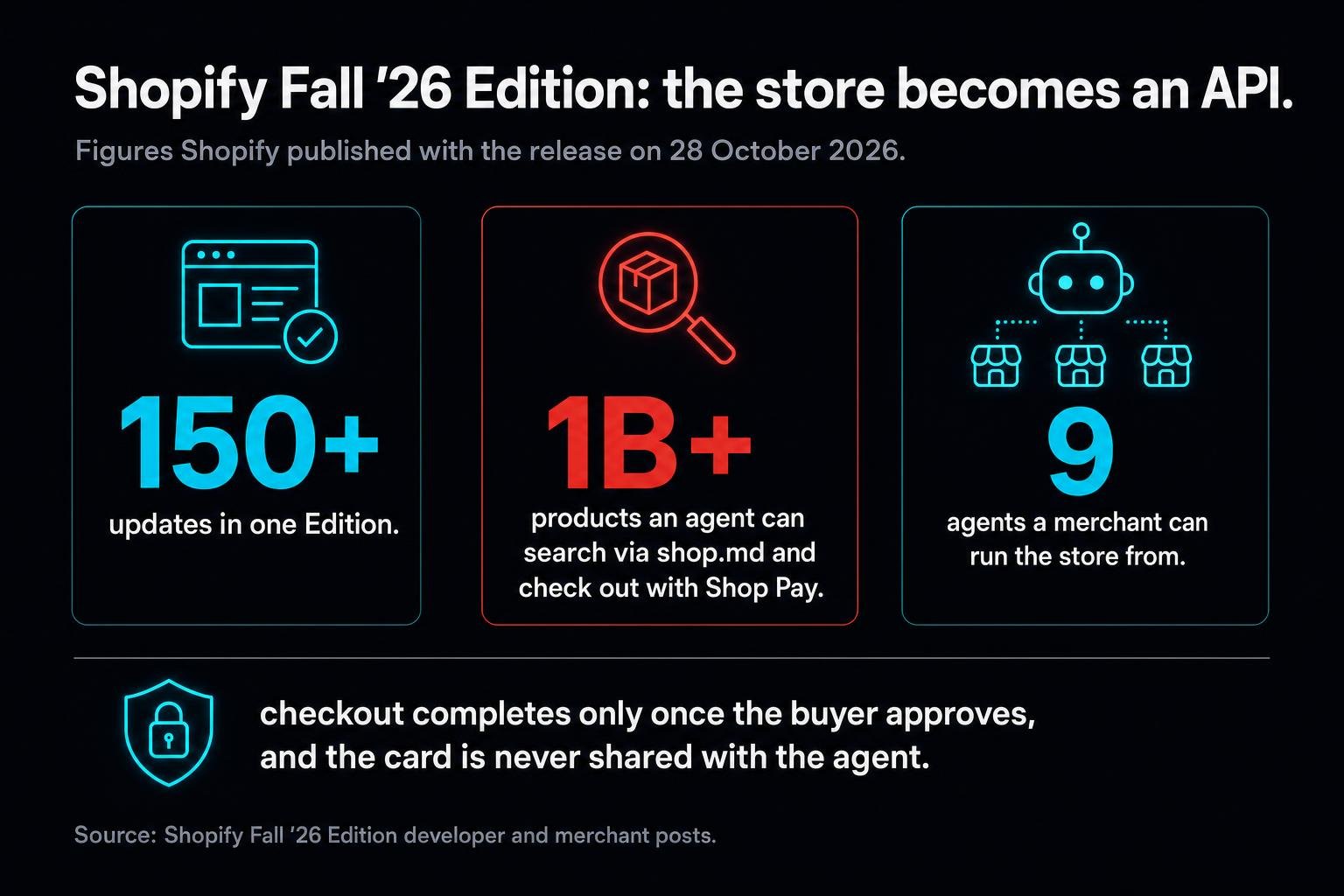
On 28 October, Shopify shipped its Fall '26 Edition. The company calls it "Exponential" and counts more than 150 updates. Most editions are a grab bag of features. This one has a spine. Nearly every headline release does the same job from a different angle: it lets a piece of software, acting on a person's behalf, search a store, fill a cart and pay.
Picture a shop on a high street. For two decades the front door was built for a human with a browser: a window display, an aisle, a till. Shopify has now cut a second entrance for agents, and it is open on every storefront unless the merchant decides otherwise. That is the single most important fact in this release, and it deserves a careful look.
What actually shipped
- WebMCP tools on every Liquid and Hydrogen storefront and checkout. Browser agents can search products, update the cart and complete checkout once the buyer approves, with validation on the checkout page. Shipped, and on by default.
- Shop.dev. One connection to Catalog, sign-in with Shop, cart, checkout and Shop Pay. In Shopify's words, "no key required."
- shop.md. A skill a buyer gives to ChatGPT, Claude or another agent. It searches more than a billion products and checks out with Shop Pay.
- Shop Pay inside personal agents, starting with Meta Muse, Claude Duet and Instinct. The card is never shared with the agent.
- Universal Checkout. One checkout for a cart that spans several merchants, in the Shop app and with partners.
- Connectors for AI agents. A merchant can run the store from nine agents, including ChatGPT, Claude, Copilot, Gemini, Grok, Muse and Perplexity.
- Catalog eligibility view. The admin now shows whether a store qualifies for Shopify Catalog and links to the fixes.
- Shop Promise. Delivery and returns badges. Badged products "can rank higher" in the Catalog data agents use. US stores only for now.
The approve button is the whole design
Read that list again and notice the pattern. On the buyer's side, the agent does the searching and the cart-building, but checkout completes only once the buyer approves, and the card never leaves Shop Pay. On the merchant's side, the rebuilt Sidekick runs calculations, writes code, searches the web and remembers what the merchant teaches it, and the merchant approves its changes.
The closest analogy I have is a power of attorney with a signature line that never goes away. The agent can prepare the deal, carry the paperwork and work out the details. It cannot sign. Shopify built both sides of its platform around that one constraint, and it is a smart constraint, because it is the thing that lets a merchant switch the new door on without lying awake at night.
Shopify did not ask merchants whether they want agents in the store. It asked whether the store is ready for them, and put the answer in the admin.
Qualifying and ranking just became the job
Two of the smaller releases carry the biggest consequence. The Catalog eligibility view turns "are we visible to agents" into a yes or no, with a to-do list attached. Shop Promise turns delivery and returns into a ranking signal inside the data agents read. Put those together and you get a familiar shape: it is the early search-engine era again, except the crawler is now a shopper with a wallet.
Two caveats matter. Shop Promise is US only. And "can rank higher" is Shopify's phrasing, which describes a possibility, not a guarantee. Still, if a product with a delivery badge tends to surface and one without tends not to, then operations has quietly become marketing.
The developer side tells the same story
The platform changes point the same way. The new theme architecture keeps page structure in the Liquid template rather than a separate JSON file, adds blocks with typed contracts, partial updates and built-in Tailwind, and ships markdown files whose stated purpose is to guide agents. Hydrogen is rebuilt and generally available for any framework and runtime, with Vue bindings and agent skills. Vercel Shop, an open-source Next.js template on the Hydrogen SDK, is generally available too.
Opening a door to software also means knowing who is knocking. The AI Toolkit security check is now part of the Edition: one CLI command that flags unauthenticated routes, cross-shop data access and unverified webhooks. Collaborator requests now show merchants how long a partner organisation has been on Shopify, where it registered, where the request came from and roughly how many stores it works with. Those are trust features, and they ship in the same release as the open door for a reason.
Why this matters beyond Shopify
If you sell online, the unit of competition is shifting from the page to the record. An agent does not admire your hero image. It reads structured product data, checks delivery and returns, and decides. Your catalog quality is now your storefront.
If you build software, study the defaults. WebMCP is on by default. Shop.dev needs no key. Catalog eligibility is a visible status, not a hidden score. Shopify is betting that lowering friction for agents is worth more than the control merchants give up, and it has drawn the line at approval rather than access.
And if you are a buyer, the personal agent with a wallet is no longer a US-only idea. Meta's Muse launched in Singapore on the same day, with Shopee, Lazada, Grab, Agoda and Singapore Airlines as early partners. The shopper on the other side of the agent could be anywhere.
What measuring AI citations taught me about this
I built a measurement harness that runs a fixed set of buyer questions against ChatGPT, Perplexity and Gemini, detects whether a target brand or domain is cited, and tracks that citation rate over time. The lesson was blunt. Until you measure it, "AI visibility" is a feeling. Once you do, it becomes a baseline and a trend, and you can argue about it with numbers instead of opinions.
Shopify just moved that same problem into commerce. Catalog eligibility is a yes or no. Shop Promise is a ranking signal. An agent searching 1B+ products through shop.md either surfaces your product or it does not, and none of that shows up in a traffic dashboard built for browsers.
So if I were running a store this week, I would do this, in order: open the eligibility view and fix whatever it flags; write down the questions a real buyer would ask an agent about my category; then run those questions, on a schedule, through the agents my customers actually use, and log whether my products appear. Treat the first result as a baseline, not a verdict. The trend is what tells you whether the new door is working.
One signal a day. No noise.
A 3-minute read when something genuinely shifts in AI, automation, or defense tech. Free, most weekdays.
Free, most weekdays. No spam, unsubscribe anytime.Sources
- Shopify: Fall '26 Edition, developer post - https://www.shopify.com/news/fall-26-edition-developer
- Shopify: Fall '26 Edition, merchant post - https://www.shopify.com/news/fall-26-edition-merchant
- AI Agents Directory: AI agents news brief, 28 October 2026 - https://aiagentsdirectory.com/news/ai-agents-news-brief-october-28-2026
Quick answers
Did Shopify turn on agent checkout for every store?
WebMCP tools ship on by default on every Liquid and Hydrogen storefront and checkout. Browser agents can search products, update the cart and complete checkout once the buyer approves, with validation on the checkout page.
Does an AI agent get my card details when it checks out with Shop Pay?
No. Shop Pay inside personal agents, starting with Meta Muse, Claude Duet and Instinct, is designed so the card is never shared with the agent. The buyer still approves the purchase.
How do I know if my store qualifies for Shopify Catalog?
The Shopify admin now has a Catalog eligibility view that shows whether the store qualifies and links to the fixes if it does not.
Is Shop Promise available outside the United States?
Not yet. Shop Promise delivery and returns badges are US stores only. Shopify says badged products can rank higher in the Catalog data agents use.