Amazon Gave Its AI Agent Two Speeds
Amazon now lets sellers decide, workflow by workflow, whether its AI only recommends or is allowed to act, and logs every move. Mastercard and a wave of commerce tools shipped the same idea in the same fortnight.

The most important AI feature shipped this month is not a smarter model. It is a dropdown with two options.
On 23 September, Amazon expanded Seller Assistant from a tool that answers questions into one that runs persistent workflows: monitoring pricing, inventory, ratings and account health around the clock and acting, in Amazon's words, "within seller-defined parameters." The part worth pausing on is how those parameters work. For each workflow, the seller chooses whether the agent only recommends or is authorised to act. Actions land in an audit trail. Some can be set to require approval first.
That is it. That is the feature. And it is the clearest signal yet about how AI actually enters a business that has money on the line.
Why a boring settings field is the news
Think about how you onboard a new hire who is good but unproven. You do not hand them the company card on day one and you do not lock them in a room either. You let them draft the email and you press send. After a few weeks of watching their drafts, you stop reading every one. The trust is not a binary. It is a dial you turn, one task at a time, and you keep the receipts while you turn it.
Until now, most AI products offered the opposite: a product-wide on switch. Either the assistant was a chatbot that suggested things into the void, or it was an automation that did things and you found out afterwards. Amazon split the difference and made the split a per-workflow setting, which is how permissions have always worked in serious software and how they never quite worked in the first wave of AI tools.
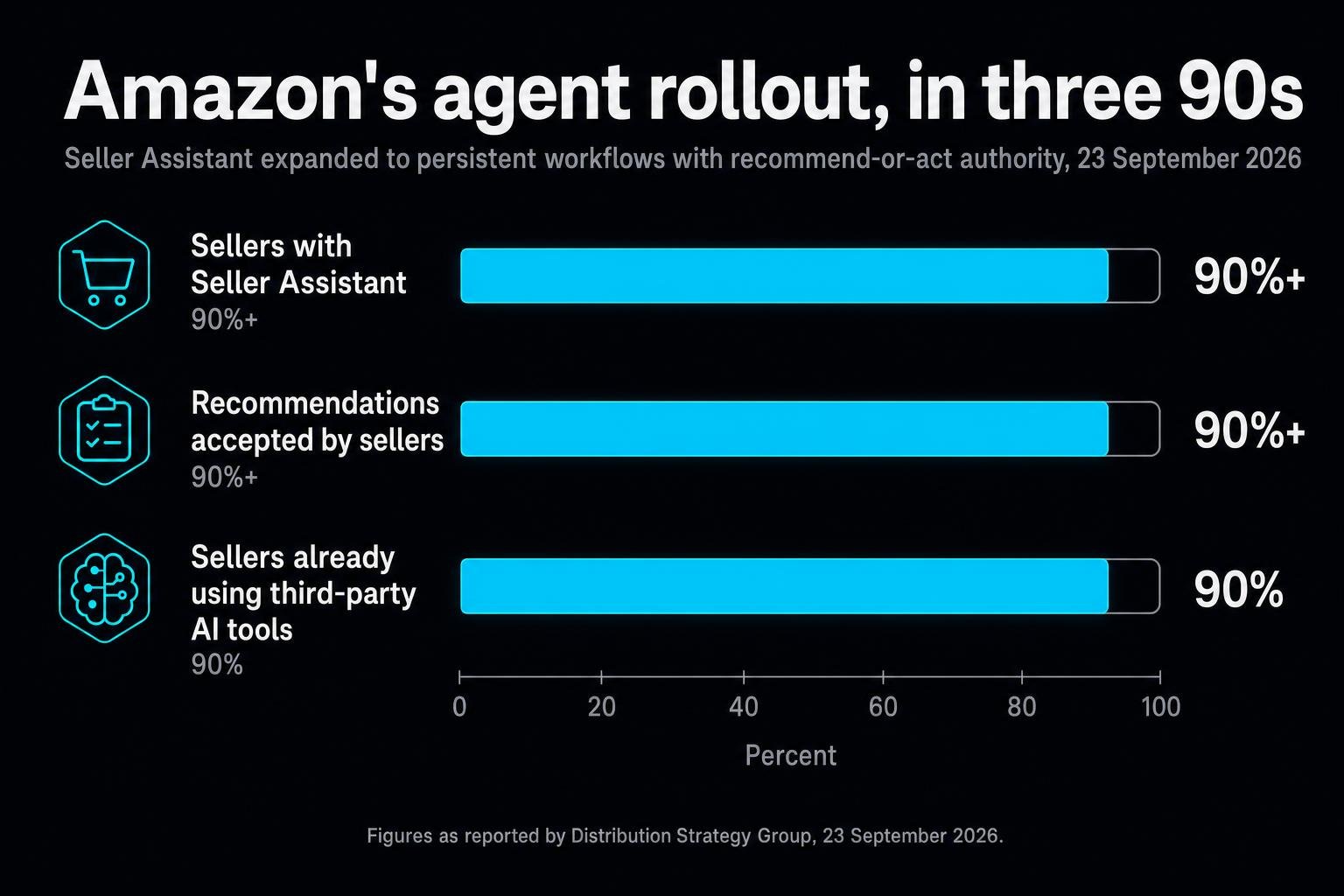
The numbers Amazon put behind it explain the confidence. Seller Assistant is rolled out to more than 90% of sellers, with hundreds of thousands of active users, and Amazon says its recommendations are accepted more than 90% of the time. It also says 90% of sellers already use third-party AI tools. Read those together and the strategy is obvious: the acceptance rate is the argument for turning the dial from recommend to act. You earn the promotion with a track record, same as the new hire.
The interesting product is no longer the agent. It is the record of what it was allowed to do, and who said so.
Amazon opened the door, and kept the key
The same announcement included a Selling Partner plugin that exposes listings, metrics, inventory and sales data to outside AI tools. It launches with Amazon Quick and is in beta with Anthropic's Claude, US stores first, with limits on data access, human approval for actions, and audit trails again. Primary account holders get 12 months of Quick Plus free through 31 December.
So outside agents are welcome, through a gate Amazon built and controls. That is the shape of the whole moment. Platforms are not refusing agents. They are refusing unauthorised agents, and the authorisation is becoming the product.
The card networks arrived at the same answer
Payments got there independently, which is what makes it convincing. On 17 September, Alchemy added Mastercard Agent Pay credentials to its AgentCard: an agent pays with a one-time tokenised Mastercard credential linked to your existing card, and you or your issuer set limits by amount, merchant category and location. It supports Verifiable Intent, Mastercard's framework for proving that an agent acted within the instructions the user actually authorised.
Strip the jargon and Verifiable Intent is a receipt for permission rather than for money. Not "this card was charged 240 euros" but "this human authorised an agent to spend up to this much, at this kind of merchant, and here is the proof." It is Amazon's audit trail wearing a card network's uniform.
Europe got the plumbing to match. On 14 September, Worldline launched a payment handler for the Universal Commerce Protocol on its Global Collect platform, among the first in Europe, covering Visa, Mastercard, Amex, Apple Pay, Google Pay and SEPA bank transfers. Agentic checkout had mostly been running on rails that suit American shoppers. SEPA support is what lets a European shopper's agent pay the way Europeans actually pay.
The dashboard era is ending
Then there is Noibu, which launched six AI agents for ecommerce stores covering conversion optimisation, A/B testing, ADA compliance, bug resolution, site speed and return on ad spend. Each one runs the same loop: analyse the store data, diagnose the problem, draft a fix, deploy it once a human approves, then measure the result.
Their own framing is the sharpest line in the whole story. For a decade, they said, tools like this "ended at a dashboard." A dashboard is a very expensive way of telling someone they have a problem. What closes the gap between knowing and fixing has always been a person with the credentials and the nerve to push the change. Noibu replaced most of that person with software and kept exactly one human step: the approval.
What to take from it
Three different industries, three weeks, one design. Marketplace, card network, storefront tooling. None of them shipped "trust the AI." All of them shipped graduated authority plus a written record.
If you are evaluating any agentic tool right now, that is your checklist, and it is short. Can I set what this thing is allowed to do, separately for each job it does? Can I start it in suggest-only mode and see its hit rate before I promote it? When it acts, is there a record of what it did and which human's authority it was acting under?
If the answer to all three is yes, you are looking at a product built by people who expect to be audited. If a vendor can only offer you on or off, they have not thought about the day it gets something wrong. And it will, eventually, on a Tuesday, at scale. The approve button is not friction. It is the only part of this that is load-bearing.
One signal a day. No noise.
A 3-minute read when something genuinely shifts in AI, automation, or defense tech. Free, most weekdays.
Free, most weekdays. No spam, unsubscribe anytime.Sources
- Distribution Strategy Group - Amazon expands agentic AI to automate seller pricing and inventory tasks - https://distributionstrategy.com/2026/09/amazon-expands-agentic-ai-to-automate-seller-pricing-inventory-tasks/
- Finextra - Alchemy integrates with Mastercard's Agent Pay - https://www.finextra.com/pressarticle/110970/alchemy-integrates-with-mastercards-agent-pay
- PYMNTS - Mastercard and Alchemy partner to enable everyday agentic payments - https://www.pymnts.com/news/artificial-intelligence/2026/mastercard-alchemy-partner-enable-everyday-agentic-payments/
- Worldline - Press release, payment handler for the Universal Commerce Protocol - https://worldline.com/en/home/top-navigation/media-relations/press-release/pr-2026_09_14_01
- The Paypers - Worldline launches payment handler for Universal Commerce Protocol - https://thepaypers.com/payments/news/worldline-launches-payment-handler-for-universal-commerce-protocol
- Business Wire - Noibu launches AI that improves your ecommerce store every day - https://www.businesswire.com/news/home/20260915467534/en/Noibu-Launches-AI-That-Improves-Your-Ecommerce-Store-Every-Day
- Practical Ecommerce - New ecommerce tools, September 23, 2026 - https://www.practicalecommerce.com/new-ecommerce-tools-september-23-2026
Quick answers
What exactly changed with Amazon Seller Assistant?
On 23 September 2026 Amazon expanded it from answering questions to running persistent workflows that monitor pricing, inventory, ratings and account health around the clock. Sellers choose per workflow whether the agent only recommends or is authorised to act, actions are recorded in an audit trail, and some can be set to require approval.
Can outside AI tools now access Amazon seller data?
Yes, through a new Selling Partner plugin that exposes listings, metrics, inventory and sales data. It launched with Amazon Quick and is in beta with Anthropic's Claude, US stores first, with limits on data access, human approval for actions, and audit trails.
What is Mastercard's Verifiable Intent?
It is Mastercard's framework for proving an agent acted within the instructions a user actually authorised. Alchemy added Mastercard Agent Pay credentials to AgentCard on 17 September, letting agents pay with one-time tokenised credentials linked to an existing card, with limits set by amount, merchant category and location.
How should I evaluate an agentic tool for my own business?
Ask three questions: can I set permissions per task rather than product-wide, can I run it in suggest-only mode first and see its acceptance rate, and does every action leave a record showing whose authority it acted under. Amazon, Mastercard and Noibu all shipped versions of those three things within the same few weeks.