Agents Get a Plug. Platforms Hold the Socket.
In one week, Google, WordPress and a Dubai bank all rebuilt their plumbing for AI agents. The lesson is the same everywhere: agents are welcome, but only through a door the platform controls.

For two years the AI agent story has been about the agents themselves. How smart they are, how many steps they can take, whether they can book a flight without booking the wrong one. This week the story moved somewhere less glamorous and far more important: the wiring. Three very different organisations, a search giant, the world's biggest CMS, and a bank, all shipped new plumbing for agents within days of each other. And every one of them attached a condition to the plug.
Google speeds up the Ads API, then narrows the door
On 12 October Google said its Ads API will move to two releases a month starting with version 26. The stated reason, in Google's own words, is "giving automated agents and workflows near-instant access" to new features. The four breaking major versions a year stay. Sunset dates stay. There is already a schedule listing 21 releases for 2027. The quarterly recap posts drop to twice a quarter, so the release notes page becomes the only per-release record.
Read in isolation, that sounds like Google rolling out the red carpet for agents. Read alongside the two changes that came before it, the picture is sharper. On 31 August Google banned what it calls "programmatic proxies" from API access. That covers hosted MCP servers and wrapper APIs that re-expose Google Ads to third parties. On 10 September it moved access to Google Cloud projects with mandatory brand verification. And Google has said developer tokens will be rejected in a future major version, not yet named.
So the faucet is opening wider, but only for people holding their own, verified cup. If your agent runs inside your own cloud project, acting on your own accounts, you get features faster than ever. If your business model was to put one agent in the middle and let other companies log into it, that model is now the exact thing the rules were written to stop.
WordPress makes every site an agent tool, with a one-click install
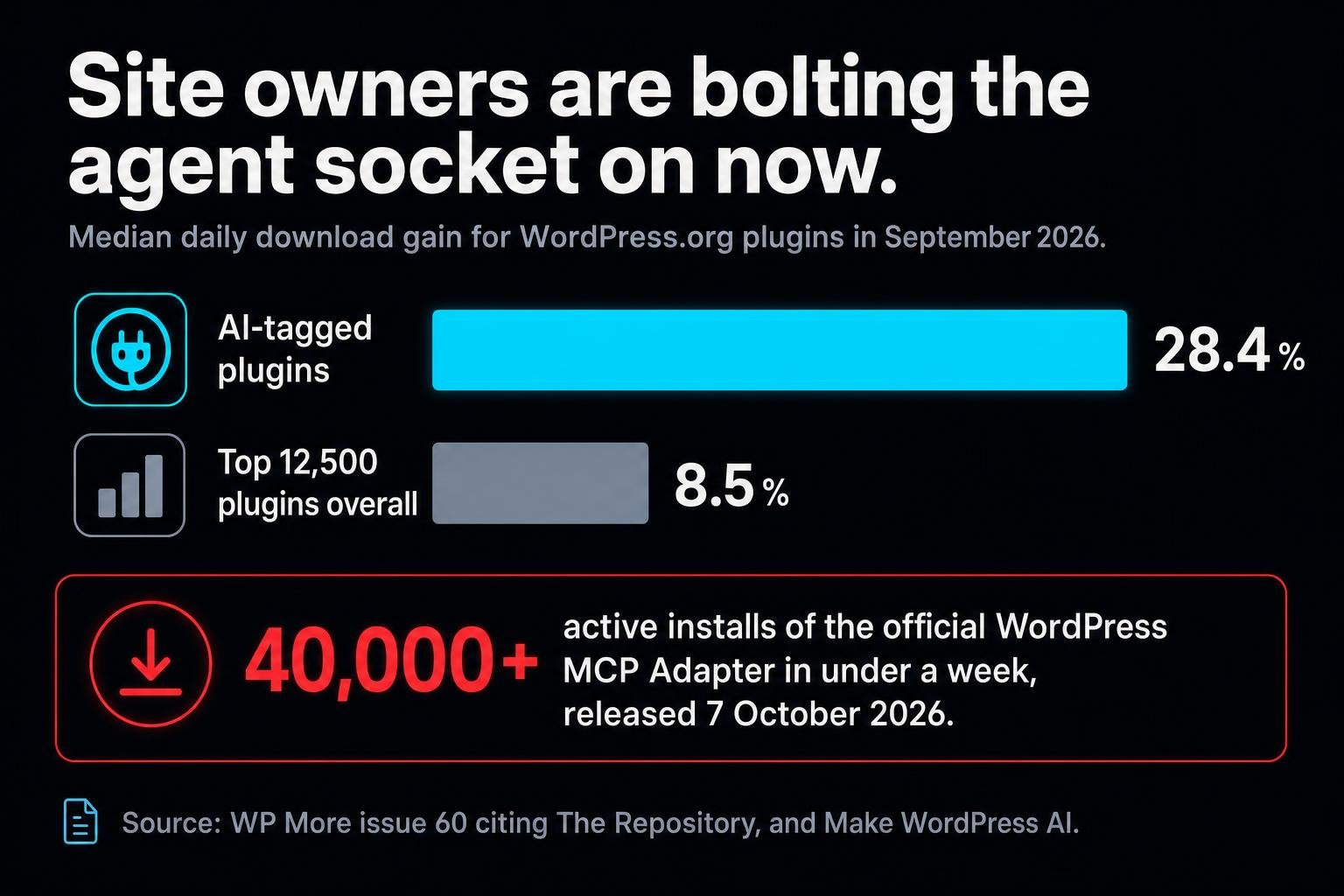
On 7 October the WordPress AI team put MCP Adapter 0.7.0 on the WordPress.org plugin directory. It ships a default MCP server that exposes a site's "abilities" (from the Abilities API arriving in WordPress 6.9) to agents such as Claude and ChatGPT, and it supports the stateless 2026-07-28 MCP spec. It is explicitly experimental and server-only. Within a week it was reported at more than 40,000 active installs.
Here is the detail I find most telling. The team kept it out of WordPress core on purpose, because MCP is still too volatile. They want the plug to exist, and they want to be able to rip it out and replace it when the standard shifts. A separate release, WordPress AI 1.4.0, adds a "Markdown Feeds" experiment that serves site content as Markdown so AI systems can read it cleanly.
The demand signal underneath is loud. In September, plugins tagged with AI saw a median daily download gain of 28.4 percent. Across the top 12,500 plugins overall, the figure was 8.5 percent. Site owners are not waiting for the standard to settle. They are bolting the socket onto the wall now.
The biggest CMS on the web just made "your site is an agent tool" a single click. The question is no longer whether agents can reach your business. It is what you let them do once they arrive.
A bank shows what the grown-up version looks like
Mashreq, a bank in Dubai, piloted IBM's Bob for integration engineering and reported that design and troubleshooting time fell by up to 70 percent, with tasks that used to take two to three hours dropping to minutes. The number is the bank's and IBM's own, from an early pilot, so treat it as a claim rather than a benchmark.
The architecture is the part worth copying. The agents do not hold API keys and roam. They reach integration knowledge, API specs, architecture standards and operational context through IBM Context Forge, an MCP-based gateway. That gateway handles roughly 4,000 agent requests a month. Mashreq is also exploring on-premises deployment for work that needs locally hosted models.
Think of it like a hotel. You could hand every guest a master key and hope for the best. Or you could put a front desk in the lobby that issues a key card scoped to one room, logs every swipe, and can cancel a card the moment something looks wrong. A regulated bank chose the front desk. It is the same choice Google is forcing on advertisers and the same choice WordPress is quietly making by keeping the adapter outside core.
Why this matters beyond the headlines
Put the three stories together and a pattern appears that I think will define the next year of agent work.
- Access is becoming identity-bound. Google ties API access to a verified cloud project. The bank ties every agent call to a gateway with a request count. The era of a shared token passed around in a config file is ending.
- The gateway is the product. The agent is interchangeable. The layer that decides which tools an agent can see, logs what it did, and can be audited later is where the real value and the real trust live.
- Standards are shipping before they are stable. WordPress hit 40,000 installs on an adapter its own team calls experimental. Google is releasing twice a month against a spec that is still moving. Everyone is building on wet concrete, and they know it.
- The middleman is the first casualty. Any business whose plan was to sit between a platform and its customers, re-selling access through a hosted agent, should read Google's proxy ban twice.
None of this slows agents down. If anything it speeds them up, because platforms are far more willing to hand out capabilities when they can see who is holding them. What it does change is who gets to build. The winners will not be the ones with the cleverest agent. They will be the ones who built the front desk.
FAQ
What did Google change about the Ads API? From version 26 it moves to two releases a month, aimed at automated agents and workflows. Four breaking major versions a year and the existing sunset schedule remain, and 21 releases are already listed for 2027.
What is Google's "programmatic proxy" ban? Since 31 August, hosted MCP servers and wrapper APIs that re-expose Google Ads to third parties are banned from API access. Access now runs through Google Cloud projects with mandatory brand verification.
What does the WordPress MCP Adapter do? It runs a default MCP server that exposes a site's abilities to agents like Claude and ChatGPT. It is experimental, server-only, kept out of core for now, and passed 40,000 active installs in under a week.
What is an MCP gateway? A single control point that decides which tools and context each agent can reach and logs every request. Mashreq's gateway handles about 4,000 agent requests a month and is the pattern the bank chose instead of giving agents direct API keys.
One signal a day. No noise.
A 3-minute read when something genuinely shifts in AI, automation, or defense tech. Free, most weekdays.
Free, most weekdays. No spam, unsubscribe anytime.Sources
- PPC Land - Google Ads API moves to two releases a month starting with v26 - https://ppc.land/google-ads-api-moves-to-two-releases-a-month-starting-with-v26/
- Make WordPress AI - The MCP Adapter plugin is now available on WordPress.org - https://make.wordpress.org/ai/2026/10/07/the-mcp-adapter-plugin-is-now-available-on-wordpress-org/
- WP More - Issue 60 - https://wpmore.substack.com/p/issue-60
- PYMNTS - Mashreq's AI agents cut integration time up to 70% - https://www.pymnts.com/news/artificial-intelligence/2026/mashreqs-ai-agents-cut-integration-time-up-to-70/
Quick answers
What did Google change about the Ads API?
From version 26 the Google Ads API moves to two releases a month, which Google says is for automated agents and workflows. Four breaking major versions a year and existing sunset dates remain, and 21 releases are already scheduled for 2027.
What is Google's programmatic proxy ban?
Since 31 August 2026, hosted MCP servers and wrapper APIs that re-expose Google Ads to third parties are banned from API access. Access now runs through Google Cloud projects with mandatory brand verification, and developer tokens will be rejected in a future major version.
What does the WordPress MCP Adapter do?
It runs a default MCP server that exposes a WordPress site's abilities to agents such as Claude and ChatGPT. It is experimental, server-only, deliberately kept out of core, and was reported at more than 40,000 active installs within a week of its 7 October release.
What is an MCP gateway and why did a bank use one?
An MCP gateway is a single control point that decides which tools and context each agent can reach and logs every request. Mashreq routes about 4,000 agent requests a month through IBM Context Forge instead of giving agents direct API keys, and reports integration design and troubleshooting time down by up to 70 percent in an early pilot.