Black Friday's new shopper never says your name
Meta's Muse started filling Sainsbury's and Walmart baskets this week, and PayPal quietly changed who carries the risk on agent-made orders. Meanwhile, AI answers are already picking the store for shoppers who never name one.

Picture this: it is the Tuesday before Black Friday, you are tired, and you tell an AI assistant, "Feed a family of four for a week, keep it under budget, and find me a winter coat." You do not mention a store. You do not open a single tab. You go and make tea.
Somewhere, a piece of software is now deciding where your money goes. As of this week, that is no longer a thought experiment.
The robot got a shopping trolley
On 24 November, Sainsbury's announced that Muse, Meta's personal AI agent, "launches in the UK today." Give it a budget or a meal plan and it builds a basket using Aldi Price Match, Nectar Prices and current offers. It also shops Tu clothing. According to Sainsbury's, Muse "shops the Sainsbury's website and Tu.co.uk as a customer would, so it sees the same products, prices and offers." Every order still goes through Sainsbury's own checkout, with the usual confirmation and a chance to amend or cancel.
The same day, PYMNTS reported, citing a Walmart release, that Walmart customers can use Muse to find Black Friday deals through the Walmart Agent Gateway. Muse hands over the shopping list, Walmart does the product matching, and the customer's wider purchase history is not shared with the agent. Walmart's Agent Profiles let shoppers set spending limits, approve purchases and see which purchases their agent made.
Put those two announcements side by side and a pattern jumps out. Neither retailer let the agent just wander in.
Retailers are building a staff entrance for agents
The most revealing line came from Sainsbury's itself: "Rather than leaving an agent to find its own way around our website, we're working directly with Meta to shape how Muse shops with Sainsbury's."
Think of a valet key. It opens the door and starts the engine, but it does not open the boot or the glovebox. Walmart's gateway works roughly like that: the agent gets the list-to-product step, and Walmart keeps the purchase history to itself. Sainsbury's keeps the final yes inside its own checkout, where the customer can still change their mind.
The fight is no longer only for the shopper's attention. It is for the agent's route through your store, and for who gets to say the last yes.
It is a sensible instinct. An agent improvising its way around a website is like a tourist navigating by vibes. It might get there. It might also come home with a crate of lemons and a very confident explanation.
Then PayPal moved the risk
Here is the part merchants should read twice. Tech Times reported on PayPal's Agentic Virtual Card merchant terms for eligible US business accounts. When a buyer approves a purchase through PayPal inside an AI shopping service and the merchant's checkout needs a card number, PayPal can issue the agent a one-time virtual card. The merchant gets paid through its own card processor, not its PayPal balance.
The fine print: those payments are not eligible for PayPal Seller Protection. Disputes follow card-network chargeback rules. The merchant pays interchange on a card type PayPal selects. The cards cannot be stored or reused, refunds must go back to the same card, and the receipt must say "PayPal." And PayPal "may" provide a BIN range or transaction indicator so merchants can spot these orders. May. Not will.
So a store could take an agent-made order, lose a protection it was used to, and have no guaranteed way to tell the order came from an agent. (Tech Times says the terms took effect 23 November; PayPal's own document only says "last updated Nov. 23.")
The AI is already choosing the store
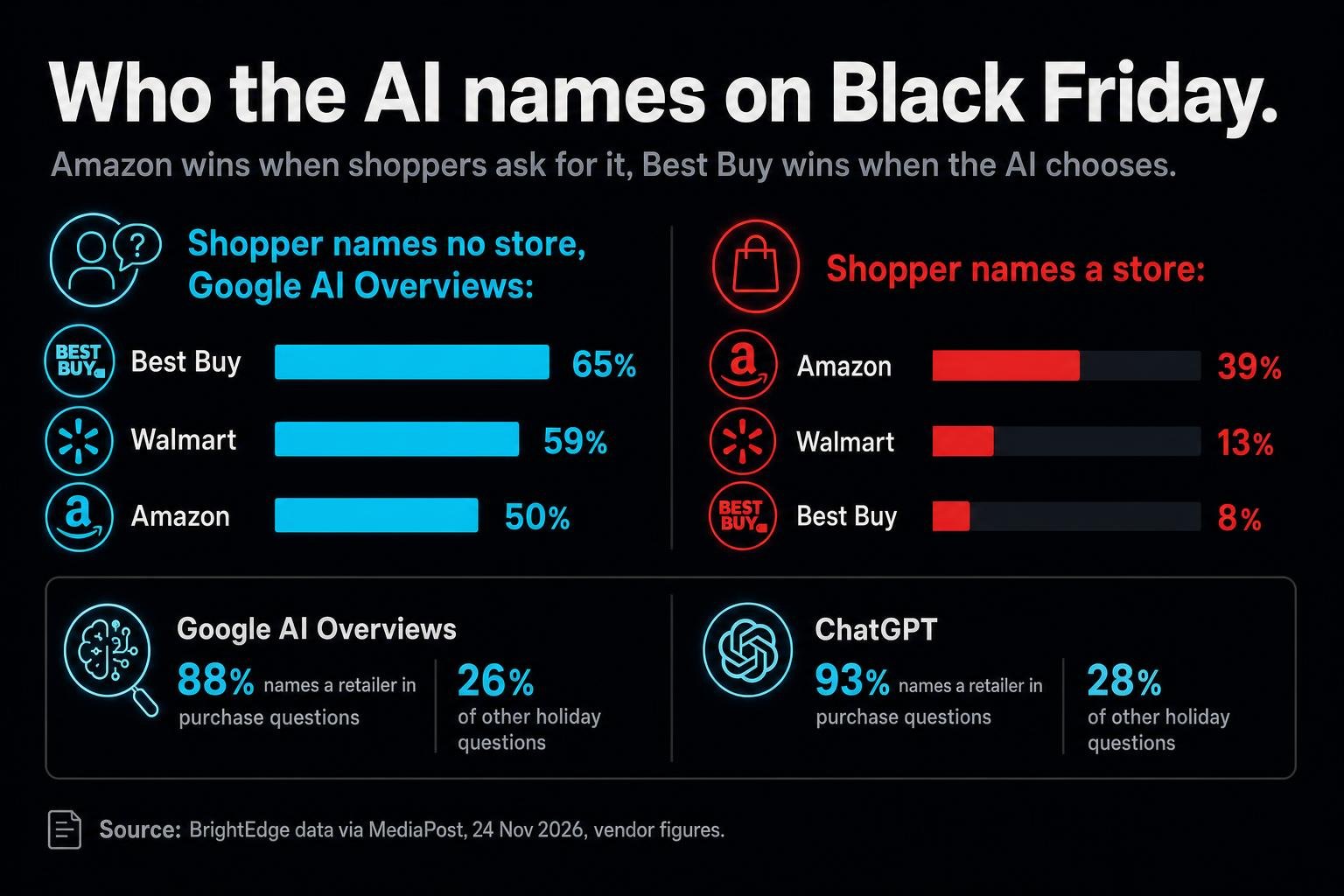
Now the bigger, quieter shift. BrightEdge data reported by MediaPost (vendor data, not independently verified) looked at how AI answers handle holiday shopping questions. Google AI Overviews names a retailer in 88% of answers to price, availability or purchase questions, versus 26% for other holiday questions. ChatGPT names one in 93% of purchase-related answers, versus 28%.
When the shopper names no store, Best Buy is recommended in 65% of Black Friday AI Overview answers, Walmart in 59% and Amazon in 50%. On ChatGPT, a specific retailer appears 95% of the time. But when shoppers do name a retailer themselves, Amazon comes up 39% of the time, Walmart 13% and Best Buy 8%.
Look at that flip. Amazon wins when people ask for it by name. Best Buy wins when they do not. On ChatGPT, 41% of shopping questions are open-ended, so a big share of shoppers are letting the answer choose, and the answer almost always chooses someone.
A hotel concierge works the same way. Ask "where should I eat tonight?" and you get their favourite, not a ranked list of the whole city. The restaurants they never mention do not get a bad review. They just get nothing.
What the three stories add up to
Agents are starting to shop. The biggest retailers are building controlled doors for them. The payment rails are quietly changing who carries the risk when something goes wrong. And before any of that happens, an AI answer has often already decided which store's door the agent walks up to.
For a smaller merchant, that first step is where the money leaks, because it is invisible. Nobody bounces off your site if they never arrive. There is no abandoned cart to recover, no ad click to retarget, no angry review to answer. Just a sale that went somewhere else, recommended by a machine that never said your name.
Why I stopped guessing about AI answers
I built a measurement harness that runs a fixed set of buyer questions against ChatGPT, Perplexity and Gemini, checks whether a target brand or domain gets cited, and tracks that citation rate over time. The reason was simple: everyone had an opinion about AI visibility, and nobody had a number.
The BrightEdge flip is exactly why that matters. If most of your customers already type your name, you look fine in every report you own. The open-ended questions, the best TV deal this weekend kind, are where you can vanish without a trace, and your analytics will never record a visit that did not happen.
So before Black Friday turns into agent Friday, write down the questions a buyer would ask with no store name in them. Run them on each assistant. Note who gets named and who does not. Then run the same set again next week, and the week after. A fixed question set, run on a schedule, turns AI visibility from an argument into a measurement.
If a shopper never types your store's name and the AI never says it, how would you even know you lost the sale?
One signal a day. No noise.
A 3-minute read when something genuinely shifts in AI, automation, or defense tech. Free, most weekdays.
Free, most weekdays. No spam, unsubscribe anytime.Sources
- Sainsbury's - Muse from Meta gives customers even more choice in how they shop with Sainsbury's - https://corporate.sainsburys.co.uk/news/press-releases/muse-from-meta-gives-customers-even-more-choice-in-how-they-shop-with-sainsbury-s/
- PYMNTS - Walmart turns to Meta's Muse to power Black Friday - https://www.pymnts.com/news/retail/2026/walmart-turns-to-metas-muse-to-power-black-friday/
- Tech Times - PayPal excludes AI agent virtual card payments from Seller Protection before Black Friday - https://www.techtimes.com/articles/331383/20261123/paypal-excludes-ai-agent-virtual-card-payments-seller-protection-before-black-friday.htm
- MediaPost - AI becomes retail's new gatekeeper, Best Buy wins - https://www.mediapost.com/publications/article/419659/ai-becomes-retails-new-gatekeeper-best-buy-wins.html
Quick answers
What is Meta's Muse shopping agent?
Muse is Meta's personal AI agent. Sainsbury's announced its UK launch on 24 November 2026: customers give it a budget or meal plan and it builds a basket using Aldi Price Match, Nectar Prices and offers, and it also shops Tu clothing. Orders go through Sainsbury's own checkout with the usual confirmation and the option to amend or cancel.
What is the Walmart Agent Gateway?
According to PYMNTS, citing a Walmart release, the gateway takes a shopping list from Muse and has Walmart do the product matching, so the customer's wider purchase history is not shared with the agent. Walmart's Agent Profiles let shoppers set spending limits, approve purchases and see which purchases their agent made.
Are PayPal Agentic Virtual Card payments covered by Seller Protection?
No. Per Tech Times' reading of PayPal's merchant terms for eligible US business accounts, these payments are not eligible for Seller Protection, disputes follow card-network chargeback rules, and the merchant pays interchange on a card type PayPal selects.
How often do AI answers recommend a specific retailer?
BrightEdge data reported by MediaPost says Google AI Overviews names a retailer in 88% of price, availability or purchase answers and ChatGPT in 93% of purchase-related answers. When no store is named, Best Buy appears in 65% of Black Friday AI Overview answers, Walmart 59% and Amazon 50%.
Part of: AI shopping agents · the running scoreboard