The Bouncer Takes Cyber Week Off
Amazon threw Meta's Muse shopping agent out in September. Now, a day before Black Friday, the two are negotiating its return while the rest of retail quietly stands its bot defenses down. The sticking point is a $68.6 billion ad business.

Picture this: it is tomorrow morning, Black Friday, and the first customer through Amazon's door is not a person. It is somebody's Muse, the AI agent Meta lets you name and send off to run your errands, and it has a list. It does not browse. It does not linger over the sponsored shelf at eye level. It wants the thing, the best price, and the exit. Now picture the bouncer at that door, who has been told since September to turn Muse away, glancing at his phone and seeing a message from head office: we are talking to these people, hold on.
That is roughly where things stand, according to Fortune's Sebastian Herrera, who reported on 25 November that Amazon and Meta are in ongoing talks to connect Muse to Amazon's store and end the blockade Amazon imposed in September. Both companies declined to comment. Any deal needs both CEOs to sign off. And the two issues dominating the talks tell you exactly what this fight is about: how Muse would handle Amazon's search results, and advertising.
Why a $68.6 billion ad business fears a polite shopping bot
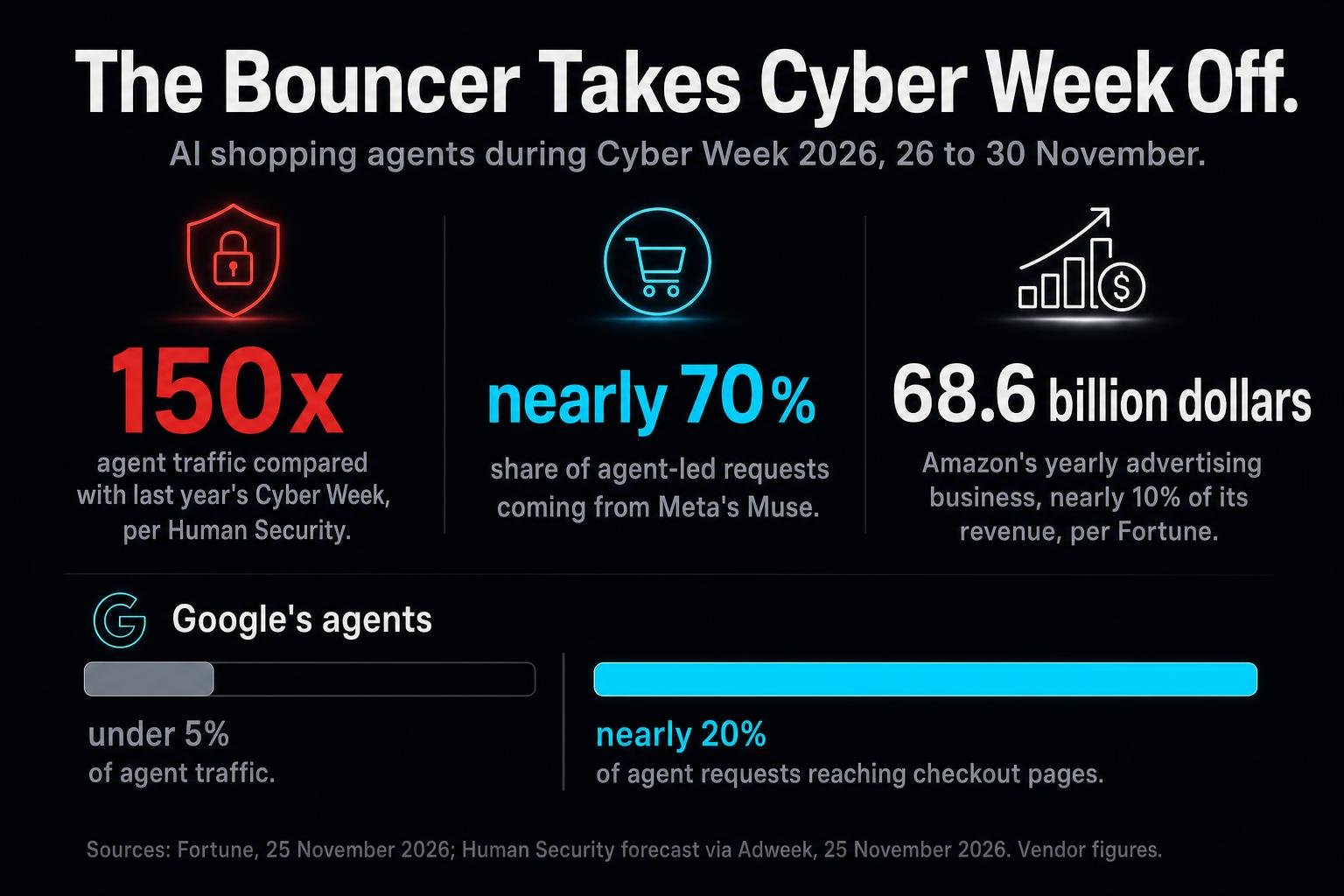
Amazon's advertising business brings in $68.6 billion a year, nearly 10% of its revenue, by Fortune's figure. Think of Amazon's store as a supermarket where brands pay for the eye-level shelf. The whole economics of that shelf depend on a human walking past it. An agent does not walk. It queries. If an outside agent flattens the sponsored placements into a plain list of options, the shelf is still there, but nobody is looking at it, and the rent stops making sense.
The second worry is quieter and bigger. Amazon does not want an outside agent to sit between it and its customers. Whoever owns the conversation with the shopper owns the relationship, and Amazon has built its business on making sure that conversation happens on its own pages.
Speaking at Semafor, Amazon's Jassy said outside agents must provide a "fair exchange of value," and noted that more than 400 million customers used Alexa for shopping in the past year, by Amazon's own count. Meta's Zuckerberg, for his part, has said shopping is Muse's top use case and that Meta plans to take a "small fee from transactions." So the negotiation is really two companies arguing over who gets the toll booth. (The shopper, as usual, is the road.)
Meta brings a crowd to the negotiation
Meta is not arriving empty-handed. Muse passed 10 million setups in the US and Canada as of October, per a Meta figure reported by Fortune. Its retail partners already include Shopify, Walmart and Best Buy. OpenAI's Dots launched in September, so Amazon is not deciding about one agent; it is setting the precedent for all of them. Meta and Amazon also have a 2023 in-app purchase partnership to build on, which means the two already know how to split a sale.
The demand side is lining up too. A National Retail Federation survey this month found roughly half of holiday shoppers plan to use AI. Morgan Stanley estimated in 2025 that agentic shopping could reach $190 billion to $385 billion of US e-commerce by 2030, or 10 to 20% of the total. Those are a survey and a bank forecast, not sales, but they explain why nobody at either company is in a hurry to walk away.
The bouncer takes the weekend off
Here is the strange part. While Amazon negotiates, the rest of retail is quietly standing its bouncers down. Human Security, a bot-detection vendor, told Adweek's Kendra Barnett that it expects agentic traffic during Cyber Week, 26 to 30 November, to run 150 times last year's level. Muse accounts for nearly 70% of agent-led requests. Human expects retail agent traffic to more than double from its pre-holiday baseline to the Black Friday weekend peak, mirroring last year's 145% jump.
And then the line that should make every store owner sit up: Human expects block rates to dip during Cyber Week, as retailers loosen their bot defenses to protect conversion. In plain words, the bouncer is being told that for five days the cover charge matters more than the guest list. Turning away one paying agent is suddenly a worse mistake than letting in a few bad ones. John Searby, Human's chief strategy officer, called it the "first real season" for agent commerce.
Amazon is negotiating the terms of entry. Everyone else just propped the door open with a chair.
A same-day PPC Land headline says Amazon blocks 20 of 24 named AI agents, the most of 79 top US retailers checked. That comes from a headline alone, so treat it as a pointer rather than a verified count. But the direction fits: the biggest store has the strictest door, and it is the one on the phone.
Not all agents shop the same way
One detail in Human's numbers deserves its own paragraph. Google's agents are under 5% of agent traffic, but nearly 20% of the agent requests that reach checkout pages. Muse sends the crowd; Google's agents go deeper per visit. If you run a store, that is the difference between a tour bus unloading at your entrance and a handful of people walking straight to the register. Both show up as "agent traffic" on a dashboard. Only one of them is already holding a card. All of these figures are the vendor's own, so read them as a forecast from someone who sells the thermometer.
Why this matters beyond Amazon
Three groups should care. Retailers, because the choice between blocking and admitting agents is no longer theoretical; it is being made this week, under conversion pressure, often by whoever controls the bot filter rather than whoever owns the strategy. Brands that pay for sponsored placement, because if the shelf stops being seen, the price of the shelf changes. And shoppers, because the "small fee from transactions" and the "fair exchange of value" are both, in the end, a slice of the same purchase.
The talks may settle nothing before Cyber Monday. But the question Amazon is asking out loud is the one every store will face eventually: not whether to let the agents in, but on whose terms, and who gets paid when they do.
What a bot-gated login taught me
I once built an automated bridge for a multi-clinician healthcare practice whose records system had no API and sat behind a bot-gated login. The practice owned its data and wanted the automation. The gate did not care. It asked the only question gates know how to ask, is this a bot, and it got the right answer for the wrong reason.
The bridge holds an authenticated session through that protection, matches each patient's balance to their appointment, and syncs the result into the practice's CRM behind a safety gate, with no sensitive data left on disk. About 2,800 records synchronized in one automated run. What made it safe was not slipping past the door. It was that the automation acted for the people who owned the records, and could only do the narrow thing it was allowed to do.
That is the lesson I read into this week. "Bot or human" is the wrong question, and retailers loosening block rates for Cyber Week are answering it by not asking. "Fair exchange of value" is the right question in CEO language: acting for whom, allowed to do what, paid how. Amazon is at least asking it.
If your best customer comes back next year as somebody else's shopping agent, who gets paid for the shelf it never looks at?
One signal a day. No noise.
A 3-minute read when something genuinely shifts in AI, automation, or defense tech. Free, most weekdays.
Free, most weekdays. No spam, unsubscribe anytime.Sources
- Fortune - Exclusive: Meta and Amazon discuss ending Muse shopping bot blockade, as ads, search emerge as key issues - https://fortune.com/2026/11/25/exclusive-amazon-meta-talks-deal-muse-ai-shopping-agent-blockade/
- Adweek - AI Agent Traffic to Surge 150x This Cyber Week, Driven Mostly by Meta Muse - https://www.adweek.com/commerce/ai-agent-traffic-to-surge-150x-this-cyber-week-driven-mostly-by-meta-muse/
Quick answers
What are Amazon and Meta negotiating about Muse?
Fortune reported on 25 November 2026 that Amazon and Meta are in ongoing talks to connect Meta's Muse shopping agent to Amazon's store and end the blockade Amazon imposed in September. The two main issues are how Muse would handle Amazon's search results and how advertising would work. Any deal needs both CEOs to sign off, and both companies declined to comment.
How large is Amazon's advertising business?
According to Fortune, Amazon's advertising business is $68.6 billion a year, nearly 10% of the company's revenue. Amazon does not want an outside agent to flatten the sponsored placements that produce that revenue or to sit between Amazon and its customers.
How much AI agent traffic is expected during Cyber Week 2026?
Human Security, a bot-detection vendor quoted by Adweek, expects agentic traffic during Cyber Week, 26 to 30 November 2026, to run 150 times last year's level, with Meta's Muse accounting for nearly 70% of agent-led requests. Human also expects retailers' block rates to dip during the week as they loosen bot defenses to protect conversion. These are vendor estimates.
Which retailers already work with Meta's Muse?
Fortune reports that Muse's current retail partners are Shopify, Walmart and Best Buy, and that Muse passed 10 million setups in the US and Canada as of October 2026, according to Meta.
Part of: AI shopping agents · the running scoreboard