Your Brand's Evil Twin Is Getting Cited by AI
New research says impostor websites are showing up in AI answers for big brands, often presented as the official source. More AI sessions now end without a click, so the user may never see that the source is fake.

Imagine calling directory assistance for your bank's phone number. The operator calmly reads you a number that belongs to someone pretending to be your bank. You have no reason to doubt it, so you dial. According to research released this week, something like this is happening inside AI answers.
What Scrunch found
On 12 November, Scrunch, a Sitecore company, launched two products at Sitecore Symposium: Citation Optimization and Imposter Detection. Alongside them came research covering ChatGPT, Perplexity, Gemini, Google AI Overviews, AI Mode and Microsoft Copilot.
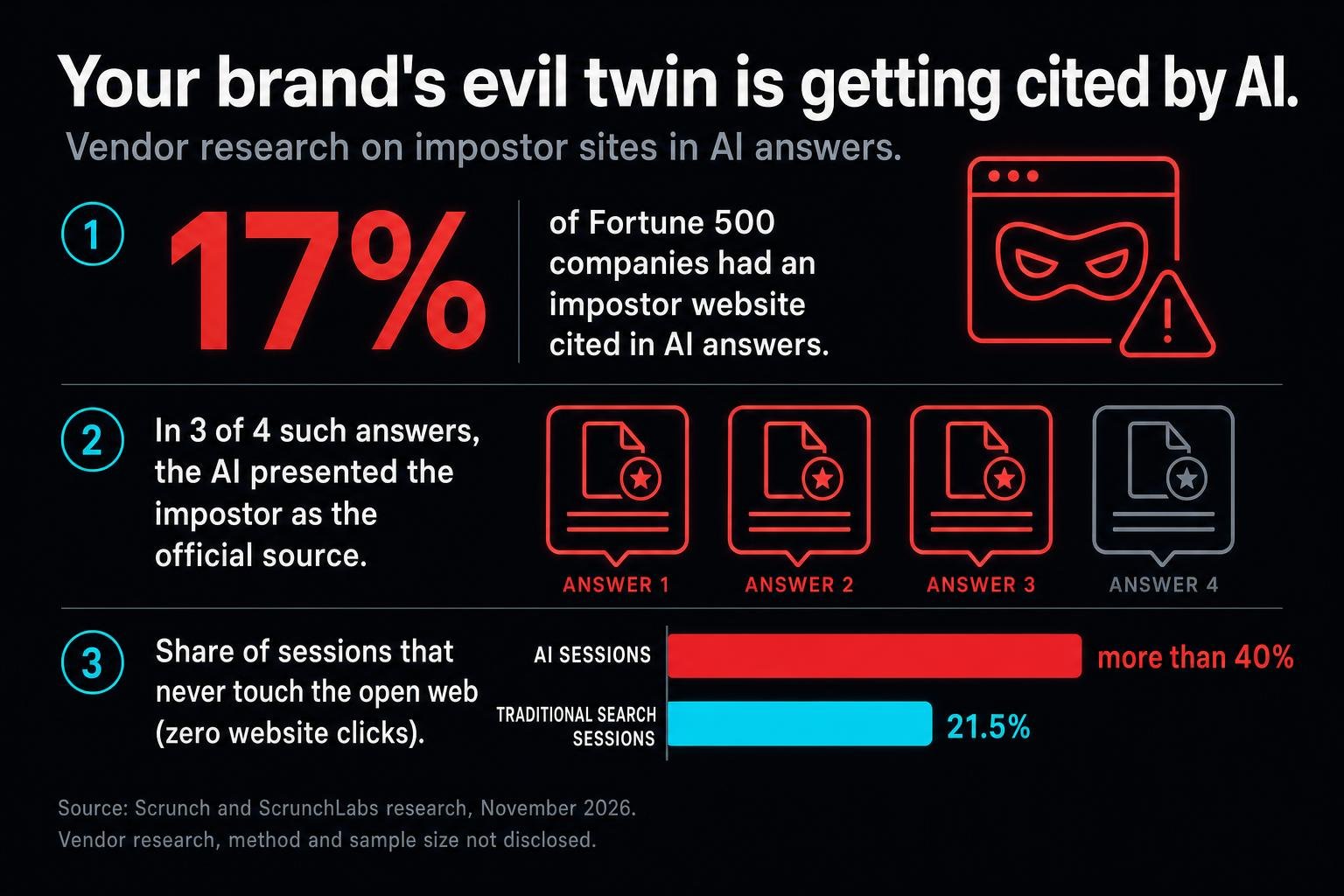
The headline number: 17% of Fortune 500 companies had an impostor website cited in AI answers. The more uncomfortable part is that in three of every four of those answers, the AI presented the impostor as the brand's official source. It didn't just mention a lookalike site somewhere in a list. It named the lookalike as the real brand.
One caveat, stated plainly. This is vendor research. Scrunch and Sitecore sell the products the research supports, and Agile Brand Guide, which covered the launch, notes that no sample size or method was given. I read it as a smoke alarm going off, not as a fire investigator's final report. Even so, you should go and check the kitchen.
Why the answer is becoming the storefront
A second piece of ScrunchLabs research, "The New Shape of Search," explains why this matters more than an ordinary bad search result. It found that more than 40% of AI sessions involved neither a prior open-web search nor a later click to the open web. For traditional search sessions the figure was 21.5%.
Think about what that removes. In a classic results page, a strange domain is at least visible. A careful person might notice the misspelling or the odd extension before clicking. In an AI answer the source is a footnote at best, and in a growing share of sessions the user never leaves the answer at all. The AI's summary is the whole visit. If that summary vouches for an impostor, nothing else gets a chance to correct it.
In an AI answer, the impostor doesn't need to fool you. It only needs to fool the machine reading on your behalf.
The machines aren't great at spotting fakes either
A separate research result makes the problem look structural rather than accidental. In a study called DeepStress, researchers at Orange Research and Aix-Marseille replaced the retrieval step of 12 search agents with synthetic documents. They set each document's trustworthiness, relevance and accuracy independently, so they could see which of those the agents actually responded to.
The findings, from a published summary, show two different failures. Several open-weight agents answered with high confidence from sources that were obviously flagged as untrustworthy. And many questions were answered from the model's own memory even when every returned document was wrong. So agents sometimes believe bad sources and sometimes ignore the sources entirely. Neither behavior helps a brand whose real site is competing with a convincing fake.
Put that next to the Scrunch numbers and the picture is consistent. Getting retrieved is not the same as being trusted correctly, and being well known is not the same as being identified correctly.
What the new tools actually do
The product launches show where this work is going. Citation Optimization takes each prompt a brand tracks and lists the third-party pages that AI answers cite. It ranks those pages by influence and by how easily the brand could earn a place there, shows where competitors appear instead, and drafts outreach using the brand's approved information. Scrunch says partners Noble, Stacker and Getfluence are being integrated to automate more of that work. Imposter Detection surfaces suspected impostor sites and starts takedowns. Scrunch reports more than 500 customers and has not published pricing.
The shift is from "is my website optimized?" to "which sources does the machine trust when it talks about me, and are any of them lying?" It's like a job candidate whose references get called while the candidate is out of the room. You can't control the conversation, but you can know who's on the reference list.
What this means if you run a brand
- Your site is one witness, not the judge. AI answers are assembled from many pages, and your official domain is only one of them.
- Ask the blunt question. Ask each major assistant for your official website and your support contact, then read what it says and which domain it cites.
- Treat this as a security issue too. An impostor that an AI calls official is a phishing problem as much as a marketing one, so the security team and the marketing team both need to see the results.
- Distrust confident dashboards. Vendor research can point you at a problem. Only your own repeated checks can tell you whether you have it.
The open web used to give people one last look at the address before they walked in. As more of the journey happens inside the answer, that look is going away. Brands now need to know whose address the machine is giving out.
What tracking citations taught me
I built a measurement harness that runs a fixed set of buyer questions against ChatGPT, Perplexity and Gemini, detects whether a target brand or domain is cited, and tracks the citation rate over time. Its real value was not any single answer. It turned answer-engine optimization from opinion into a baseline and a trend.
This week's research shows why that matters. A one-off check tells you whether you appeared today. A fixed question set run repeatedly shows you when something changes, and a wrong domain showing up is exactly that kind of change.
If I were running this check after reading the Scrunch numbers, I would add one question to the fixed set: what is this brand's official website? I would then record which domain gets cited, not just whether the brand is named. "We were mentioned" and "our real domain was cited" are different results. Only the second protects your customers.
One signal a day. No noise.
A 3-minute read when something genuinely shifts in AI, automation, or defense tech. Free, most weekdays.
Free, most weekdays. No spam, unsubscribe anytime.Sources
- GlobeNewswire - Scrunch launches Citation Optimization to help brands influence the sources behind AI recommendations - https://www.globenewswire.com/news-release/2026/11/12/3401689/0/en/scrunch-launches-citation-optimization-to-help-brands-influence-the-sources-behind-ai-recommendations.html
- Agile Brand Guide - Yesterday's marketing technology and AI news, November 13, 2026 - https://agilebrandguide.com/yesterdays-marketing-technology-ai-news-november-13-2026
- Hugging Face Papers - DeepStress - https://huggingface.co/papers/2607.13920
- AI Weekly - Orange's DeepStress finds search agents trust fake sources - https://aiweekly.co/alerts/oranges-deepstress-finds-search-agents-trust-fake-sources
Quick answers
What did Scrunch find about impostor websites in AI answers?
Scrunch's research across ChatGPT, Perplexity, Gemini, Google AI Overviews, AI Mode and Microsoft Copilot found that 17% of Fortune 500 companies had an impostor website cited in AI answers. In three of four of those answers, the AI presented the impostor as the brand's official source. This is vendor research, and no sample size or method was given.
Why are impostor citations worse in AI answers than in regular search?
ScrunchLabs found that more than 40% of AI sessions involved neither a prior open-web search nor a later click to the open web, compared with 21.5% of traditional search sessions. When users never leave the answer, they never see the suspicious domain that might have warned them.
Do AI search agents check whether a source is trustworthy?
Not reliably, according to the DeepStress study from Orange Research and Aix-Marseille. Several open-weight search agents answered with high confidence from obviously flagged sources, and many questions were answered from the model's own memory even when every returned document was wrong.
What do Scrunch's Citation Optimization and Imposter Detection do?
Citation Optimization lists the third-party pages AI answers cite for each prompt a brand tracks, ranks them by influence and by how easily the brand could earn a place, shows where competitors appear, and drafts outreach. Imposter Detection surfaces suspected impostor sites and starts takedowns.