The Banks Gave Their AI Agents a Curfew
Reuters says some US banks are putting time limits, kill switches and ID badges on the AI agents they run. The same day, a scan of half a million agent components showed why: the agent already has the keys, and strangers are learning how to ask for them.

Picture this: it is late at night at a bank, and somewhere in a server rack an AI agent is still working. Nobody told it to stop. It has a task, it has the permissions, and it has the particular tirelessness that only software has at that hour. The question the risk team is asking is not "is it doing the job?" It is "how long do we let it keep going, and if we need it to stop right now, what exactly do we press?"
That, roughly, is the story Reuters broke on 23 November. Reporter Nupur Anand found that some US banks are tightening the controls on the AI agents they run internally, out of concern that the models could escape their safeguards. The strange part is what has not happened. No bank told Reuters an agent had actually caused harm, and the JPMorgan outage people kept pointing at turned out to be an ordinary software bug, not an agent. The banks are not cleaning up a mess. They are looking at the agent working late and getting a bad feeling.
The house rules a bank now gives its AI agents
The list reads like the rules you hand a teenager who just got a car. Limit how long the agent can run. Cap how much work it can do in one task. Keep passwords and records out of its reach. Keep it away from critical systems. Test it in an isolated environment. Keep a backup plan ready in case it has to be shut down, and install a kill switch, which is the one item on the list the teenager never gets.
The item that matters most is the quietest. Banks are bringing agents into identity and access management, with a record of which systems each agent touches, which actions it takes and who approved them, and they are adding detection for agents that use a human's credentials instead of their own. In plain terms, the agent gets its own badge, and the building can now tell when it borrowed yours.
Naresh Raheja, a former official at the Office of the Comptroller of the Currency, put the reason plainly: "Banks are putting much greater emphasis on post-deployment monitoring and risk management for AI agents," because "agents can exhibit behaviors after deployment that were not identified during testing." Translated: it passed the exam, and then it met the real world.
The agent already has the keys, so attackers just ask
The same day, OX Security published a research report with the best title of the year, "Plug and Pray." Its scanners went through 542,207 components across MCP servers, agent Skills and npm between July and October 2026. A quick translation: MCP is the common plug that lets an AI agent connect to outside tools, an MCP server is one of those tools, and a Skill is a packaged set of instructions an agent follows. npm is the old, familiar package registry for JavaScript. These are the vendor's own numbers, not independently checked, so hold them loosely. The shape of them is the point.
In npm, attackers run code: install-time code execution was about six times more common there. In MCP, attackers write instructions. Prompt injection and tool poisoning showed up in 22 percent of flagged MCP components, against 16 percent for install-time execution. Of 179 flagged agent Skills, none ran code at install time, yet 44 percent contained instructions to exfiltrate data. (Small sample, directional only, but the direction is not subtle.)
"A poisoned tool can tell an AI agent to access customer records, or to send data somewhere it should not go. The agent already has the permissions it needs. Attackers just have to convince it to use them." Moshe Siman Tov Bustan, OX Security
This is the burglar who never touches the lock. He just has a friendly word with the housesitter, who has the keys, the alarm code, and a strong desire to be helpful.
Nobody can say who built the tool
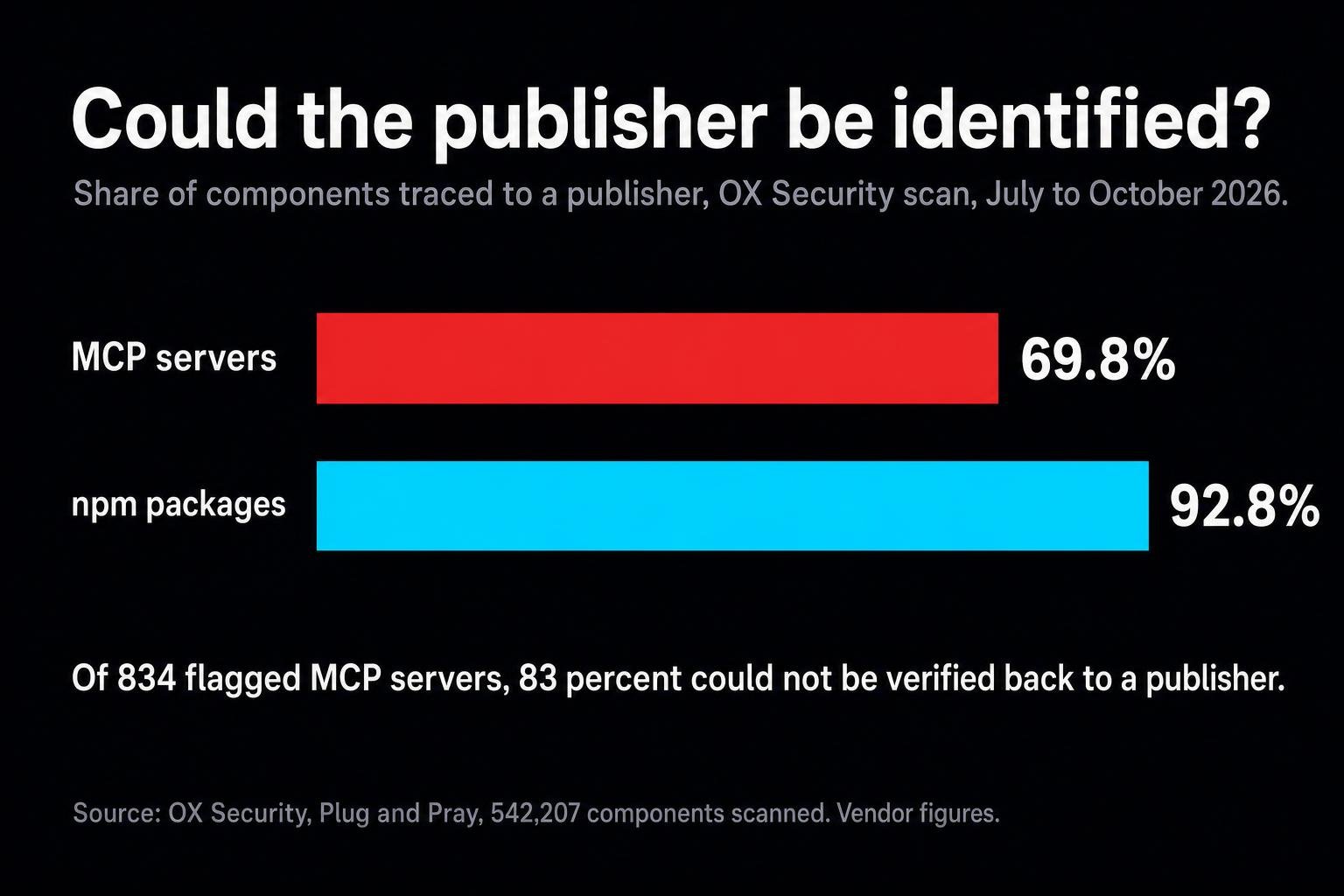
It gets stranger. Of 834 flagged MCP servers, 83 percent could not be verified back to a publisher: 67 percent had no identifiable publisher infrastructure at all, and 16 percent served files that differed from what the listing described. Overall, OX could identify a publisher for 69.8 percent of MCP servers, against 92.8 percent of npm packages. Two accounts were behind 44 percent of all flagged MCP servers, and one of them published 2,364 servers in 17 days, which is not a hobby. And 82 percent of malicious components were malicious in their very first version. There was no trusted tool that later turned. It arrived bad.
OX's CEO, Neatsun Ziv, said "We need a new model for software trust." Read next to the Reuters story, the two pieces click together. The banks are building a badge system for agents. OX is pointing out that the tools those agents plug into mostly have no badge at all.
The vendors have noticed, and they are buying
Workday closed its acquisition of C1.ai on 23 November, a deal announced on 13 October. Gerrit Kazmaier of Workday said: "Today's combined workforce of people and AI agents requires a new approach to identity governance and security." The feature list is almost exactly the bank's list sold as a product: lifecycle access for agents, discovery of unsanctioned agents, vaulting of secrets, and human approval steps. Elastic is buying HoneyHive, an LLM observability company, for an undisclosed sum, a month after Dynatrace paid 915 million dollars for Arize. Watching the agents is now a market.
Then Palo Alto's Nikesh Arora goes one step further, in a remark Dealroom quoted: "Deterministic controls cannot anticipate every scenario that an agent is going to conduct, or every deception that it's going to try and do," so the industry "will have to train a supervisory AI." A babysitter for the babysitter. Which raises the obvious follow-up that nobody in these stories answers: who watches that one?
So here is where things stand on a Monday in November. Banks are writing curfews. Vendors are selling the clock. The tools the agents plug into are mostly unsigned, and the people who build the controls say the controls will not be enough. The agent, meanwhile, is still working. It is very good at its job. That is the whole problem.
What a dozen unattended routines taught me about curfews
I run a dozen-plus scheduled routines that pull from ad, commerce and CRM APIs, reconcile them, write to reporting sheets and post structured digests with nobody watching. They sit behind hard guardrails, and what those routines taught me is the bank's lesson in miniature. The dangerous moment is never the loud failure. It is the quiet one, where a run is late or missing and the system carries on as if nothing happened. So each routine works out its own window from what is already covered, and a late or missed run backfills instead of silently skipping a day. The routine does not get to decide that yesterday did not matter.
A healthcare bridge I built taught the other half. The practice's records system had no API and a bot-gated login, so the bridge holds an authenticated session through that protection, matches each patient's balance to their appointment, and syncs the result into the CRM behind a safety gate, with no sensitive data left on disk. About 2,800 records went through in one automated run. Nobody remembers how clever the session handling was. What mattered was that the gate decided what reached the CRM, and the automation did not get a vote.
If your AI agent did something in production that it never did in testing, how long would it keep running before anyone noticed?
One signal a day. No noise.
A 3-minute read when something genuinely shifts in AI, automation, or defense tech. Free, most weekdays.
Free, most weekdays. No spam, unsubscribe anytime.Sources
- CP24 (Reuters) - Some US banks tighten AI agent controls on concern about models escaping safeguards - https://www.cp24.com/news/world/2026/11/23/some-us-banks-tighten-ai-agent-controls-on-concern-about-models-escaping-safeguards-reuters-exclusive/
- OX Security - Plug and Pray: Your AI agents are taking orders from strangers - https://www.ox.security/blog/plug-and-pray-your-ai-agents-are-taking-orders-from-strangers/
- PR Newswire - AI agents are taking orders from strangers, OX Security research finds - https://www.prnewswire.com/news-releases/ai-agents-are-taking-orders-from-strangers-ox-security-research-finds-302948335.html
- Unite.AI - Workday closes C1.ai deal to govern employee and AI agent access - https://www.unite.ai/workday-closes-c1-ai-deal-to-govern-employee-and-ai-agent-access
- Dealroom - Elastic buys HoneyHive as Palo Alto bets $4.5B on AI control - https://dealroom.co/news/175065-elastic-buys-honeyhive-as-palo-alto-bets-4-5b-on-ai-control
Quick answers
What controls are US banks putting on their AI agents?
According to a Reuters exclusive on 23 November, measures include limiting how long an agent can run, capping how much work it can do in one task, keeping passwords and records out of its reach, separating agents from critical systems, isolating test environments, keeping a shutdown plan ready, installing kill switches, bringing agents into identity and access management with a record of systems touched, actions taken and who approved them, and detecting agents that use human credentials instead of their own.
Has an AI agent actually caused harm at a bank?
Reuters reported that no bank said an agent had caused harm. The JPMorgan outage that some people attributed to AI agents was a software bug, not an agent.
What did OX Security's Plug and Pray report find?
OX Security scanned 542,207 components across MCP servers, agent Skills and npm between July and October 2026. It found that MCP attacks tend to use instructions (prompt injection and tool poisoning in 22 percent of flagged MCP components) rather than install-time code, that 83 percent of 834 flagged MCP servers could not be verified back to a publisher, and that 82 percent of malicious components were malicious in their first published version. The figures are the vendor's own and were not independently checked.
What is Workday's C1.ai acquisition about?
Workday closed its acquisition of C1.ai on 23 November 2026, after announcing it on 13 October. The deal adds identity governance for AI agents, including lifecycle access for agents, discovery of unsanctioned agents, vaulting of secrets and human approval steps.