ChatGPT Just Gave Brands a Front Desk
OpenAI now lets businesses claim a verified profile inside ChatGPT, see how often it mentions them, and put their own AI agent next to the answer. Customers have already said what they expect from that agent, and most businesses aren't listening yet.

For two years, being mentioned by ChatGPT has been like being talked about at a party you weren't invited to. Maybe you could hear your name through the wall. You couldn't walk in, correct anyone or even count how often it came up.
On 10 November, OpenAI opened the door. In a new beta, companies can claim a profile inside ChatGPT, get a blue check and use a Business Hub to update their details, prices and stock. The same hub shows how often ChatGPT mentions them, how many people click through to their site and the common topics in those conversations.
Read that last sentence again. A company can now see, from the engine itself, how often it shows up in AI answers. For anyone who has tried to measure AI search visibility, that's a big change.
What actually launched
- Verified profiles. Businesses claim their listing, get a blue check and manage their own details, prices and stock.
- Business Hub analytics. How often ChatGPT mentions you, click-throughs to your site and common conversation topics.
- Business Agents. Eligible US e-commerce and online-service firms can deploy their own agent. When the brand appears in an answer, the user can open its profile and chat with the brand's agent. That chat is labelled and kept separate from ChatGPT's own reply.
- Shopify connection. Merchants can connect from Shopify admin or from the Business Hub.
- Ads. These agents can also run as ads through ChatGPT Ads, which has reportedly passed a $1B run rate and 100,000 advertisers. OpenAI says paying does not change how often a business gets recommended.
The answer and the storefront are now separate rooms
Picture a good librarian. You ask for a book on sourdough, and the librarian recommends three. Then you notice that each publisher has a booth at the back of the room, clearly signed, where you can go and ask questions. The librarian's advice and the publisher's pitch both exist, but you always know which one you're hearing.
That's the trust model OpenAI is going for. ChatGPT's reply is the librarian, and the Business Agent is the booth. The labelling and separation matter more than any feature on the list, because once a user suspects the librarian is being paid, every answer loses value. OpenAI's statement that paying doesn't change recommendation frequency is its claim to protect that separation. Brands and buyers should hold OpenAI to it.
The reported rules point the same way. Agents must say they're AI, keep prices accurate and avoid pressure tactics. Purchases and sharing personal data need the user's explicit approval. For now, checkout still sends the user to the brand's own site, while agent payments with Visa are being developed.
Customers already wrote the job description
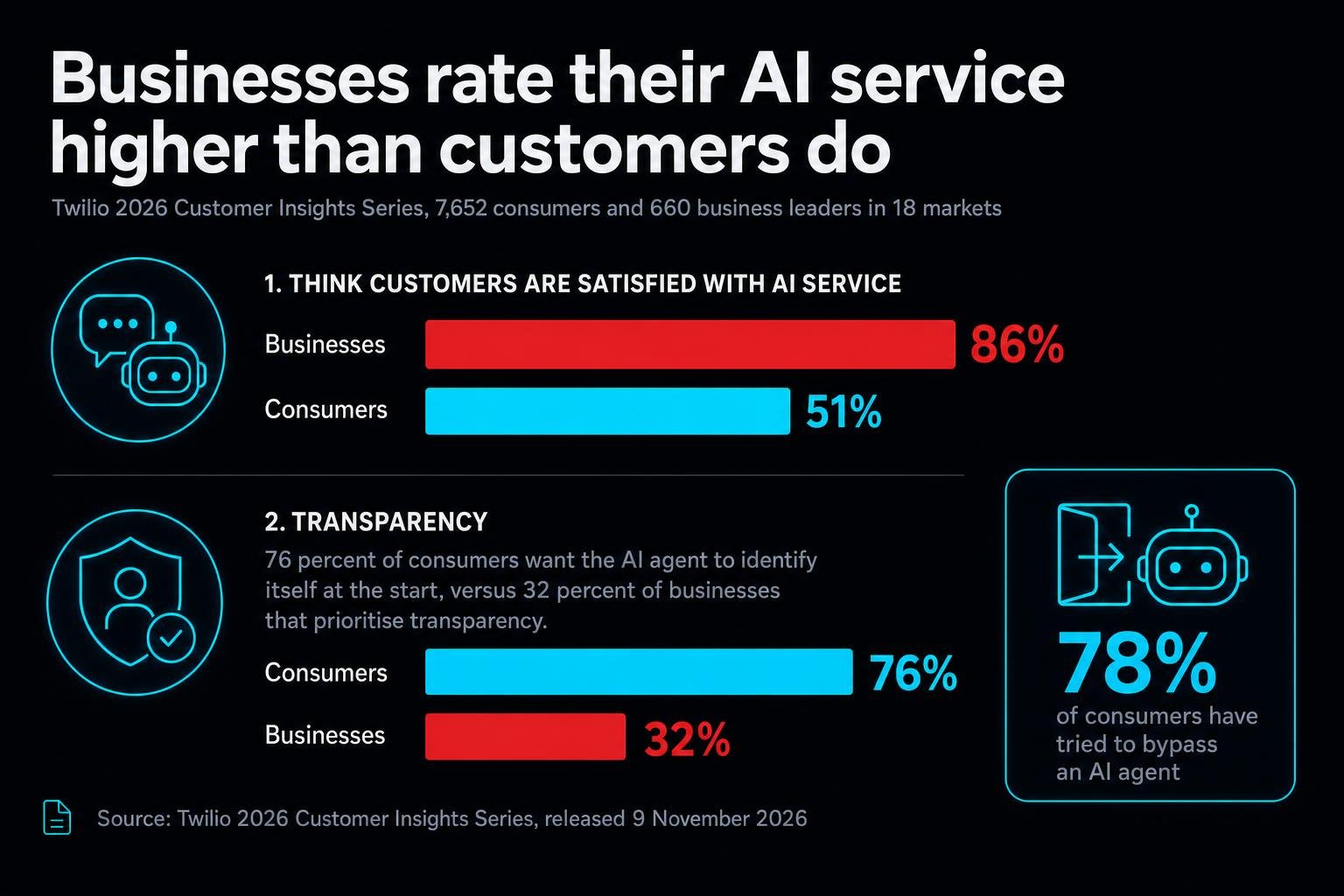
The timing is striking. A day earlier, on 9 November, Twilio released its 2026 Customer Insights Series, a survey of 7,652 consumers and 660 business leaders across 18 markets. It reads like a warning label for every brand about to switch on a Business Agent.
- 86% of companies think customers are satisfied with AI service. Only 51% of consumers say they are.
- 78% of consumers have tried to get around an AI agent.
- 63% want a quick way to reach a person.
- 76% want the agent to say it's an AI at the start of the conversation, yet only 32% of businesses make transparency a priority.
Seen next to that data, OpenAI's rules look less like red tape and more like the minimum. An agent that says it's an AI up front is doing what three in four consumers asked for. Most businesses, by their own account, weren't planning to.
For the first time, a business can see its own reflection inside ChatGPT. The risk is liking that reflection more than its customers do.
That 35-point satisfaction gap is the trap. A brand that judges its new agent only by how it feels about it will repeat the mistake Twilio measured: thinking the experience is fine while customers look for the exit.
Why the mention count changes the game
AI visibility has mostly run on guesswork. You typed some questions into a chatbot, squinted at the answers and argued about what they meant. A first-party count of how often you're mentioned, plus clicks and topics, turns that into something closer to a dashboard.
It also moves responsibility onto the brand. If you can edit your own prices and stock in the Business Hub, an AI answer built on stale information is partly your fault now. Keeping the profile accurate becomes routine upkeep, like your store hours on a maps listing.
Keep the limits in view. This is a beta. Business Agents are for eligible US e-commerce and online-service firms only. Checkout still goes to the brand's own site. And the hub is one engine reporting on itself, which is useful but not the whole picture.
The short version
ChatGPT now has a front desk for brands: a verified profile, a mirror that shows how often you come up and, for some, an agent of your own sitting next to the answer. The tools are new. What customers want from them isn't. Say you're an AI, keep the facts straight, don't push, and let people reach a human quickly.
Why I'd still measure from the outside
I built a measurement harness that runs a fixed set of buyer questions against ChatGPT, Perplexity and Gemini, checks whether a target brand or domain is cited, and tracks that citation rate over time. The goal was to turn answer-engine optimization from opinion into a baseline and a trend.
That's why the Business Hub excites me, and why I wouldn't let it be my only number. It's one engine reporting on itself. A fixed question set, asked the same way across more than one engine, is what makes a change in the trend mean something.
My order would be:
- Claim the profile and fix prices and stock first, so the engine is working from accurate data.
- Write down your buyer questions before you look at the hub, so the dashboard doesn't define success for you.
- Compare the hub's mention count against those same questions in ChatGPT and the other engines, and watch both over time.
One signal a day. No noise.
A 3-minute read when something genuinely shifts in AI, automation, or defense tech. Free, most weekdays.
Free, most weekdays. No spam, unsubscribe anytime.Sources
- AI Weekly: OpenAI puts verified business profiles and agents in ChatGPT - https://aiweekly.co/alerts/openai-puts-verified-business-profiles-and-agents-in-chatgpt
- The Next Web: OpenAI brings businesses and Business Agents into ChatGPT - https://thenextweb.com/news/openai-businesses-in-chatgpt-business-agents
- Agile Brand Guide: Yesterday's marketing technology and AI news, November 10, 2026 - https://agilebrandguide.com/yesterdays-marketing-technology-ai-news-november-10-2026
Quick answers
What are ChatGPT business profiles?
In a beta launched on 10 November 2026, OpenAI lets companies claim a verified profile in ChatGPT with a blue check. They can update their details, prices and stock through a Business Hub, which also shows how often ChatGPT mentions them, their click-throughs and common conversation topics.
What is a ChatGPT Business Agent?
It's a brand's own AI agent that eligible US e-commerce and online-service firms can deploy. When the brand appears in an answer, the user can open its profile and chat with the agent. That chat is labelled and kept separate from ChatGPT's own reply.
Does paying for ChatGPT Ads make ChatGPT recommend a business more often?
OpenAI says it does not. Business Agents can run as ads through ChatGPT Ads, but OpenAI states that paying does not change how often a business is recommended.
What do consumers expect from AI customer service agents?
In Twilio's 2026 survey, 76% of consumers wanted the agent to identify itself at the start, 63% wanted a quick way to reach a person, and 78% had tried to bypass an AI agent. 86% of companies thought customers were satisfied with AI service, but only 51% of consumers said they were.