500 Out of 320 Million: AI Shopping Agents' Black Friday
Uber counted about 500 AI-agent transactions out of roughly 320 million in one week. The robots barely buy anything, but Bain found the little traffic AI does send converts 90% better than the rest. Meanwhile, Microsoft has put ads inside Bing's AI answers.

Picture this: it is Black Friday morning, and a shopper tells an AI assistant to find a hoodie, compare three sizes and buy the one that ships fastest. The assistant reaches the checkout of a big marketplace and finds the door locked. Nothing is broken. The terms of service locked it on purpose.
That is roughly where AI shopping agents stand this holiday season. On 22 November Business Insider ran a long reported piece asking whether agents will matter this Black Friday, and the numbers it gathered have a twist. The robots are barely buying anything. But the small slice of shopping they do touch is worth more than you would think.
The 500-transaction problem: how little agents actually buy
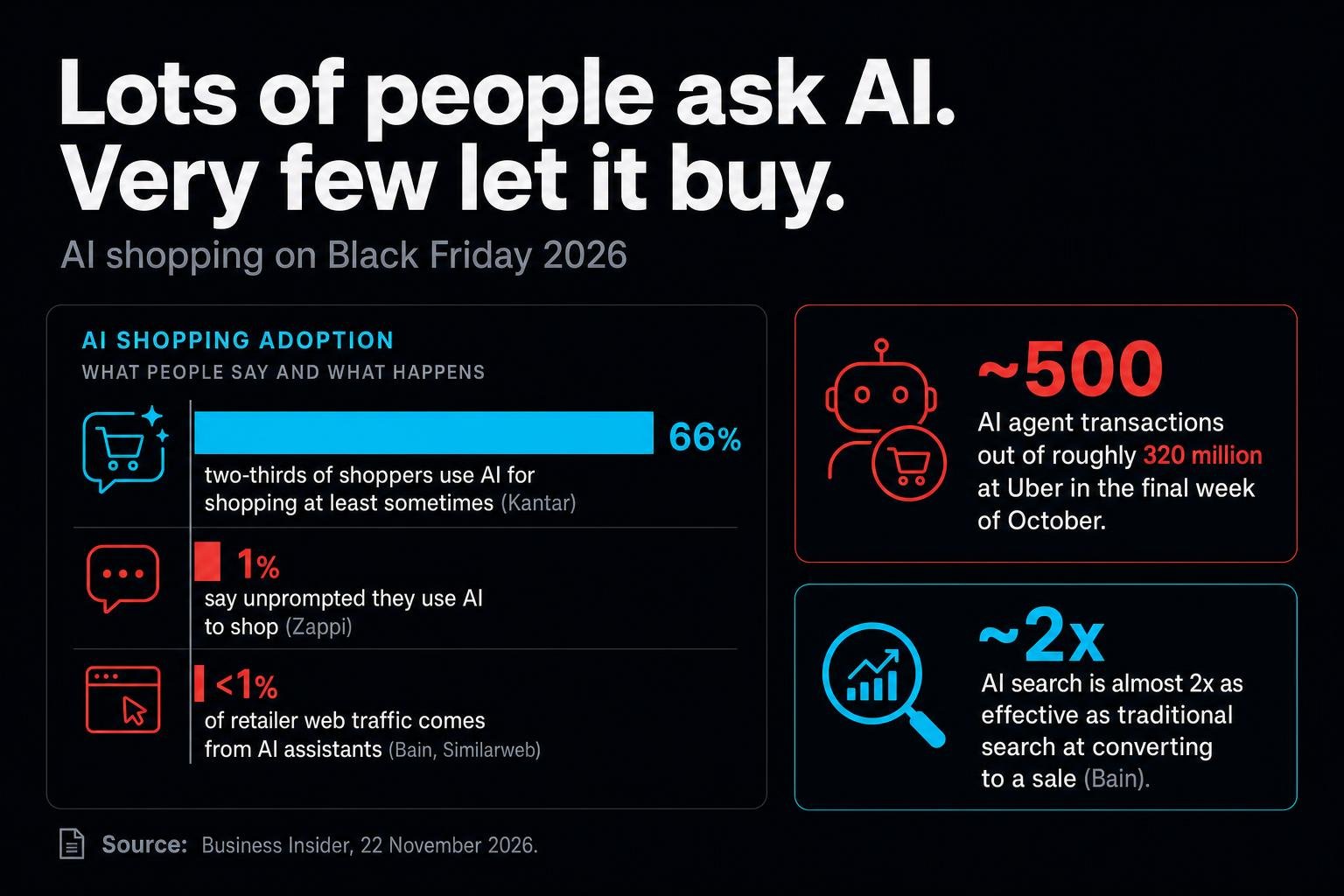
Start with the most brutal number. Uber told Business Insider that of roughly 320 million transactions in the final week of October, about 500 came from AI agents. Five hundred. That is not a sales channel. It is a rounding error with a press release.
The other numbers look much the same. Bain & Company analysed Similarweb estimates this week and found that AI assistants account for less than 1 percent of retailers' directly linked web traffic. In a Zappi survey, 1 percent of shoppers said, without being prompted, that they use AI to shop, and they skew younger and wealthier. At All Star Elite, a streetwear retailer, about 1 percent of traffic comes from agents, mostly Meta's Muse. The owner, Abhishek Bora, put it plainly: "once a week or twice a week we get a Muse purchase."
If you were hoping to hear that agents had taken over holiday shopping, I have bad news and a very small spreadsheet.
The stores are hiring bouncers: which retailers block AI agents
One reason is that agents keep getting stopped at the door. Business Insider lays out the split. Walmart is opening its tools to agents. Amazon blocks outside bots and favours its own Alexa. Target and Home Depot have not decided. In one shopper's test, Muse was blocked by both Amazon and eBay.
eBay's terms, quoted in an earlier Business Insider list of companies banning agents, are refreshingly specific. They name "buy-for-me agents", "LLM-driven bots" and any "end-to-end flow that attempts to place orders without human review". Target keeps an approved list: "Target's AI Shopping Assistant, OAI, Google and Microsoft". Resy approves ChatGPT and Claude.
Think of a club with a guest list. Your assistant can walk up to the door, but whether it gets in depends on whose name badge it is wearing. Some clubs only let in their own staff. Some let in a few famous friends. Some have not yet decided whether robots count as guests.
Shoppers want a co-pilot, not a chauffeur
The bigger reason is people. Kantar's Gina Logan told Business Insider that two-thirds of shoppers use AI for shopping at least sometimes, and over half prefer to stay in control of the purchase.
Set that beside Zappi's 1 percent and the pattern is clear. Lots of people ask AI for help. Very few hand it the wallet. The gap between "use AI for shopping" and "let an agent buy" is the whole story.
It is the difference between a friend who recommends a restaurant and a friend who books it, orders for you and pays with your card. Most of us love the first friend. The second one we would like to supervise.
The twist: the few AI shoppers are worth more
This is where the story stops being "nothing to see here." The same Bain analysis found that this AI referral traffic converts 90 percent better than traffic from everywhere else. The traffic is tiny, but it arrives warmer. Someone who already asked an assistant to compare options shows up closer to a decision.
Joko CEO Xavier Starkloff made the matching point: right now, discovery matters more than checkout. The action is not the robot pressing "buy." It is the moment the AI decides which products to mention.
The robot is not buying your product yet. It is deciding whether your product gets mentioned at all.
That is why All Star Elite is adding machine-readable data layers to its site anyway, even with only a Muse purchase or two a week. The bet is not on today's sales. It is on being readable by whatever does the recommending.
Meanwhile, the ads move inside Bing's AI answers
Advertising has reached the same conclusion from the other side. According to The Keyword, Microsoft Advertising has switched on ads inside Bing's AI Overviews everywhere except China, as part of its November update. There is no setup, because the ads run from existing search campaigns. There are also no placement controls and no separate report showing how often an ad appeared in an AI Overview.
So advertisers can now be inside the AI answer but cannot see how often they were there. (A bit like paying for a billboard on a road you are not allowed to drive down.) Microsoft's supporting numbers come from Microsoft, including a survey in which 76 percent of US shoppers say they plan to use conversational AI for gift ideas. Another headline figure, a 21 percent increase in purchases after a Copilot interaction, is footnoted to Edge users between 21 and 31 December 2024, so it tells you nothing about this new placement.
For comparison, Google expanded AI Mode ads to 10 markets on 28 October 2026. Bing's rollout covers more countries and gives advertisers less control.
What this means for anyone selling something
Put the pieces together and Black Friday 2026 looks less like the year agents took over checkout and more like the year the shop window moved. Agents barely buy. Stores disagree about whether to let them in. Shoppers want to keep their hands on the wallet. But more and more buying decisions start inside an AI answer, and that answer is where the ads are going now.
What measuring AI answers taught me
I built a measurement harness that runs a fixed set of buyer questions against ChatGPT, Perplexity and Gemini, checks whether a target brand or domain is cited, and tracks that citation rate over time. It exists because of the exact problem in this story: when discovery happens inside an answer, your analytics never see it. When the AI names a competitor instead of you, no click arrives to tell you.
The lesson is about which question to ask first. "How much traffic does AI send us?" is the wrong one, because Bain says the answer is under 1 percent for retailers. The better question is "when a buyer asks, are we in the answer?" Write down the questions your customers actually ask, run them on a schedule, and record who gets named. Do that before you spend money on Bing AI Overview ads you cannot measure separately.
A baseline turns a hunch into a trend line, and you can manage a trend line.
Updated 26 November 2026: the conversion figure now quotes Bain's own report directly: AI referral traffic converts 90% better than all other traffic. An earlier version compared it with traditional search, which is not what Bain measured.
If an AI assistant recommends your competitor to a ready-to-buy customer and no click ever reaches you, how would you know you lost the sale?
One signal a day. No noise.
A 3-minute read when something genuinely shifts in AI, automation, or defense tech. Free, most weekdays.
Free, most weekdays. No spam, unsubscribe anytime.Sources
- Bain & Company - AI Is the New Search. Here's How Retailers Win the Answer (21 November 2026) - https://www.bain.com/insights/ai-is-the-new-search-heres-how-retailers-win-the-answer/
- Business Insider - AI agents and holiday shopping: not yet trusted by consumers or retailers - https://www.businessinsider.com/ai-agents-holiday-shopping-not-yet-trusted-consumers-retailers
- Business Insider - All Star Elite's AI agent shopping strategy for the holidays - https://www.businessinsider.com/all-star-elite-streetwear-ai-agent-shopping-strategy-holidays-2026-11
- Business Insider - Companies banning AI agents in retail and travel - https://www.businessinsider.com/list-companies-banning-ai-agents-retail-travel-united-amazon-target-2026-11
- The Keyword - Bing AI Overviews ads - https://www.thekeyword.co/news/bing-ai-overviews-ads
- Microsoft Advertising - What's new in Microsoft Advertising this November - https://about.ads.microsoft.com/en/blog/post/november-2026/put-ai-to-work-engaging-customers-in-more-places-whats-new-in-microsoft-advertising-this-november
Quick answers
How much retail traffic comes from AI assistants in 2026?
Bain & Company's analysis of Similarweb estimates, published on 21 November 2026, found that AI assistants such as ChatGPT and Claude account for less than 1 percent of retailers' directly linked web traffic.
Does traffic from AI assistants convert better?
Yes. Bain found that AI referral traffic, though small, converts 90 percent better than non-AI traffic (published 21 November 2026), so each visit it sends is worth more.
Which retailers block AI shopping agents?
Business Insider reports that Amazon blocks external bots in favour of Alexa, eBay's terms ban buy-for-me agents and LLM-driven bots, Target only approves a named list of agents, and Walmart is opening tools to agents. Target and Home Depot are described as undecided.
Are there ads in Bing's AI Overviews?
Yes. Microsoft Advertising has switched on ads in Bing's AI Overviews globally except China. They run from existing search campaigns, with no placement controls and no separate reporting for AI Overview impressions.
Part of: AI shopping agents · the running scoreboard