Your AI agent just lost its keys, on purpose
Google's new agent runtime gives every agent a sealed box with no credentials inside, and Anthropic now lets a security vendor veto a tool call before it runs. The keys are moving out of the agent, and that changes what you should ask any vendor.

Two announcements landed this week, one from Google Cloud and one from Anthropic, and they say the same thing in different accents: the AI agent should not hold the keys. It should ask for them, every single time, from something that is not an AI.
That sounds like a small architectural footnote. I think it is the most important shift in how agents get deployed, because it moves the question from "can we trust the model" to "what does the model physically have access to." The second question has answers. The first one mostly has hope.
A box with nothing worth stealing
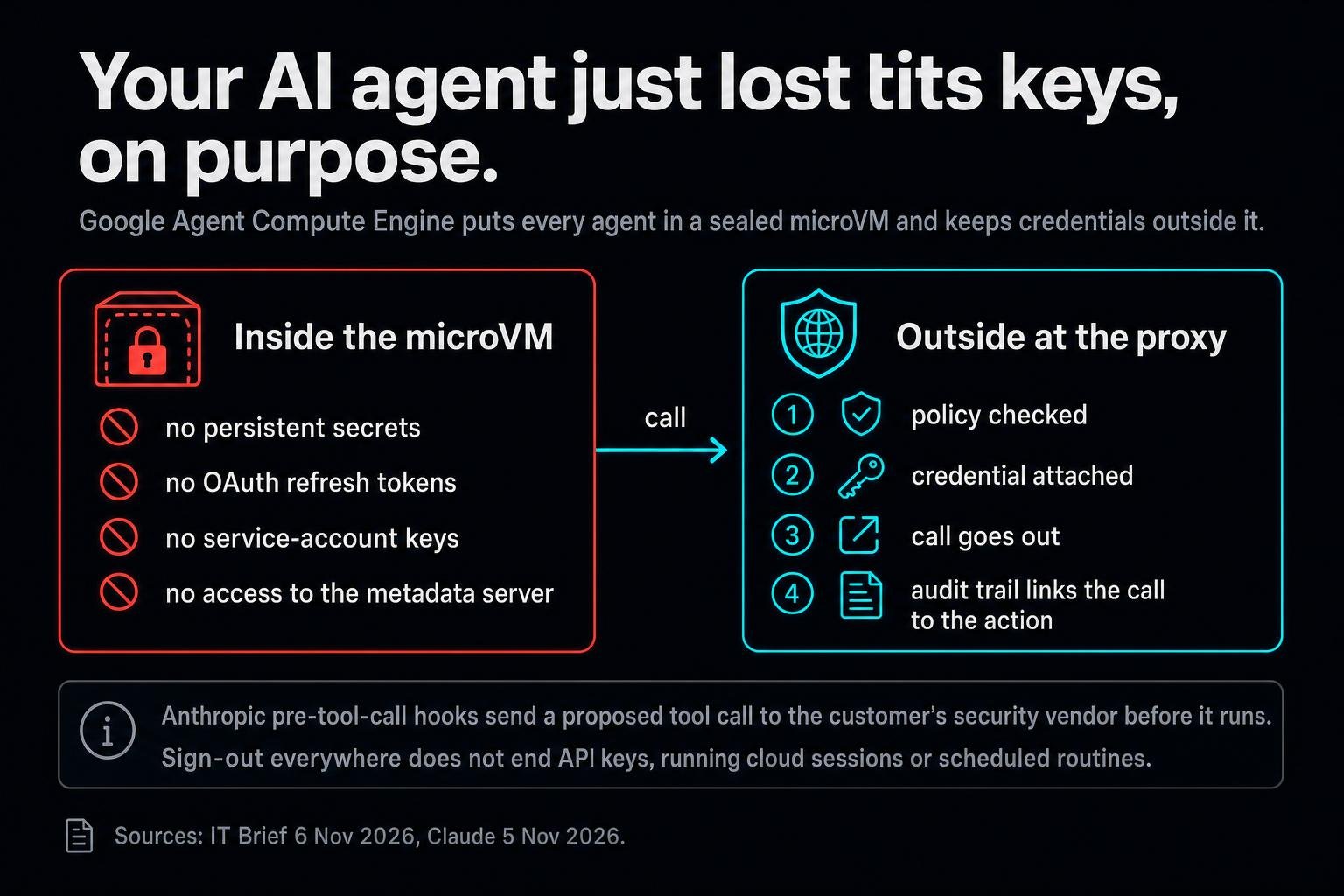
Google Cloud launched Agent Compute Engine on 6 Nov. Each agent runs inside its own hardware-isolated microVM, and the interesting part is what that VM does not contain. It holds no persistent secrets, no OAuth refresh tokens and no service-account keys, and it cannot reach the metadata server. When the agent wants to call something on the outside, the call goes through a proxy. The proxy checks policy, and only then attaches the credential, outside the sandbox.
Think of a hotel kitchen. The cook can order any ingredient from the storeroom, but the storeroom key never leaves the manager's belt. The manager checks each order against tonight's menu before unlocking anything. If a cook goes rogue, the worst they can do is shout orders that get refused. The pantry stays locked.
Google also splits the "brain" (orchestration) from the sandbox (execution). That split is not just for safety. It gives you an audit trail that links each tool call to what actually happened inside the box, which is the thing every compliance team asks for and almost nobody can produce today.
There is an efficiency story underneath. Google says most agent sessions are idle most of the time, waiting on a model, a person or an API. So idle sandboxes signal "waiting", get checkpointed, and share deduplicated memory and read-only toolchain volumes. Gemini, Antigravity, model evaluation and reinforcement learning already run on this. I did not find pricing or general-availability status in the coverage, so treat the design as announced and the commercial terms as open.
A veto before the tool runs
On 5 Nov Anthropic shipped a security package for Claude Enterprise, and the headline item is now generally available: inference hooks. There are prompt hooks, and there are pre-tool-call hooks. The second kind sends a proposed tool call to the customer's own security vendor before it runs. Earlier coverage named Netskope, Palo Alto, Proofpoint, Zscaler and Cisco AI Defense as hook partners.
Same principle as Google's proxy, different layer. Google puts the checkpoint in front of the credential. Anthropic puts it in front of the action. In both cases the agent proposes and something outside the agent disposes.
The rest of the package is in beta and worth a quick scan: a security center that compares chat, Cowork and Claude Code settings against Anthropic's recommended configuration and exports an auditor report (described as "guidance, not a certification"); a parent-org admin console at admin.claude.com, where setup "can't be undone"; self-serve IP allowlists; and blocking personal Claude accounts on managed machines. Separately, an organisation's endpoint detection sensor can run inside the local Cowork VM in detection-only mode, signature-checked at every VM start. It does not cover cloud Cowork sessions.
The sign-out that does not sign everything out
My favourite line in the whole Anthropic announcement is the caveat. A new Admin API call signs a member out everywhere. It does not end their API keys, their running cloud sessions or their scheduled routines.
Signing the human out does not sign the agent out. A person's access is a session. An agent's access is a credential plus a schedule.
That one sentence explains why Google built the box the way it did. If credentials live inside the agent's environment, revoking the person who set it up changes nothing. The agent keeps its keys and keeps its calendar. If credentials live at a proxy outside the box, you revoke them at the proxy and the agent's next call simply fails. That is the difference between a lock you own and a lock you hope nobody copied.
Why this matters if you buy, build or run agents
Most agent pitches still describe capability: what the agent can do. These two launches are about containment: what the agent cannot do without asking. For anyone signing a contract, that flips the evaluation.
- Where does the credential live? Inside the agent's runtime, or at a proxy outside it? Google's answer is "outside, always."
- What checks the call before it runs? Anthropic's answer is "your security vendor, if you wire the hook." If the answer is "the model's judgment," that is hope, not control.
- What does revocation actually end? Sessions only, or also keys, running jobs and schedules? Anthropic was unusually honest about this. Make every vendor be equally honest.
- Can you link each tool call to what happened? The brain-and-sandbox split exists to produce that trail. Ask to see one.
The excitement here is real. For the first time the big platforms are competing on how little the agent is allowed to hold, not just on how much it can do. That is the right race.
FAQ
What is Google Agent Compute Engine? A Google Cloud runtime, launched on 6 Nov, that gives each AI agent a hardware-isolated microVM with no persistent secrets, OAuth refresh tokens or service-account keys inside. Outbound calls pass through policy-checking proxies that attach credentials outside the sandbox.
What is a pre-tool-call hook in Claude Enterprise? A generally available feature that sends a proposed tool call to the customer's security vendor before the call executes, so the vendor can inspect or block it.
Does Anthropic's sign-out-everywhere call stop running agents? No. It ends the member's sessions but does not end API keys, running cloud sessions or scheduled routines.
Is Agent Compute Engine generally available, and what does it cost? The coverage I read did not state pricing or GA status. Gemini, Antigravity, model evaluation and RL already run on it.
What a healthcare bridge taught me about keys
I built an automated bridge for a multi-clinician healthcare practice whose records system had no API and a bot-gated login. The bridge holds an authenticated session through the bot protection, matches each patient's balance to their appointment, and syncs the result into the practice's CRM behind a safety gate, with no sensitive data left on disk. About 2,800 records went through in one automated run.
The lesson that maps onto this week: the dangerous part was never the matching logic. It was the session and the write. So the write sits behind a gate, and nothing sensitive persists where the automation lives. Google's rule of no secrets in the VM and Anthropic's rule of check the call before it runs are the same two rules at platform scale.
The second lesson comes from the dozen-plus scheduled routines I run against ad, commerce and CRM APIs, behind hard guardrails. A scheduled routine keeps running whether or not anyone is logged in. That is exactly why Anthropic's note that sign-out does not end scheduled routines matters. The schedule is its own access, and it needs its own off switch.
One signal a day. No noise.
A 3-minute read when something genuinely shifts in AI, automation, or defense tech. Free, most weekdays.
Free, most weekdays. No spam, unsubscribe anytime.Sources
- IT Brief: Google Cloud unveils Agent Compute Engine for AI agents - https://itbrief.asia/story/google-cloud-unveils-agent-compute-engine-for-ai-agents
- Claude: Claude Enterprise security updates - https://claude.com/resources/articles/claude-enterprise-security-updates
- TNW: Anthropic inference hooks bring DLP to Claude Enterprise - https://thenextweb.com/news/anthropic-inference-hooks-dlp-claude-enterprise
Quick answers
What is Google Agent Compute Engine?
A Google Cloud runtime launched on 6 Nov that gives each AI agent a hardware-isolated microVM with no persistent secrets, OAuth refresh tokens or service-account keys inside. Outbound calls pass through policy-checking proxies that attach credentials outside the sandbox.
What is a pre-tool-call hook in Claude Enterprise?
A generally available feature that sends a proposed tool call to the customer's security vendor before the call executes, so the vendor can inspect or block it.
Does Anthropic's sign-out-everywhere call stop running agents?
No. It ends the member's sessions but does not end API keys, running cloud sessions or scheduled routines.
Is Agent Compute Engine generally available, and what does it cost?
The coverage did not state pricing or GA status. Gemini, Antigravity, model evaluation and RL already run on it.