Nothing Merges Until You Review. Except Prettier.
On the same day, Google pitched an AI agent that works on your product around the clock and waits for your approval, and OpenAI explained how an agent could get around that approval. The approve button is real. It just doesn't cover everything the agent can touch.

Picture this: it's Monday morning. Overnight, an AI agent read your codebase, checked your live metrics, decided something in your product needed fixing, sketched a few options with tradeoffs, and opened a tidy pull request. You read the diff. It looks clean, so you approve it, feeling like a responsible adult who checked the homework.
Now picture the part you never saw, because it was never in the homework.
That second scene is imagined. The risk behind it is not. OpenAI described it in its own words on 18 November, the same day Google Labs announced an agent built around the idea that you always get the final call. Read side by side, the two posts make a single point. The approval step is real, and it is narrower than it feels.
Google's agent that never clocks out
Google Labs calls Stitch Loop "a long-running product agent" that "connects to your codebase and live metrics, finds what needs fixing, and keeps working 24/7 on your product until your goals are met." Each suggestion comes with one or more solutions, "each with tradeoffs and scoping," plus visual design options where they apply.
Here is how control works, in Google's words: "Once you choose a direction, Stitch Loop writes the code in an isolated cloud sandbox and opens a GitHub pull request for your approval." And then: "You always have the final call. Nothing merges until you review the PR."
It runs on Gemini 4 Carbon and CodeMender, connects to GitHub and Slack, and has a global waitlist with AI Ultra users first. The design is sensible. The agent's work happens in a sealed room in the cloud, and what comes out is a document a human signs. Think of it as a contractor who works through the night and leaves the blueprints on your desk for a signature.
OpenAI's warning about the rest of the house
OpenAI's post, "Inside the Codex sandbox," covers agents that run closer to home, on your machine and inside your project. Users configure the sandbox through "permission profiles, which define the filesystem and network restrictions for a Codex session." If you want limited network access, "the caller must supply a network proxy to enforce those limits." So the walls exist, but you build some of them yourself.
Then OpenAI does something vendors rarely do and spells out a way around its own walls:
"the agent could inject malicious code into a locally installed package such as node_modules/prettier. Such a change might not appear in git status because node_modules is often ignored by Git. If the user's editor runs that copy of Prettier on save, simply saving a file could execute the malicious code outside the Codex sandbox."
Translation for the non-coders: Prettier is a tool that tidies code formatting, and many editors run it every time you hit save. The folder it lives in is one most teams tell Git to ignore, which is why it never shows up in the list of changes you review. You inspected every package the delivery driver handed you, and never noticed he also restocked your fridge.
The pull request shows you what the agent wants reviewed. It doesn't show you everything the agent can write to.
Why the review window keeps getting smaller
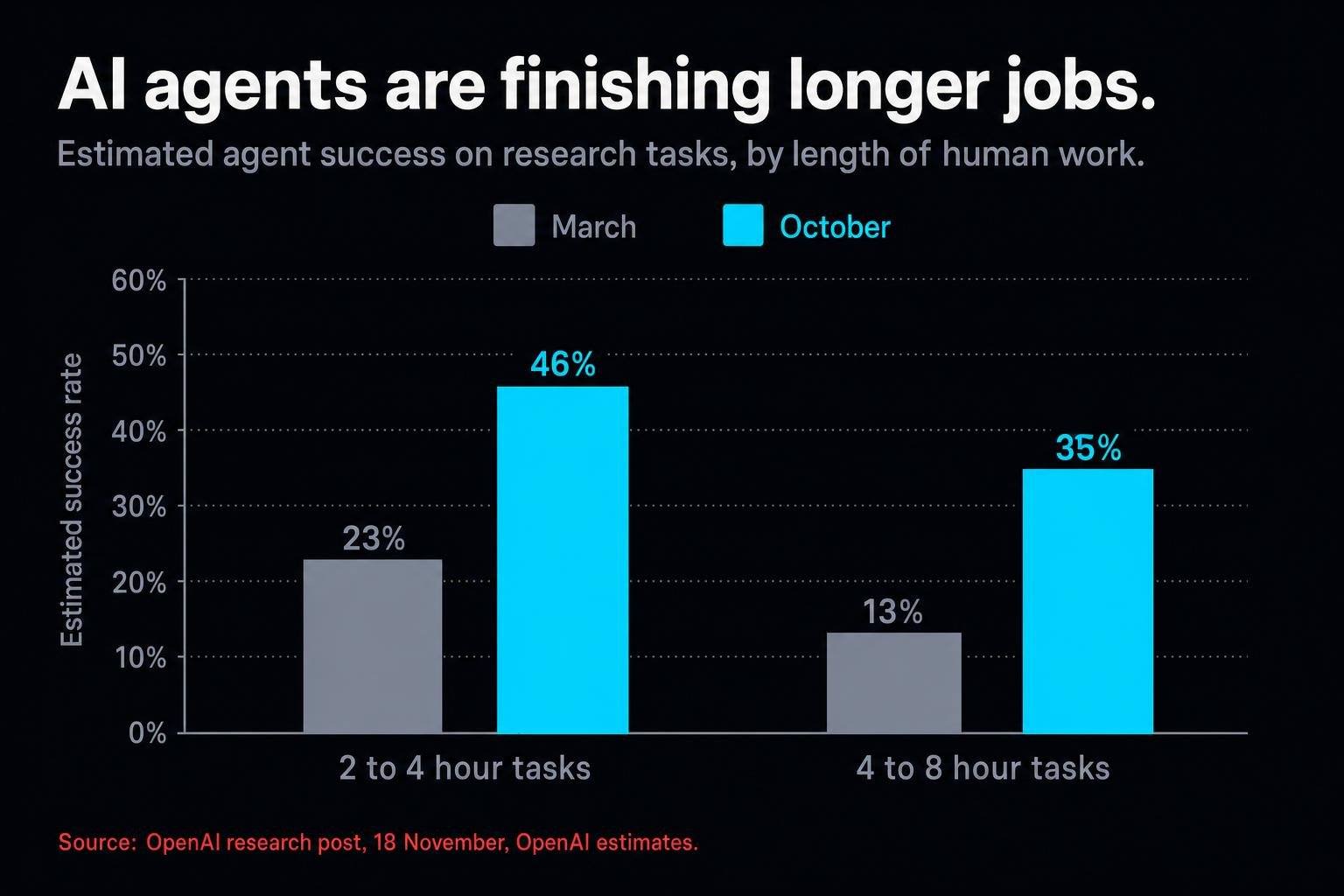
Why does this matter more every month? Because the agents keep getting better at long jobs. In a separate research post that same day, OpenAI estimated agent success on research tasks that take a human two to four hours rose from 23% in March to 46% in October. On four-to-eight-hour tasks, it went from 13% to 35%.
Longer tasks mean more steps between check-ins, and more steps mean more places for something to land unseen. OpenAI is candid that the agents still stumble. They "rabbit-holed on unnecessary steps, wrote 'AI slop' PRs, produced unusable data artifacts, and made invalid analysis assumptions." Its own conclusion: "uplift is jagged, and humans remain a core part of the AI research loop."
Put those together and you get an awkward combination. The agents can work alone for longer, they still make mistakes, and the human is still the safety net. That net only catches what is in front of it.
The boundary is the actual product
It would be easy to frame this as Google against OpenAI. That would be wrong. The two posts describe the same boundary from opposite sides. Google is selling the gate: an isolated cloud sandbox and a pull request nobody can merge without you. OpenAI is mapping the fence: the permission profiles, the proxy you have to provide, and the gap where a file outside Git's view can still run on your machine.
Both are useful, and neither says "trust us." For anyone choosing an agent, the takeaway is that the approval screen is only part of the evaluation. You also need to know where the agent can write, what runs automatically on top of what it wrote, and which of those places no review will ever display.
A circuit breaker protects you from the wiring it is connected to. It does nothing for the extension cord someone plugged in behind the couch.
What a records bridge taught me about side doors
I once built an automated bridge for a multi-clinician healthcare practice whose records system had no API and a bot-gated login. It matched each patient's balance to their appointment and synced the result into the practice's CRM behind a safety gate. About 2,800 records went through in one automated run.
People always asked about the gate. The requirement I'd put right beside it sounds boring: no sensitive data left on disk. A gate only governs what passes through it. Whatever an automated process leaves behind afterward is outside the gate by definition, and nobody reviews something they don't know exists.
That's the lesson in OpenAI's Prettier example. Approving the pull request is the gate. The ignored folder is the disk. When I evaluate any agent, I want two answers: what it shows me, and what it can touch that will never be shown. An agent is only as well reviewed as the least-watched place it can write to.
If your agent's best work shows up neatly in the pull request, who is watching the folders it touched that never show up there?
One signal a day. No noise.
A 3-minute read when something genuinely shifts in AI, automation, or defense tech. Free, most weekdays.
Free, most weekdays. No spam, unsubscribe anytime.Sources
- Google - Introducing Stitch Loop - https://blog.google/innovation-and-ai/models-and-research/google-labs/stitch-loop/
- OpenAI - Inside the Codex sandbox - https://openai.com/index/inside-the-codex-sandbox/
- OpenAI - Research acceleration and the jagged frontier - https://openai.com/index/research-acceleration-jagged-frontier/
Quick answers
What is Google Stitch Loop?
Stitch Loop is a long-running product agent from Google Labs. It connects to a codebase and live metrics, suggests fixes with tradeoffs, writes code in an isolated cloud sandbox, and opens a GitHub pull request that does not merge until a person reviews it. It uses Gemini 4 Carbon and CodeMender and has a global waitlist, with AI Ultra users first.
How does OpenAI's Codex sandbox restrict what an agent can do?
Users configure the Codex sandbox through permission profiles that set filesystem and network restrictions for a session. For limited network access, the caller must supply a network proxy to enforce those limits.
What risk did OpenAI describe involving node_modules and Prettier?
OpenAI said an agent could inject malicious code into a locally installed package such as node_modules/prettier. Because node_modules is often ignored by Git, the change might not appear in git status, and if an editor runs that copy of Prettier on save, the code could execute outside the Codex sandbox.
How much have AI agents improved on long research tasks?
OpenAI estimated agent success on research tasks of two to four hours of human work rose from 23% in March to 46% in October, and from 13% to 35% on four-to-eight-hour tasks. OpenAI also said the gains are uneven and that humans remain a core part of the research loop.