Shopify Just Gave AI Agents a Fact Sheet for Your Store
Shopify moved its Knowledge base into the admin and now drafts the facts AI agents get about your store from your own pages. Review before you publish, because the shopper asking the question is increasingly a piece of software.

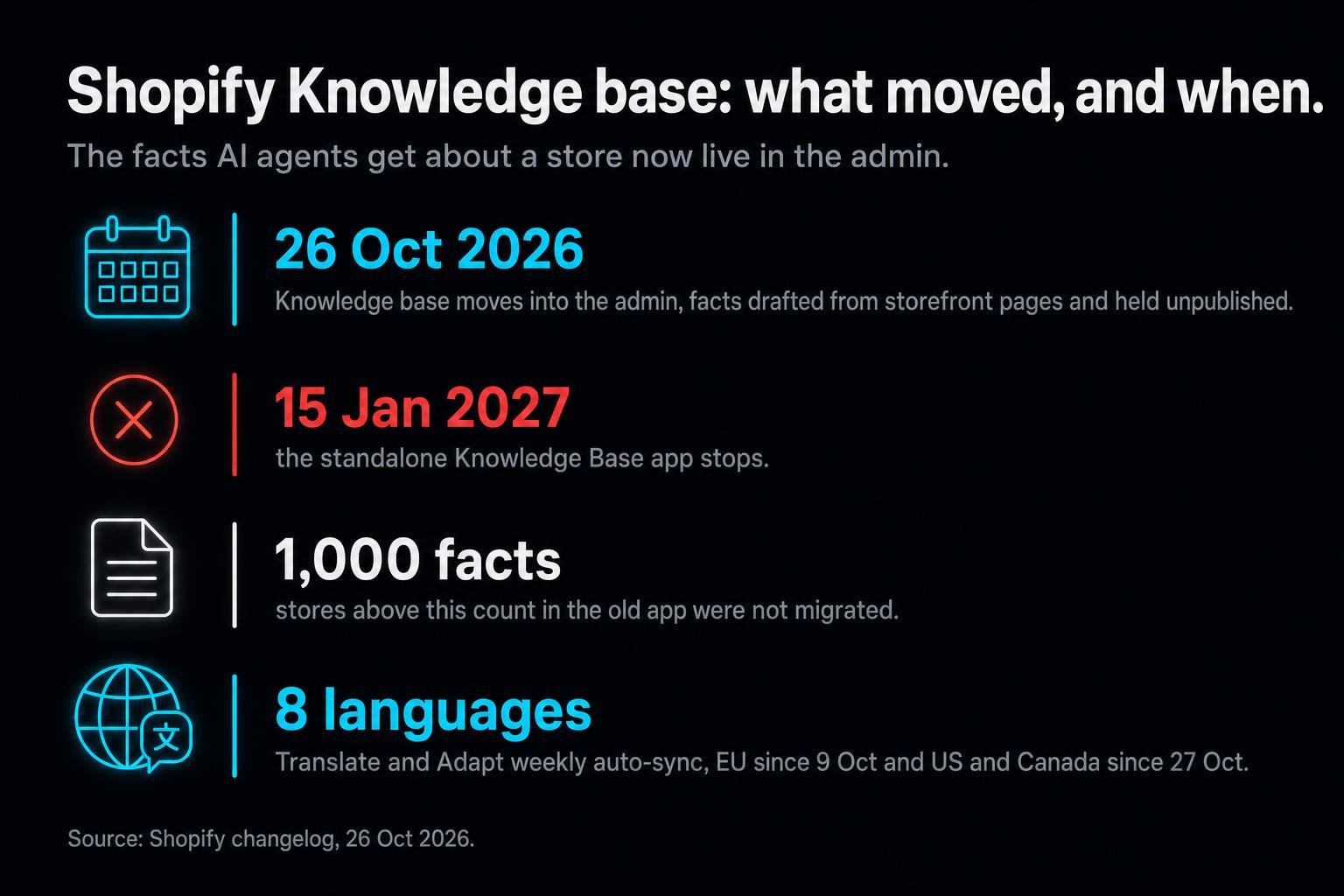
On 26 October Shopify moved its Knowledge base into the admin, under Sales channels, then Agentic, then Knowledge base. It is one page where a merchant reviews, edits and publishes the facts that AI agents get about the store: contact details, gift services and similar basics. Shopify drafts each fact from the store's own published pages, links it back to the page it came from, and keeps it unpublished until the merchant publishes it.
Small change on the surface. I think it is one of the more important merchant-facing moves of the year, because it names something most store owners have not had to think about yet. There is now a layer of software between you and your customer, and it has its own idea of what your store is.
The laminated card behind the front desk
Think of a hotel. For decades, guests walked up to the front desk and asked the concierge: is there late checkout, is there parking, can you send flowers to a room. The concierge answered from a laminated card kept behind the counter. Nobody wrote the card for guests. It was written for the person answering.
Shopify's Knowledge base is that card, except the concierge is now an AI agent and the guest is a shopper who may never open your site. The agent gets the facts, the agent answers, and the shopper trusts the answer. Whatever is on the card is what gets said.
Until now, the card was whatever an agent could pull from your pages on its own, with no review step. Now there is a step. That is the whole story, and it matters.
Why the timing is not an accident
The day after Shopify's change, identity company Socure launched Agent Intelligence, a product that detects AI agents driving browser sessions whether or not they declare themselves, and names them when it can. Socure's own figures, so weigh them as vendor numbers: agent requests are up more than 1,700% year on year, and for the first time more than half of internet traffic is not human.
I would not quote the decimal places. I would quote the direction. The question "does this store gift wrap" is increasingly asked by software on a shopper's behalf, and the software does not browse like a person. It does not notice your banner or your hero image. It wants a fact, a source, and a yes or a no.
The agent reads the card, not the room. Whatever you publish to it is the version of your store that gets repeated.
A draft is not the truth
Here is the part I like most about Shopify's design. The facts arrive as drafts, each linked to the page it was drafted from, and nothing goes live until you say so. That default is correct, and it is worth understanding why.
Drafting from your own published pages sounds safe. It is only as safe as those pages. A contact page that still lists the old phone number, a shipping page written for a policy you changed last spring, a gift services note from a promotion that ended: every one of those becomes a confident, sourced fact that an agent will hand to a customer with a straight face. The link to the source page is your friend here. It tells you exactly which page to fix, not just which fact.
It is autocomplete for your store's identity. Autocomplete is fast and usually right, and the times it is wrong are exactly the times you wish you had looked.
Dates to put in the calendar
- 26 October 2026: Knowledge base is in the admin, with facts drafted from your storefront and held unpublished until you publish them.
- 15 January 2027: the standalone Knowledge Base app stops. Stores that had more than 1,000 facts in the old app were not migrated and must re-add what they want before that date.
- 9 October (EU) and 27 October (US and Canada): Translate & Adapt can now auto-sync translations weekly for up to 8 languages.
That last item belongs in the same conversation. It is a second place where machine-written words go out under your brand on a schedule, and the decision is the same one: is this allowed, and who checks it. A merchant who would never let an untrained temp rewrite the returns policy should ask the same question of a weekly sync.
What this means if you run a store
The fact sheet is now a product surface. It deserves an owner, the way the homepage has an owner. The practical shape of that is simple. Open the page. Read every draft against the page it came from. Publish only what is true today. Then treat the source pages as the upstream, because the next draft will come from them too.
If you sell in more than one language, decide on the translation sync before it decides for you. And if your old app held more than 1,000 facts, the clock to 15 January 2027 is already running, and nothing moved on its own.
None of this is glamorous. It is housekeeping. But the guest at the front desk has changed, and the card behind the counter is suddenly the most-read page you own.
What measuring AI citations taught me
I built a measurement harness that runs a fixed set of buyer questions against ChatGPT, Perplexity and Gemini, detects whether a target brand or domain is cited, and tracks that citation rate over time. The lesson that carries over: answer engines are not a black box you argue with. They are a system you measure, and the moment you measure them, opinion turns into a baseline and a trend.
Shopify's Knowledge base gives merchants a second lever next to the storefront itself, and it deserves the same treatment. Write down the questions a buyer actually asks about your store. Put them to the agents before you publish anything, and note what comes back. Publish only verified facts, then ask again a week later and compare. If the answers move toward what you published, the card is being read. If they do not, you have learned where the agents are getting their version of your store instead, and that is the page to fix next.
One signal a day. No noise.
A 3-minute read when something genuinely shifts in AI, automation, or defense tech. Free, most weekdays.
Free, most weekdays. No spam, unsubscribe anytime.Sources
- Shopify changelog: Knowledge base is now available in your admin - https://changelog.shopify.com/posts/knowledge-base-is-now-available-in-your-admin
- Shopify changelog: index (Translate and Adapt weekly auto-sync) - https://changelog.shopify.com/
- Help Net Security: Socure launches Agent Intelligence - https://helpnetsecurity.com/2026/10/27/socure-agent-intelligence
Quick answers
Where is the Shopify Knowledge base now?
Since 26 October 2026 it lives in the Shopify admin under Sales channels, then Agentic, then Knowledge base. It is one page to review, edit and publish the facts AI agents get about a store.
Are the facts published automatically?
No. Shopify drafts each fact from the store's own published pages, links it to the source page, and keeps it unpublished until the merchant publishes it.
When does the standalone Knowledge Base app stop?
On 15 January 2027. Stores with more than 1,000 facts in the old app did not migrate and must re-add the facts they want before that date.
Why does this matter for AI shopping agents?
Agents answer shopper questions from the facts a store publishes. Socure reports agent requests up more than 1,700% year on year and, for the first time, more than half of internet traffic not human, per the company's own figures.