AI agents check out twice as often as humans do
Microsoft Clarity looked at more than five million sessions driven by browser agents from OpenAI, Google and Anthropic. The agents barely click out, rarely wander, and finish the purchase far more often than people do.

For twenty years we built websites for a visitor who browses. They land, they scroll, they compare, they click a link to a review site, they come back three days later and maybe they buy. Every funnel chart, every heatmap, every "average pages per session" number assumes that visitor.
Microsoft Clarity just published numbers that describe a different visitor. Clarity analysed more than 5.2 million sessions it classified as agentic, across 230,511 projects, between 13 August and 9 September 2026. These were sessions driven by the browser agents from OpenAI, Google and Anthropic. The behaviour inside those sessions does not look like browsing. It looks like errands.
The numbers
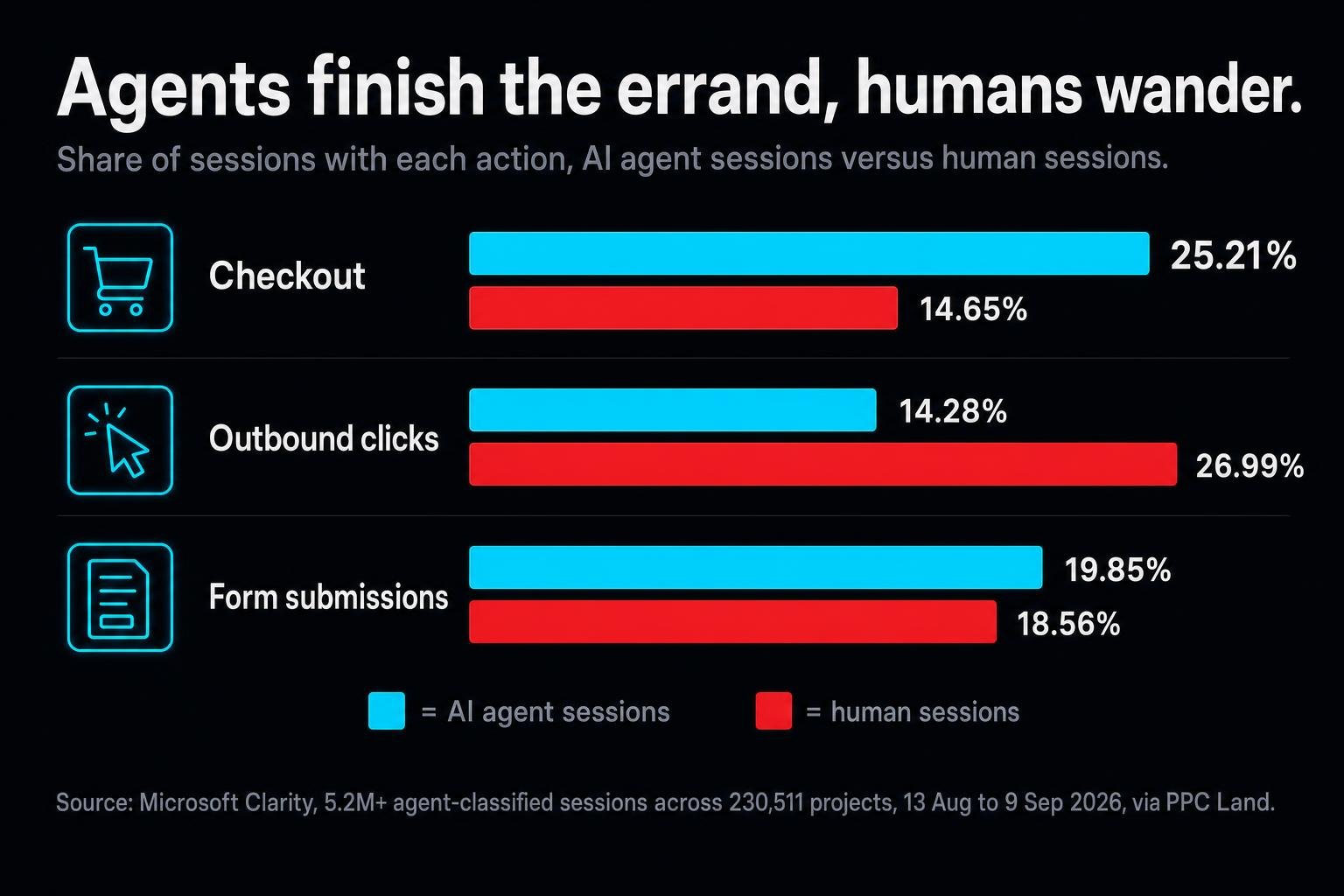
Four comparisons stand out, as reported by PPC Land from the Clarity analysis:
- Checkout appeared in 25.21% of agent sessions, against 14.65% of human sessions.
- Book appointment showed up in 8.42% of agent sessions and check availability in 2.41%. Both made the agent top ten and neither made the human top ten, which means humans did each in under 1.62% of sessions.
- Outbound clicks reversed completely: 14.28% of agent sessions versus 26.99% of human sessions.
- Form submissions were nearly identical: 19.85% for agents, 18.56% for humans.
Here is the analogy I keep coming back to. A human in a shopping mall is a shopper. They drift between stores, read the posters, step outside for coffee, and sometimes leave with nothing. An agent is a personal assistant sent in with a written list. It walks to the counter, pays, books the fitting, and leaves. It does not read the posters. It does not follow the sign to the store across the hall.
That is what the outbound-click reversal is telling us. Humans leave your site through a link almost twice as often as agents do. The agent came to do one thing on your site and the rest of the web is noise to it.
The agent is not a visitor you persuade. It is a visitor you serve, quickly, or lose.
Read the fine print first
This is a vendor study, and the honest version of this post has to say where it is thin.
- Clarity cannot separate the agent from the human inside a session. Many of these sessions are a person and an agent trading the keyboard. A checkout at the end could be the human stepping in to approve the payment. The headline rate is for the whole session, not the machine alone.
- The base does not add up. PPC Land ran the arithmetic and found the published percentages imply a base of roughly 1.22 million sessions, not 5.2 million. The study does not explain the gap. That does not make the ratios wrong, but it does mean we do not know exactly what population they describe.
- The window closed one day after Meta Muse launched, so Meta's agent is not counted at all. The mix of agents on the open web today is already different from the mix in this data.
None of that erases the pattern. A 25% checkout rate against 15%, and a 14% outbound rate against 27%, are not rounding errors. But treat these as a first reading, not a settled law.
Why it matters for anyone who runs a website
The first implication is about what gets measured. If a growing share of your sessions are agents, the metrics you tuned for people start lying to you. Bounce rate, time on page and pages per session were designed to score a browser. An agent that lands, checks availability, books, and leaves in forty seconds looks like a terrible engagement score and a wonderful customer.
The second implication is about where the value sits. If agents do not click out, then the parts of your site that depended on sending people elsewhere, or on catching people who were sent to you, weaken as agent traffic grows. The parts that let a task finish on your own pages, the cart, the booking calendar, the availability check, get more important. Those surfaces now have two audiences: a person reading them and a program parsing them.
The same week, Reddit's third-quarter letter said search referrals fell by more than one million a week on average during October, and its CEO Steve Huffman said Google's AI Mode "does not drive traffic." That is a different mechanism, answer engines rather than browser agents, but it rhymes. Across the stack, the click that used to carry a visitor between sites is getting rarer, and the action is happening wherever the task can be completed.
What to actually do with this
Three practical moves, in order, none of which require believing the study to the decimal:
- Find out whether you have agent traffic at all. Clarity says its Agent Activity Dashboard is now generally available for projects that show agent traffic. Whatever analytics you run, start by asking what share of sessions are classified as agents, and write that number down with the date.
- Walk your own checkout and booking flows as an agent would. Plain labels, stable field names, no critical step buried in an image or a pop-up that needs a hover. If a program cannot tell which button means "confirm," it will fail quietly and you will never see the lost sale.
- Separate agent sessions in your reporting before you draw conclusions. The Clarity study could not split the agent from the human inside a session, and most sites cannot either yet. But you can at least report agent-classified sessions as their own row, so a change in the mix does not masquerade as a change in behaviour.
The visitor we built the web for is still here. There is just a second one now, and it arrived with a list.
What measuring AI answer engines taught me about reading this
I built a measurement harness that runs a fixed set of buyer questions against ChatGPT, Perplexity and Gemini, checks whether a target brand or domain gets cited, and tracks that citation rate over time. The lesson from that work applies directly to the Clarity numbers: a single percentage is an opinion, and a baseline plus a trend is a fact. A 25% checkout rate means little until you know what it was last month on your own site, measured the same way.
I also run a dozen-plus scheduled routines that pull from ad, commerce and CRM APIs, reconcile them, and post digests unattended, behind hard guardrails. Each one works out its own window from what is already covered, so a late run backfills instead of silently skipping a day. That discipline is exactly what agent traffic demands. If agents and humans are mixed in one session count, and the vendor itself cannot split them, then your own reporting has to carry the split, every day, with no gaps, or the trend you think you see is just a change in who showed up.
One signal a day. No noise.
A 3-minute read when something genuinely shifts in AI, automation, or defense tech. Free, most weekdays.
Free, most weekdays. No spam, unsubscribe anytime.Sources
- PPC Land - Checkout appears in 25% of AI agent sessions vs 15% for humans, Clarity finds - https://ppc.land/checkout-appears-in-25-of-ai-agent-sessions-vs-15-for-humans-clarity-finds/
- Search Engine Journal - Reddit to test login-only mode as Google search traffic drops - https://searchenginejournal.com/reddit-to-test-login-only-mode-as-google-search-traffic-drops/595270
Quick answers
How often do AI agent sessions reach checkout compared with humans?
In Microsoft Clarity's analysis of more than 5.2 million agent-classified sessions between 13 August and 9 September 2026, checkout appeared in 25.21% of agent sessions versus 14.65% of human sessions.
Do AI browser agents click outbound links?
Far less than people do. Clarity recorded outbound clicks in 14.28% of agent sessions versus 26.99% of human sessions, so humans left a site through a link almost twice as often.
What are the limits of the Clarity agent study?
Clarity says it cannot separate the agent from the human inside a session, the published percentages imply a base of about 1.22 million sessions rather than 5.2 million, and the window closed one day after Meta Muse launched, so Meta's agent is not included.
How can a site owner see agent traffic?
Clarity's Agent Activity Dashboard is now generally available for projects that show agent traffic. Whatever analytics tool you use, start by reporting agent-classified sessions as their own row.