The AI answer just ate the coupon site
Google AI Overviews, ChatGPT and other AI engines now put promo codes right inside their answers, so the shopper can copy a code without visiting a coupon site. That is bad news for coupon sites. It is also a quiet problem for any brand whose discounts are being handed out by someone else.

Picture this: it is Black Friday and you have a web hosting plan sitting in your cart. At checkout there is a small empty box that says "Promo code." You know what comes next. You open a new tab and search the brand name plus "coupon." You click through three sites covered in flashing green buttons, you try a handful of expired codes, and eventually you find one that works, or you give up and pay full price feeling slightly robbed.
This year that step got cut. You ask an AI assistant for a code, and the code shows up in the answer, sometimes on a neat little card with a Copy button. You never see the coupon site, its banner ads or its tracking cookie.
What the answer engines started doing
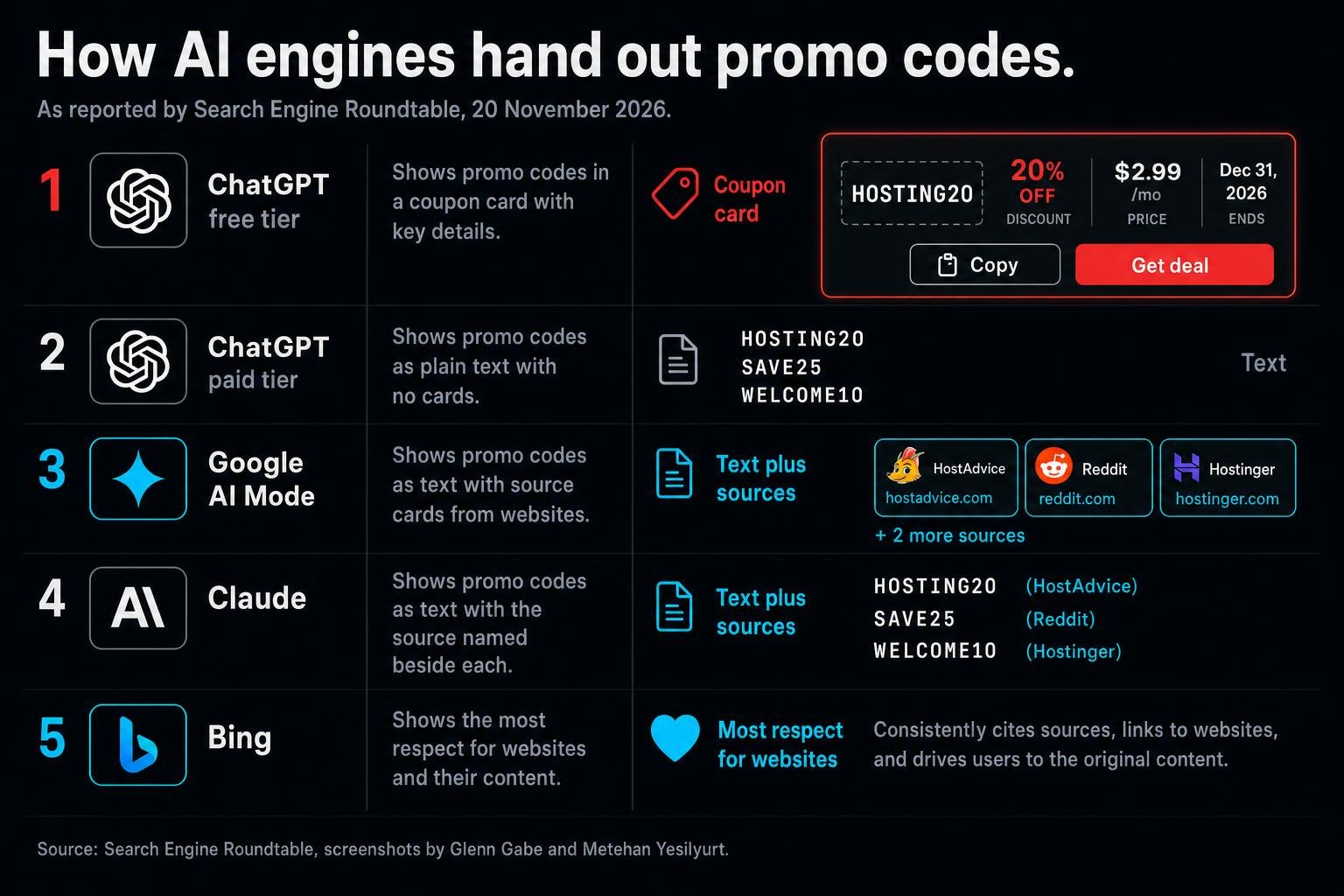
On 20 November, Barry Schwartz at Search Engine Roundtable reported that Google AI Overviews, ChatGPT and other AI engines now return coupon and promo codes inside their answers. The screenshots came from two well-known search analysts, Glenn Gabe and Metehan Yesilyurt, and each engine handles it a little differently:
- ChatGPT (free tier) shows coupon cards: a brand card, the discount and the price, an end date, the code with a "Copy" button, and a "Get deal" button.
- ChatGPT (paid tier) gave the codes as plain text with no cards. (So the free users get the nicer coupon. Somewhere, a pricing team is thinking about that.)
- Google AI Mode listed codes as text next to source cards. In the hosting example those sources were HostAdvice, Reddit and Hostinger.
- Claude listed codes as text and named the source beside each one.
- Bing, according to SER, "showed the most respect for websites."
"This is the first Black Friday where the answer itself is the deal page." Glenn Gabe
The coupon site's business was a toll booth
To see who loses here, you need to know how coupon sites make money. Yesilyurt put it plainly: the affiliate "model is the click: you come for the code, they set the cookie, they earn the commission. If the code is already on the card with a Copy button, why would anyone click?"
Think of a tour guide who earns a cut every time the group walks through the gift shop. The new guide just hands you the souvenir in the parking lot. The souvenir is the same, but the shop never sees you, and the old guide's commission depended on you walking through that door.
For years, coupon pages have been a toll booth on the road between "I want this" and "I bought this." The answer engines built a bypass.
Whose code is it, anyway?
The awkward part for brands is easy to miss. In the ChatGPT example, one of the codes was BLACKFRIDAYREDDIT. According to PPC Land's roundup, it appeared to come from community or affiliate pages, not from the brand itself.
So the AI is not only skipping the coupon site. It may also be choosing which discount represents your brand, based on whatever it found. That might be your official offer, or an affiliate code, or something a stranger posted in a forum thread. It is a bit like a friend who tells everyone at the party your Wi-Fi password: helpful in spirit, but you would like a say in which password it is.
The brands already have a way in
Merchants are not completely shut out. Schwartz noted that merchants already send codes to Google through promotion extensions and structured data (machine-readable labels on a page). Those codes can flow into Search, Shopping, AI Overviews and agentic checkout in AI Mode, where the AI completes the purchase for the shopper. Yesilyurt's advice to brands was just as direct: publish your current codes on an official promotion page.
The logic holds up. If an answer engine is going to quote a discount for you, you want the most obvious, current, authoritative source to be yours, not a stale thread.
A page that is only a means to an end
Another comment from the same news day explains why this was coming. As reported by PPC Land, Google's head of Search, Liz Reid, said on the FOMO Sapiens podcast that interest is falling in pages that only restate surface facts. "People don't want purely AI, they want AI in the web," she said, and her test for a page was whether a human would actually want to read it, "or is it just a means to an end?" She gave no traffic figures.
A coupon page may be the clearest example of a means to an end the web has ever made. Nobody reads one for the prose. You go there for one string of letters and leave as fast as possible. A page like that is exactly what an answer engine can replace with one card and a Copy button.
The bigger point goes beyond coupons. Any page whose only job is to hand over a single fact (a code, a price, a phone number, opening hours) is now competing with the answer itself. The question for a business is no longer only whether people visit that page. It is whether the answer engine pulls that fact from you, from someone else, or from a guess.
What tracking AI citations taught me
I built a measurement harness that runs a fixed set of buyer questions against ChatGPT, Perplexity and Gemini, checks whether a target brand or domain is cited, and tracks that citation rate over time. The biggest lesson was simple. Until you measure it, answer-engine visibility is just opinion, and usually it is the opinion of whoever talks most confidently in the meeting. A baseline and a trend end that argument.
Coupons make the lesson sharper. It is no longer enough to know whether an engine mentions you. You need to know which source it credits and which code it gives out in your name. If I were a merchant this week, I would ask the engines the questions my shoppers actually ask, write down every code and every source they show, and then run the same questions again on a schedule. The first run tells you who is speaking for your discounts. The trend tells you whether publishing an official promotion page is changing that.
If the AI answer already has the deal, which other pages on your website do people visit only because they have no other choice?
One signal a day. No noise.
A 3-minute read when something genuinely shifts in AI, automation, or defense tech. Free, most weekdays.
Free, most weekdays. No spam, unsubscribe anytime.Sources
- Search Engine Roundtable: Google, ChatGPT and AI engines now show coupon codes - https://www.seroundtable.com/google-chatgpt-coupon-codes-42581.html
- PPC Land: Alibaba and Temu cut marketing as AI engines start handing out coupons - https://ppc.land/alibaba-and-temu-cut-marketing-as-ai-engines-start-handing-out-coupons/
Quick answers
Do AI search engines show coupon codes now?
Yes. Search Engine Roundtable reported on 20 November 2026 that Google AI Overviews, ChatGPT and other AI engines return coupon and promo codes directly inside their answers.
How does ChatGPT display coupon codes?
On the free tier, ChatGPT showed coupon cards with the brand, the discount and price, an end date, the code with a Copy button, and a Get deal button. The paid tier gave the codes as text without cards.
Where do AI engines get the coupon codes?
From a mix of sources. Google AI Mode showed source cards such as HostAdvice, Reddit and Hostinger, and one code in a ChatGPT example appeared to come from community or affiliate pages rather than from the brand.
How can brands influence which codes AI engines show?
Merchants can send codes to Google through promotion extensions and structured data, which can flow into Search, Shopping, AI Overviews and agentic checkout in AI Mode. Analyst Metehan Yesilyurt also advises publishing current codes on an official promotion page.
Part of: AI shopping agents · the running scoreboard