The AI Agent's Notes Held the Keys
Cursor's breach report shows how old coding-agent logs, some with pasted API keys in them, became a path to a poisoned extension. The same week, the FBI warned that stolen AI keys now power attack agents.

Every time you paste an API key into a chat with a coding agent so it can "just test the endpoint," that key goes somewhere. On 13 November, Cursor published an incident report that shows where it can end up, and how far it can travel from there.
For anyone running AI agents, I think this is one of the most useful security stories of the year. The breach wasn't huge (Cursor's own numbers suggest it was contained). It matters because the chain is so ordinary. There was no zero-day and no genius. There was a log that held more than anyone thought.
The chain, link by link
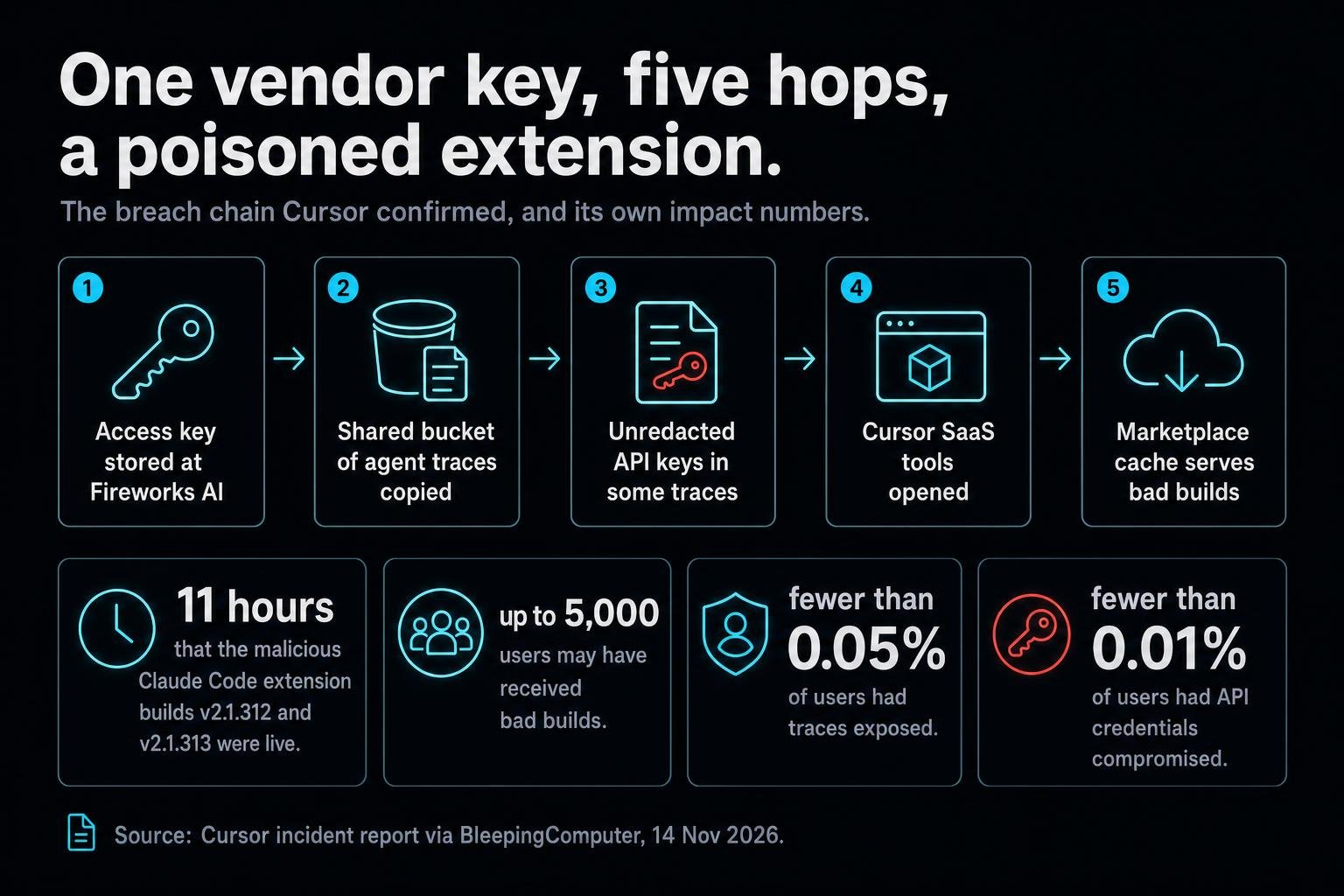
Here is what Cursor confirmed, as reported by BleepingComputer:
- Attackers obtained an access key stored at Fireworks AI, a third-party training and inference provider Cursor used.
- With it, they copied a read-only storage bucket Cursor used to share data with Fireworks. It held historical AI coding-agent traces, mostly from 2025, from users who had not turned on Privacy Mode.
- Some of those traces contained unredacted API credentials.
- Those credentials opened several of Cursor's SaaS tools: archived non-production repos, support emails, usage metrics and contact details, summaries of some agent conversations, and credentials customers had previously shared with Cursor support.
- One stolen credential allowed publishing to the cache that serves Cursor's VS Code extension marketplace. On 29 October, modified copies of Anthropic's Claude Code extension (v2.1.312 and v2.1.313) sat there for about 11 hours.
The tampered code tried to install an attacker SSH key and persistence. Researchers found bugs that likely stopped it on many Windows and macOS machines where SSH was not already on. Cursor says up to 5,000 users may have received the bad builds, fewer than 0.05% of users had traces exposed, and fewer than 0.01% had API credentials compromised. Anthropic's real extension and Open VSX were not compromised. Cursor moved all inference off Fireworks, rotated keys and rebuilt the marketplace.
Agent traces are a junk drawer
Think of an agent trace as the junk drawer in your kitchen. Nobody puts anything valuable in it on purpose. Over months it collects a spare house key, the code to the garage, a receipt with your card number on it. Then one day you hand the whole drawer to a contractor for safekeeping, and the contractor loses their own front-door key.
That is what happened here. The traces were never meant to be a credentials database. They were a record of people working, and people at work paste secrets. That data was then shared with a vendor for training and inference, which is a normal thing to do. Each step was reasonable. Together they made a path from one vendor's key to a malicious build on developer laptops.
A log is never just a log. If someone pasted a secret into it, it is a key ring, and it is only as safe as the weakest lock in every place it gets copied to.
BleepingComputer places this inside a wider wave that Wiz calls "Black October": Railway, Northflank, Lightning AI, OpenCode, Warp, Fireworks itself, and Notion transcripts exposed through Fireworks. Cursor is just the case with the clearest public post-mortem.
Why stolen AI keys matter more now
The same day Cursor's report landed, the FBI published FLASH advisory FLASH-20261113-001 on ARTEX, an autonomous penetration-testing framework. The bureau says threat actors have used it in real intrusions since August 2026. According to GBHackers' summary, ARTEX turns a plain-language objective into commands run by specialised agents. It ships with no model of its own and calls external ones instead. A companion GBHackers piece says operators use stolen LLM API keys to power it.
Read the two stories together. Leaked credentials used to be valuable for the doors they opened. An LLM key is now also valuable as fuel: one person's paid account running another person's attack. The advisory says some intrusions went from first targeting to privileged access in under three hours, and researchers counted more than 1,600 exposed ARTEX consoles in early November.
Among the FBI's recommendations are investigating unexpected LLM API traffic and enforcing least privilege on application consent grants. The first one is new homework for a lot of teams. Most companies watch their cloud bill. Far fewer watch who is spending their model tokens, and on what.
What to take from it
- Treat agent transcripts as sensitive data, not as telemetry. Know where they are stored, who they are shared with, and for how long.
- Know which privacy setting your team actually uses. In Cursor's case, only users without Privacy Mode had their traces exposed. A default is a policy whether you chose it or not.
- Stop pasting long-lived keys into agents. Use scoped, short-lived credentials, and rotate anything that has ever appeared in a chat.
- Guard your model keys like payment cards. Unexpected LLM API traffic is now a named warning sign in an FBI advisory.
None of this is a reason to stop using coding agents. It is a reason to stop assuming that what they remember is harmless.
What a records bridge taught me about leftovers
I once built an automated bridge for a multi-clinician healthcare practice whose records system had no API and a bot-gated login. The bridge had to hold an authenticated session through the bot protection, match each patient's balance to their appointment, and sync the result into the practice's CRM. About 2,800 records went through in one automated run.
The two design rules that mattered most were dull ones: no sensitive data left on disk, and every write to the CRM going through a safety gate. Whatever an automation leaves behind is something someone else can copy later, and whatever it can write without a check is something someone else can misuse.
Cursor's report is that lesson at scale. Asking what an agent can do isn't enough. Also ask what it leaves behind, and who gets a copy. If the honest answer is "transcripts with keys in them, shared with a vendor," fix that before anything else.
One signal a day. No noise.
A 3-minute read when something genuinely shifts in AI, automation, or defense tech. Free, most weekdays.
Free, most weekdays. No spam, unsubscribe anytime.Sources
- BleepingComputer: Cursor confirms security breach led to malicious Claude Code extension - https://www.bleepingcomputer.com/news/security/cursor-confirms-security-breach-led-to-malicious-claude-code-extension
- Cursor: Security incident update - https://cursor.com/blog/security-incident-update
- GBHackers: FBI warns of ARTEX AI framework - https://gbhackers.com/fbi-warns-artex-ai-framework/
- IC3: FBI FLASH advisory FLASH-20261113-001 - https://www.ic3.gov/CSA/2026/261113.pdf
- GBHackers: Hackers use LLM API keys to power ARTEX AI agents - https://gbhackers.com/hackers-llm-api-keys-artex-ai-agents/
Quick answers
What caused the malicious Claude Code extension on Cursor's marketplace?
According to Cursor's incident report, as reported by BleepingComputer, attackers obtained an access key stored at Fireworks AI, copied a bucket of historical coding-agent traces, and used API credentials found in some of those traces to reach Cursor's tools. That included a credential that could publish to the cache serving Cursor's extension marketplace.
How many Cursor users were affected?
Cursor says up to 5,000 users may have received the modified builds, fewer than 0.05% of users had traces exposed, and fewer than 0.01% had API credentials compromised. Anthropic's real extension and Open VSX were not compromised.
What is ARTEX and why does it matter for AI API keys?
ARTEX is an autonomous penetration-testing framework that the FBI says threat actors have used in real intrusions since August 2026. It calls external AI models instead of shipping its own, and GBHackers reports that operators use stolen LLM API keys to power it.
How can teams lower the risk from AI coding-agent traces?
Treat transcripts as sensitive data, check which privacy settings are actually on, avoid pasting long-lived keys into agents, rotate any key that has appeared in a chat, and monitor for unexpected LLM API traffic, which the FBI names in its recommendations.