The Video Call Where Your Friend Was a Recording
The FBI says a North Korean crew stole more than $400 million by replaying victims' own webcam footage to the people who trust them. It works like a flywheel, and the brake is a habit, not a tool.

Picture a video call with someone you have known for years. Their face is on screen. They nod, they look a little distracted, they look like themselves. Then the audio breaks, an error message pops up, and a helpful link offers an update to fix it. You click, because why wouldn't you? It's them.
Except it isn't. The face on screen is a recording, secretly captured from that person's own webcam weeks or months earlier. You are being conned by footage of a friend, and the moment you install that "fix", your webcam starts recording you for the next person on your contact list.
That is the scheme the US government says it has just disrupted. I think it is one of the most important security stories of the year for anyone who runs a company, because it attacks the thing every founder runs on: trust between people who know each other.
What the FBI actually disrupted
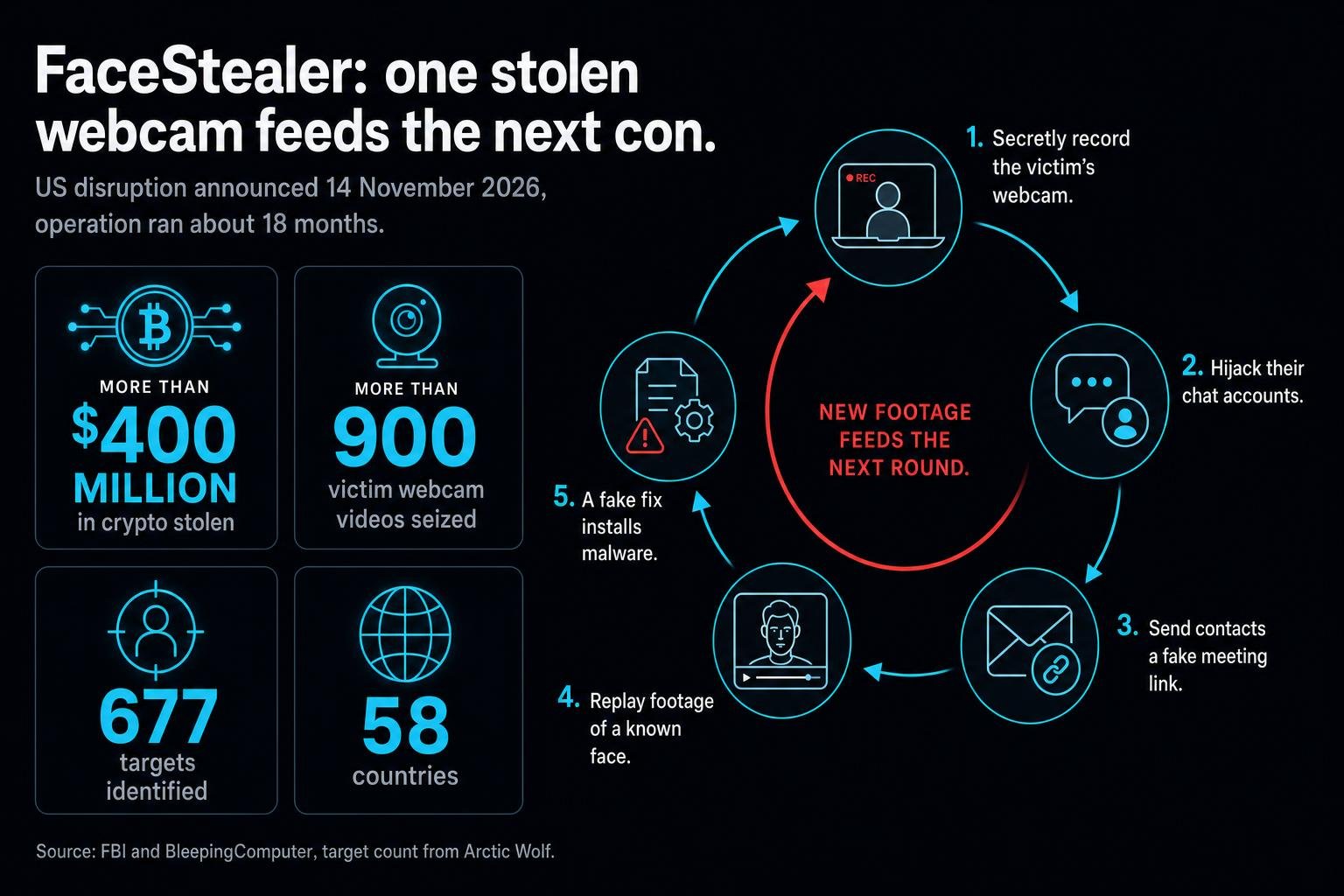
On 14 November, US authorities announced they had disrupted FaceStealer, a North Korean social-engineering operation that ran for about 18 months and stole more than $400 million in cryptocurrency. The FBI attributes it to the group known as BlueNoroff, also tracked as Sapphire Sleet, UNC1069, Stardust Chollima and APT38.
The US seized the group's cloud infrastructure and over 900 webcam videos of victims. Researchers at Arctic Wolf identified 677 targets across 58 countries, with what BleepingComputer describes as a heavy focus on company founders and senior executives.
Separately, the Justice Department said it and private-sector partners froze more than $2.7 billion from the $6.4 billion Binance heist, and obtained court authorisation to seize or restrain more than $1.2 billion of it.
The five-step loop
The FBI lays out the lifecycle in five steps:
- Compromise a victim and secretly record their webcam.
- Hijack their communication accounts. BleepingComputer names Telegram, LinkedIn, Slack and Discord.
- Message the victim's contacts with a convincing fake video-meeting link.
- Lure the new target into an imposter video platform that looks like the real thing.
- Play the recorded footage of the person they know, then stage a technical problem so the target "self-infects" by installing a fake fix.
The malware steals crypto data and credentials for Zoom, Google Meet and Microsoft Teams, along with contacts, messaging apps and webcam videos. Those videos feed the next round.
Why this one is different: it's a flywheel
Most phishing is a fishing net: cast wide, catch a few. FaceStealer is closer to a chain letter that writes itself. Every victim hands the attackers new footage, new accounts and a new address book, and each of those makes the next con more believable than the last. Some meetings reportedly featured recordings of several familiar people at once, which piles on social pressure. It's hard to say "this feels off" when three people you trust seem to be waiting on you.
The scam doesn't fake trust. It borrows yours, records it, and replays it to the people who know you.
Then there is the patience. According to the FBI, attackers sometimes waited months, or more than a year, after the first compromise before acting, likely letting victims' holdings grow. Think of a burglar who copies your house key, then waits for you to buy nicer furniture. By the time anything goes missing, nobody remembers the odd meeting update from last spring.
Founders are the target, and the supply chain is next
The focus on founders and executives makes grim sense. Their faces and names are public, they control money and access, and their week is full of video calls with investors, partners and people they have met once. A slightly glitchy call with a familiar face is just a Tuesday.
The FBI also says the group increasingly targets open-source maintainers to reach the software supply chain. In one attempt, the maintainer of a JavaScript library with tens of millions of weekly downloads was pulled into a fake Teams meeting with several participants, including one the developer knew. It was caught. Other attempts hit npm and Rust crate developers. One maintainer's laptop can be a doorway into millions of installs, which turns a personal scam into everyone's problem.
The fix is a habit, not a tool
The FBI's defensive advice is refreshingly simple:
- Join meetings only through the official app, using an invite code.
- Verify unexpected invitations independently, through a different channel.
- Keep the webcam off unless you need it.
- Never run scripts or installers offered as fixes to a meeting problem.
That last one is the real tell. Legitimate video platforms do not ask you to install something mid-call to hear a colleague. When a meeting turns into a software installation, the meeting is the attack. Leave, rejoin through the app you already have, and confirm with the person some other way.
What I find striking is that none of this needs new technology to stop. The attack is clever because it uses the tools we all trust. The defense is boring because it just means refusing to let those tools hurry us.
What I'd change on a founder's calendar this week
If I were running a startup this week, I'd do three things, in this order.
- Send the whole team one rule. Nobody installs anything, runs a script or downloads a "fix" because a meeting told them to. The call ends, you rejoin through the official app, and that's it.
- Change how calls get joined. Join from the official Zoom, Meet or Teams app with the meeting code, not from a link dropped in Telegram, LinkedIn, Slack or Discord. If an invite arrives out of the blue, even from someone you know well, confirm it on a different channel, like a phone number you already have.
- Look back, not just forward. These attackers sometimes waited more than a year before acting. Ask whether anyone installed an unexpected meeting update or plugin during the 18 months this ran, and have those machines checked properly.
A webcam cover is cheap and worth having. But the habit of refusing a mid-call install is what actually breaks the loop.
One signal a day. No noise.
A 3-minute read when something genuinely shifts in AI, automation, or defense tech. Free, most weekdays.
Free, most weekdays. No spam, unsubscribe anytime.Sources
- BleepingComputer: US disrupts North Korean campaign behind $400 million crypto theft - https://www.bleepingcomputer.com/news/security/us-disrupts-north-korean-campaign-behind-400-million-crypto-theft/
- FBI: FaceStealer cryptocurrency theft scheme - https://www.fbi.gov/investigate/cyber/facestealer-cryptocurrency-theft-scheme
- US Department of Justice: Actions to disrupt North Korea's massive theft of cryptocurrency - http://www.justice.gov/usao-cdca/pr/justice-department-announces-actions-disrupt-north-koreas-massive-theft-cryptocurrency
- FBI IC3: FLASH advisory - https://www.ic3.gov/CSA/2026/261112.pdf
Quick answers
What is FaceStealer?
FaceStealer is the FBI's name for a North Korean social-engineering operation, attributed to the group BlueNoroff, that ran for about 18 months and stole more than $400 million in cryptocurrency by luring targets into fake video meetings that replayed stolen webcam footage of people they knew.
Who did the FaceStealer scam target?
Arctic Wolf researchers identified 677 targets across 58 countries, with a heavy focus on company founders and senior executives. The FBI says the group also increasingly targets open-source maintainers, including npm and Rust crate developers, to reach the software supply chain.
How did victims get infected?
During a fake meeting the attackers staged a technical problem, such as an error message, then offered a link to a fix like an update or installer. Running it installed malware that stole crypto data, video-meeting credentials, contacts and webcam videos.
How can I protect myself from fake video-call scams?
The FBI advises joining meetings only through the official app using an invite code, verifying unexpected invitations through a separate channel, keeping your webcam off unless needed, and never running scripts or installers offered as fixes to a meeting problem.