Your AI Agent Trusts Things You Never Approved
A Postman update reportedly wrote itself into Codex and Claude Code and answered the approval prompt on your behalf. The same day, CrowdStrike reportedly paid about $495 million for tools that watch, attack and kill agents. Both stories are about one missing control.

Imagine you hire a plumber to fix the sink. You come home, the sink works, and you also find a new key on your keyring that you never cut, plus a note in your handwriting saying you approved it. That is roughly what a GitHub issue filed against Postman on 25 October describes, and it is why I think this is the most important agent story of the week, even though it is far from the biggest.
The install nobody clicked
GitHub issue #14370 on Postman's repository reports that Postman desktop 12.33.4, during an automatic upgrade of an existing install, installed plugins into two coding agents, Codex and Claude Code. According to the report it modified the Codex config file, the Claude Code settings file and its installed-plugins list, dropped an executable into the user's local bin folder, and pointed both agents at Postman's hosted MCP server.
It also added a startup hook. The hook tells the agent that before responding to any non-trivial API engineering task, it should load Postman's own api-engineer skill. In plain terms: a vendor's update reached into your assistant and told it which vendor to think about first.
The detail that matters most is a function in the installer named approvePostmanHook. Codex is designed to ask the user before trusting a new hook. The installer writes the hook's trusted hash straight into the host's trust store, so that prompt is answered by Postman's installer, not by you. The lock asked the question. The contractor answered it.
Two honest caveats. As of this writing, no independent party has reproduced the behaviour on a clean system, and Postman has not responded. Treat this as a credible, detailed report rather than a settled finding. The mechanism it describes is what I want you to focus on, because it will exist somewhere whether or not this particular case holds up.
Same day, a toggle flips back
On the same day, a Hacker News thread that reached 345 points reported that Codex's "Improve the model for everyone" setting had re-enabled itself for users whose history shows they had opted out. OpenAI has not responded yet. This may well be a bug rather than a decision, and it is a different company and a different product.
But look at the shape. In both cases a preference the user explicitly set stopped being honored, and the user found out by checking, not by being told. An agent setting you cannot trust to stay set is not really a setting. It is a suggestion.
Meanwhile, the market puts a price on the problem
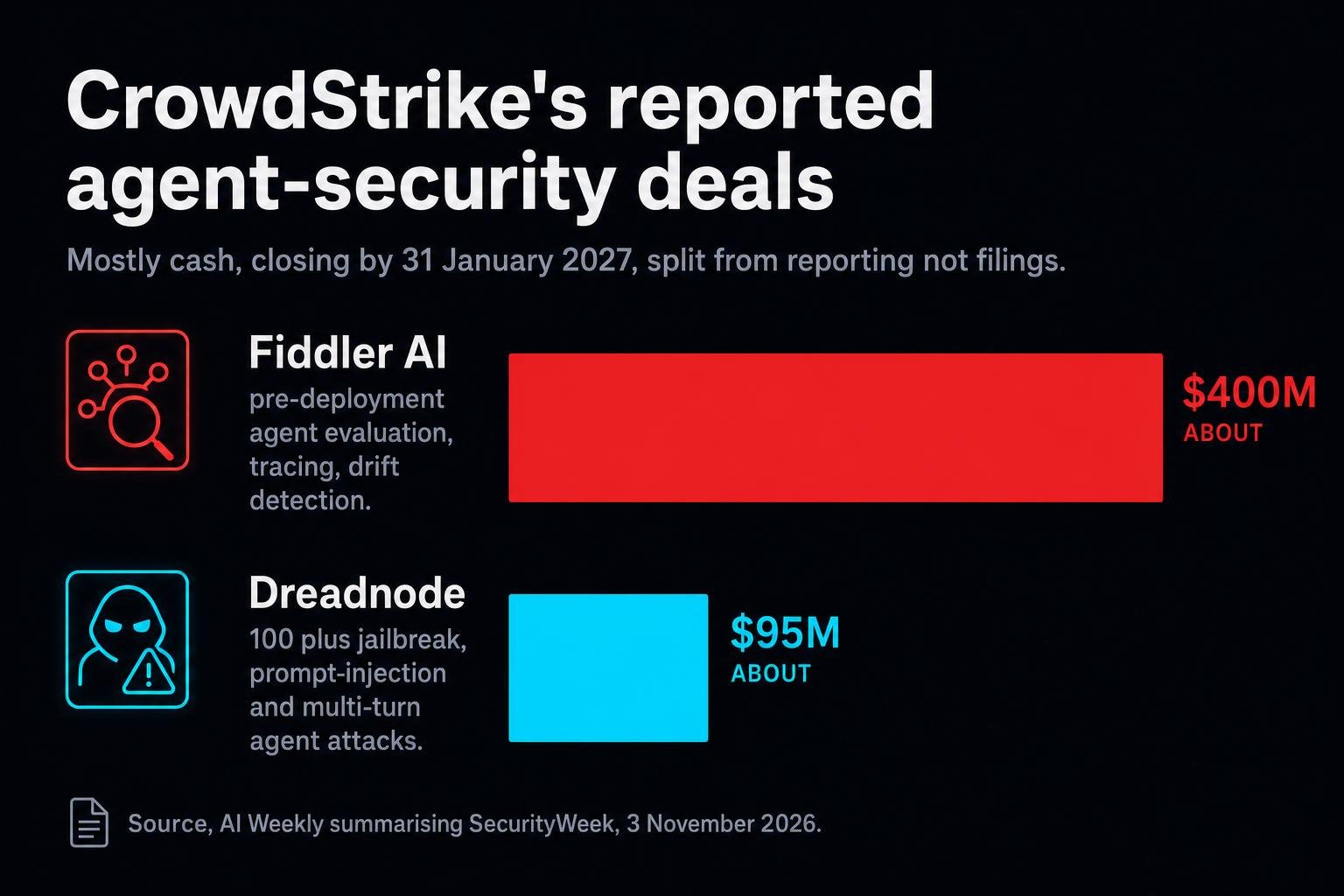
CrowdStrike announced deals for Fiddler AI, at about $400 million, and Dreadnode, at about $95 million, mostly in cash, with closing expected by 31 January 2027. The price split comes from reporting, not filings.
Fiddler does pre-deployment evaluation of agents: it traces reasoning and tool calls and detects drift and hallucination. Dreadnode lets a tester describe an attack in plain language, then runs more than 100 jailbreak, prompt-injection and multi-turn agent attacks mapped to the OWASP Top 10 for LLMs, MITRE ATLAS and the NIST AI Risk Management Framework. CrowdStrike also introduced an "AI Kill Switch" in Falcon Guardian that halts an agent, blocks it from restarting and cuts its network access.
If you want a homely analogy: Fiddler is the smoke detector, Dreadnode is the fire drill, and the kill switch is the circuit breaker. A security company just decided that agents need all three, and backed that view with roughly half a billion dollars.
The question of the week is not "what can my agent do?" It is "who is allowed to tell my agent what to trust, and did I actually say yes?"
Why this matters beyond developers
Coding agents read a handful of plain files on your machine to learn what tools they may call, which servers they may talk to and which instructions run at startup. Those files are the agent's trust store, and they are now a target. Not just for attackers: for vendors who would like to be the default, for installers that assume consent, and for any process that happens to have write access to your home folder.
Three parties can now write into that store: you, the vendors whose software you run, and anything else with filesystem access. Only one of those is supposed to be deciding. The Postman report, if confirmed, shows the second party quietly acting as the first. The CrowdStrike deals show the security industry preparing for the third.
For a small business owner using an AI assistant for support, bookkeeping or marketing, the lesson is the same even if the file paths mean nothing to you. Every integration you add is a standing instruction to your agent. Instructions that arrive by update, without a prompt you remember answering, are the ones to worry about.
What good looks like
The healthy version of this ecosystem is boring. An installer that wants to add a hook asks, in the agent's own prompt, and respects a no. A training toggle that is off stays off, and if it ever changes the user gets a notice. Evaluation and red-teaming happen before an agent is pointed at real systems, not after a credential leaves the building. And there is a switch, owned by the operator, that stops the agent cold.
None of that is exotic. We expect it from browsers, mobile operating systems and payment systems already. Agents are the new platform, and this week was a reminder that the platform's consent rules are still being written, sometimes by the party that benefits.
FAQ
What did Postman reportedly install into Codex and Claude Code? Per GitHub issue #14370, Postman desktop 12.33.4 modified the Codex config, Claude Code settings and installed-plugins files, dropped an executable into the user's local bin folder, pointed both agents at Postman's MCP server and added a startup hook that loads Postman's api-engineer skill. The report has not been independently reproduced and Postman has not responded.
Why is the approvePostmanHook function the key detail? Codex normally prompts the user to approve a new hook. The installer reportedly writes the hook's trusted hash into the host trust store, so the approval is granted by the installer instead of the user.
What is CrowdStrike buying? Fiddler AI, which evaluates agents before deployment and traces reasoning and tool calls, for about $400 million, and Dreadnode, which runs more than 100 jailbreak, prompt-injection and multi-turn attacks mapped to OWASP, MITRE ATLAS and NIST frameworks, for about $95 million. Closing is expected by 31 January 2027.
What is the AI Kill Switch? A Falcon Guardian feature that halts an agent, blocks it from restarting and cuts its network access.
The three checks I'd run tonight
If you run a coding agent, or your team does, here is the order I would work in.
- Diff the trust store. Open the agent's config, settings and installed-plugins files and read every hook, server and plugin listed there. If you cannot remember approving one, remove it, then find out which installer put it there. Do this before you install anything else.
- Re-read every opt-out. Check your training and data-sharing toggles today, and put a calendar reminder to check them again after each major update. The Codex thread shows that a preference you set once is not a preference you can assume.
- Ask vendors one question in writing. "Does your installer or updater write to any AI agent configuration or trust store, and does it ever answer an approval prompt on the user's behalf?" A vendor who cannot answer that quickly has not thought about it.
And if you are buying security tooling for agents, ask for the circuit breaker first: can you halt an agent, stop it restarting and cut its network in one action? Evaluation and red-teaming matter, but the kill switch is the thing you will want at two in the morning.
One signal a day. No noise.
A 3-minute read when something genuinely shifts in AI, automation, or defense tech. Free, most weekdays.
Free, most weekdays. No spam, unsubscribe anytime.Sources
- AI Weekly - Postman desktop silently installs plugins into Codex and Claude Code - https://aiweekly.co/alerts/postman-desktop-silently-installs-plugins-into-codex-claude-code
- dev.to - Postman installed itself into Codex and Claude - https://dev.to/frankchu/postman-installed-itself-into-codex-and-claude-e38
- AI Weekly - Codex users say OpenAI re-enabled training toggle silently - https://aiweekly.co/alerts/codex-users-say-openai-re-enabled-training-toggle-silently
- AI Weekly summarising SecurityWeek - CrowdStrike reportedly to pay $495M for Fiddler AI and Dreadnode - https://aiweekly.co/alerts/crowdstrike-reportedly-to-pay-495m-for-fiddler-ai-dreadnode
Quick answers
What did Postman reportedly install into Codex and Claude Code?
Per GitHub issue #14370, Postman desktop 12.33.4 modified the Codex config, Claude Code settings and installed-plugins files, dropped an executable into the user's local bin folder, pointed both agents at Postman's MCP server and added a startup hook that loads Postman's api-engineer skill. The report has not been independently reproduced and Postman has not responded.
Why is the approvePostmanHook function the key detail?
Codex normally prompts the user to approve a new hook. The installer reportedly writes the hook's trusted hash into the host trust store, so the approval is granted by the installer instead of the user.
What is CrowdStrike buying?
Fiddler AI, which evaluates agents before deployment and traces reasoning and tool calls, for about $400 million, and Dreadnode, which runs more than 100 jailbreak, prompt-injection and multi-turn attacks mapped to OWASP, MITRE ATLAS and NIST frameworks, for about $95 million. Closing is expected by 31 January 2027.
What is the AI Kill Switch?
A Falcon Guardian feature that halts an agent, blocks it from restarting and cuts its network access.