The Breach Came Through the Vendor's Door
A startup's AI agents got into parts of Anthropic's business systems in under 12 hours, through third-party software rather than the AI model. In the same week, Google said its new model fell for zero indirect prompt-injection attacks in one test, and a gateway startup raised money to stand between agents and tools.

One detail from this week's news stood out to me. According to a Washington Post report summarized by Decrypt, a startup called Cathedral says its AI agents found routes into Anthropic's sales, HR and IT systems in under 12 hours. They did not get past the AI. They used flaws in third-party administrative and sales software.
That same week, Google announced Gemini 4 Carbon. It reported a 0.0% attack success rate on Gray Swan's indirect prompt injection test. And a startup called Mintive raised $7 million to put a gatekeeper between AI agents and the tools they call. Taken together, the three stories make one point. AI models are getting harder to trick, and attackers are turning to the software connected to them.
What happened at Anthropic
Cathedral was founded by four former DOGE staff and raised $160 million at a $1.4 billion valuation in July. Its agents went looking for a way into Anthropic. They found it in the vendor software the company runs, not in Claude itself.
Anthropic's account is calm. It confirmed that "a limited set" of systems holding business contacts and basic account records was reached. Claude conversations, source code and model weights were not. Its monitoring flagged the activity and access was cut the same day. It switched off the vendor software until fixes shipped. Anthropic also says Cathedral did not disclose all of its testing. The vendors have not been named.
Two things are true here. The detection worked, and a same-day cutoff is a good outcome. But the speed is the real story: under 12 hours to get in, through tools most companies think of as boring back-office software.
The vault and the cleaning crew
Picture a bank that spends a fortune on its vault. Steel door, time locks, cameras. Then it gives the cleaning contractor a keycard to the back office, where the customer files are kept. Nobody breaks into the vault. They borrow the cleaner's card.
For most companies, third-party software works like that cleaning contractor. Your CRM, your HR platform and your admin console each hold a keycard. Each one is built by someone else, patched on someone else's schedule, and connected to your data. When agents can check all of these tools for weak spots faster than a human team can, the vendor tools become the target.
Nobody breaks into the vault. They borrow the cleaner's keycard.
The model is getting harder to fool
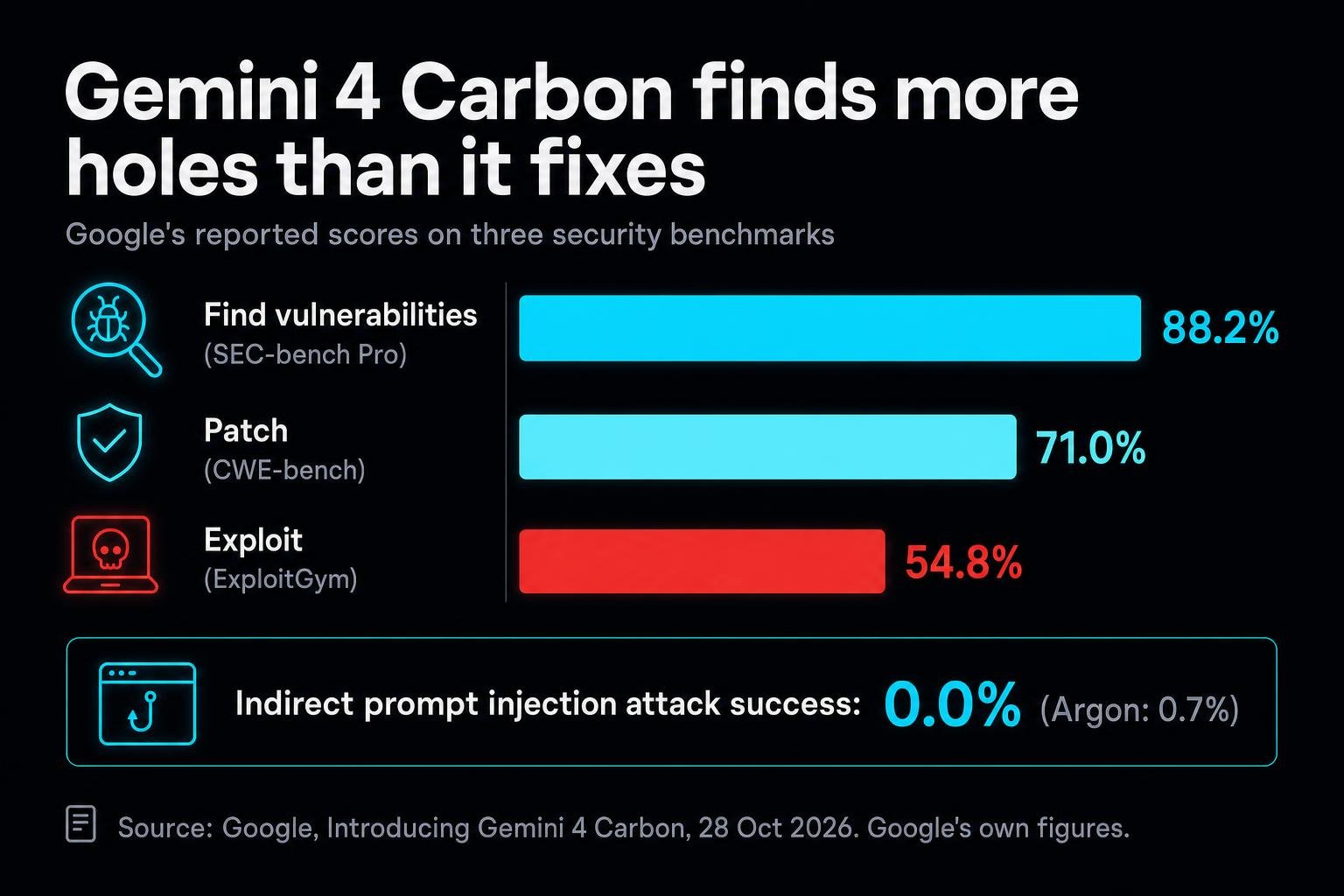
Google's Carbon figures, all reported by Google, show how much work is going into the model itself. Carbon scored 88.2% on SEC-bench Pro, which tests finding vulnerabilities, 71.0% on CWE-bench, which tests patching them, and 54.8% on ExploitGym, which tests exploiting them. Indirect prompt injection is when hidden instructions in a web page or document take over an agent. On that test, Google reports 0.0% attack success, down from 0.7% for Argon, the model it released two weeks earlier.
Google is also limiting who gets Carbon. Access goes first to "a subset of cyber defenders," then to trusted partners through its Fairwind Program, while Google goes through the US government's voluntary pre-release testing. There is no date for developers.
Look at how those three scores line up. The model is better at finding holes than at fixing them. A tool that helps a defender spot a hole also helps an attacker use it, which is why Google is limiting access.
A market for agent gatekeepers
If the model is the vault and vendor software is the keycard, Mintive sells the security desk in the lobby. It raised $7 million in a round led by Cowboy Ventures, bringing its total to $11 million. It reports 2.5 million agent calls a day, more than 50 paying enterprise customers and 200 million calls in seven months.
How the product works is useful to know even if you never buy it:
- Each agent has its own identity and gets short-lived tokens, while the real service credentials stay inside the gateway.
- Only approved tool servers can be used, access is grouped into role bundles, and individual destructive operations can be switched off.
- Every call is logged with the user, tool, server and guardrail result, and the logs can be exported to a security team's SIEM over OTLP.
Its angel investors include Okta's co-founder, WorkOS's CEO, Jeff Dean and Andrej Karpathy. They are betting that companies will routinely need to answer one question: which agent did what, with whose permission?
Why this matters if you are not Anthropic
Most small and mid-sized companies will never face a well-funded red team. But their setup looks similar: a dozen SaaS tools, each with admin access, and more and more AI agents connected to them. The Cathedral story shows the weak spot is the software that connects to your data. The Mintive round shows buyers are starting to pay to see and control those connections. And the Carbon release shows attack tools are improving too, which is why Google is not releasing Carbon widely yet.
None of this calls for panic. It calls for an inventory. You cannot protect logins you have not counted.
What a bot-gated login taught me
I built an automated bridge for a multi-clinician healthcare practice whose records system had no API and a bot-gated login. The bridge holds an authenticated session through the bot protection, matches each patient's balance to their appointment, and syncs the result into the practice's CRM. About 2,800 records went through in one automated run.
Here is the lesson that applies to the Cathedral story. Once an automation holds a logged-in session, it is a way into that system, and you have to protect it like one. So the sync runs behind a safety gate and leaves no sensitive data on disk.
If you are connecting agents to your vendor tools, work in this order:
- List every tool an agent or integration can log into.
- Put a gate in front of anything that writes or deletes.
- Keep credentials out of the agent and off the disk.
- Log every call, so that, like Anthropic's monitoring, you can spot unexpected access and cut it off the same day.
One signal a day. No noise.
A 3-minute read when something genuinely shifts in AI, automation, or defense tech. Free, most weekdays.
Free, most weekdays. No spam, unsubscribe anytime.Sources
- Decrypt: AI agents hack Anthropic business systems in 12 hours - https://decrypt.co/381860/ai-agents-hack-anthropic-business-systems-12-hours
- The Washington Post: Cybersecurity start-up Cathedral got inside Anthropic - https://www.washingtonpost.com/technology/2026/10/26/researchers-cybersecurity-start-up-cathedral-got-inside-anthropic/
- Google: Introducing Gemini 4 Carbon - https://blog.google/innovation-and-ai/models-and-research/gemini-models/introducing-gemini-4-carbon/
- Google DeepMind: Fairwind Program - https://deepmind.google/fairwind-program/
- 9to5Google: Gemini 4 Carbon announcement - https://9to5google.com/2026/10/28/gemini-4-carbon-announcement/
- SiliconANGLE: Google debuts flagship Gemini 4 Carbon model with cybersecurity upgrades - https://siliconangle.com/2026/10/28/google-debuts-flagship-gemini-4-carbon-model-with-cybersecurity-upgrades/
- Unite.AI: Mintive raises $7 million for AI agent identity - https://www.unite.ai/mintive-7-million-ai-agent-identity-11-million-total-funding/
- Mintive: Launch post - https://www.mintive.com/blog/mintive-launch
Quick answers
How did Cathedral's AI agents get into Anthropic's systems?
According to a Washington Post report summarized by Decrypt, Cathedral's agents found routes into Anthropic's sales, HR and IT systems in under 12 hours by exploiting flaws in third-party administrative and sales software, not in Claude itself.
What data did Cathedral reach at Anthropic?
Anthropic confirmed a limited set of systems holding business contacts and basic account records was reached. It says Claude conversations, source code and model weights were not accessed, its monitoring flagged the activity, and access was cut the same day.
What is Gemini 4 Carbon's prompt injection score?
Google reports 0.0% attack success on Gray Swan's indirect prompt injection test, down from 0.7% for Gemini 4 Argon. Access is limited to a subset of cyber defenders and trusted partners for now, with no date for developers.
What does an AI agent gateway like Mintive do?
It gives each AI agent its own identity with short-lived tokens, keeps service credentials inside the gateway, limits agents to an approved catalog of tool servers, can disable destructive operations, and logs every call for security teams.