Your Code Was Clean. You Still Got Robbed.
Three Shopify apps hijacked checkouts this month without a single changed file, and Node.js patched a bug that fires on an ordinary fetch. The danger lives in the places nobody is checking.

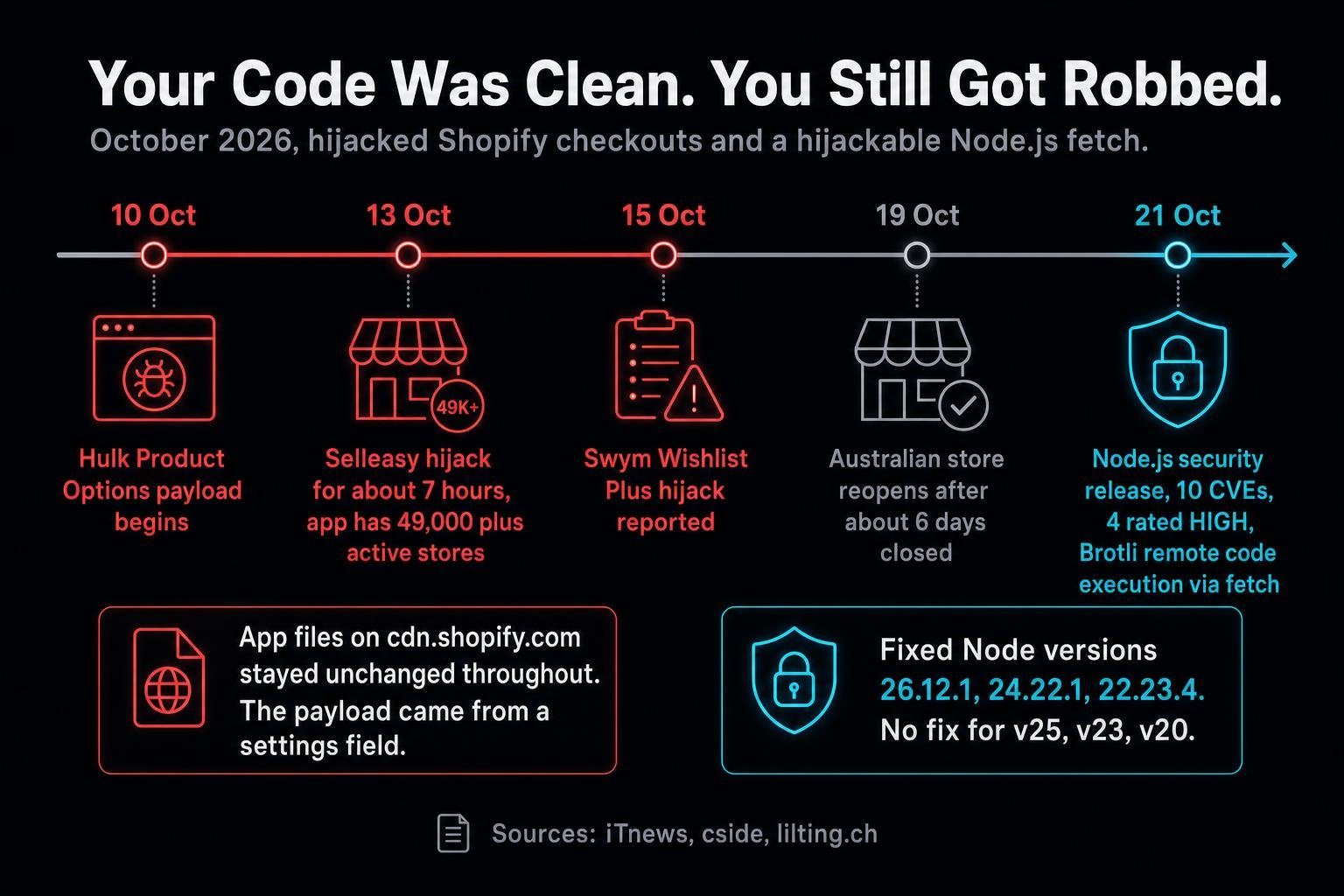
Picture a bank that inspects every brick in its vault each morning. Every brick is in place. Every bolt is tight. Meanwhile, a thief walks up to the counter with a forged note, and the teller hands over the cash. The vault was never touched. That is roughly what happened to Shopify merchants in October, and a cousin of the same problem turned up in Node.js a week later.
The thread connecting them is simple and a little unnerving: the thing you verify is not the thing that fails.
Three apps, zero changed files
Between 10 and 15 October, three popular Shopify apps started doing something their developers never wrote. Hulk Product Options (from HulkApps) began on 10 October. Selleasy (from Logbase) followed on 13 October, for a window of about seven hours. Swym Wishlist Plus was reported on 15 October. In each case a script grabbed the shopper's click on the Checkout button and sent them to a lookalike payment page on a domain such as biliing[.]top.
Here is the part that should make every store owner sit up. The app files hosted on Shopify's CDN were unchanged. Anyone comparing hashes, checking subresource integrity, or diffing the code would have seen nothing wrong. The malicious payload arrived as data, returned by the vendor's own API inside a settings field meant for custom JavaScript, and was injected into the page at runtime. The vault was fine. The note at the counter was forged.
Built to stay invisible
The attack was tuned to avoid detection. It fired once per browser session, only on a genuine Checkout click. After stealing the card details, it forwarded the shopper to the real Shopify checkout, where the order completed normally. Revenue dashboards showed nothing unusual. A merchant who noticed something odd and tried again in the same browser session saw a clean checkout. The only trace was a session-storage key beginning with the characters __ctf_.
The scale is unclear. Logbase says Selleasy has more than 49,000 active stores but has not said how many were hit. Security vendor cside, which has a commercial interest in script monitoring, says similar incidents hit Qikify in July and Hextom in August. One Australian store was told by Shopify to stay closed for about six days after the vendor removed the code, and reopened on 19 October.
This matters beyond the stores involved. Since January 2025, merchants on the simplest PCI self-assessment tier have had to confirm their site is not susceptible to script attacks. "Shopify is PCI compliant" does not cover a third-party app serving a hostile script through its own settings, because Shopify's checkout was never the thing that broke.
Node.js: the bug that answers your call
On 21 October, Node.js shipped a security release covering ten CVEs, four rated HIGH, across the 26.x, 24.x and 22.x lines. The fixed versions are 26.12.1, 24.22.1 and 22.23.4. End-of-life lines (v25, v23 and v20) get no fix at all.
The headline bug, CVE-2026-111497, is an out-of-bounds write in the bundled Brotli decompressor, described as possible remote code execution. What makes it nasty is the trigger. Node's built-in fetch automatically decompresses any response that arrives with Brotli encoding. So your server does not need to be attacked. It just needs to make a request to a server that answers in Brotli. Telling the remote end you only accept plain responses does not help, because a malicious server can reply compressed anyway.
Think of it less as a burglar and more as a parcel bomb. You placed the order. The attacker only had to be the one who packed the box. A 24 October update to the write-up gave the bug a nickname, HTTP2Shell, because the author found the same decoder issue in Python Brotli packages and in the curl bundled with Git for Windows. The release also fixed two TLS hostname-verification bypasses, a NUL-byte truncation in DNS resolution, and started rejecting certificate chains that pass through the compromised eMudhra intermediates.
The pattern underneath
What you check (files, hashes, dashboards) is not where the failure lives (settings, transport, the response you asked for).
The Shopify attack beat file integrity checks because the payload was never in a file. The Node bug beats firewall thinking because the dangerous traffic is a reply to a request your own code made. Both are failures of the map, not the territory. We audit the surfaces that are easy to audit and assume the rest follows.
Every agent, webhook worker and scraper written in Node reaches out to third-party URLs all day. Every Shopify store with a handful of apps installed has a handful of settings fields that may accept arbitrary script. Those are the counters where the forged notes get passed.
What to actually do
- If you run a Shopify store: list every app that accepts custom JavaScript or HTML in its settings. Then open a fresh private browser window, click Checkout on desktop and on a phone, and watch the address bar. A retest in the same session proves nothing. Look for session-storage keys starting with __ctf_.
- If you run Node services: check the version on every service and move to 24.22.1 or 22.23.4 (or 26.12.1). Container images built from floating tags keep the old runtime until you rebuild, so pull and rebuild, then pin the version. If you are on v20, v23 or v25, you are unpatched by definition.
- If you run Python or Windows tooling: the same decoder bug reportedly reaches Python Brotli packages and Git for Windows' bundled curl, so watch for advisories there too.
None of this is exotic. It is the discipline of asking, before every peak season and after every security release, "where could this fail that my current checks would never see?" The answer, this month, was the settings panel and the response body. Next month it will be somewhere else just as boring.
One signal a day. No noise.
A 3-minute read when something genuinely shifts in AI, automation, or defense tech. Free, most weekdays.
Free, most weekdays. No spam, unsubscribe anytime.Sources
- iTnews - Shopify tells Australian store to stay shut after hijacked extensions divert shoppers - https://www.itnews.com.au/news/shopify-tells-australian-store-to-stay-shut-after-hijacked-extensions-divert-shoppers-629693
- cside - HulkApps Shopify checkout hijack - https://cside.com/blog/hulkapps-shopify-checkout-hijack
- lilting.ch - Node.js TLS, DNS and Brotli security release - https://lilting.ch/en/articles/nodejs-tls-dns-brotli-security-release
- Node.js - October 2026 security releases - https://nodejs.org/en/blog/vulnerability/october-2026-security-releases
Quick answers
How did the Shopify checkout hijack work if the app code was not changed?
The malicious JavaScript was not in the app's files. It was returned by the app vendor's API as data inside a custom JavaScript settings field and injected into the storefront at runtime. File hashes and subresource integrity checks saw nothing because the files on Shopify's CDN were unchanged.
Which Shopify apps were affected?
Hulk Product Options from HulkApps (from 10 October), Selleasy from Logbase (13 October, about seven hours), and Swym Wishlist Plus (reported 15 October). Security vendor cside says Qikify and Hextom had similar incidents in July and August.
How can a store owner tell if their checkout was hijacked?
Open a fresh private browser window, click Checkout on desktop and on a phone, and watch where the address bar goes. The script fired once per session and then forwarded to the real checkout, so a retest in the same session looks clean. A session-storage key starting with __ctf_ is a known indicator.
Why is the Node.js Brotli bug dangerous even for servers that are not exposed to the internet?
CVE-2026-111497 triggers when Node's fetch decompresses a Brotli-encoded response. Any outbound request to a server the attacker controls can deliver it, and asking for an uncompressed response does not prevent a hostile server from replying in Brotli. Fixed versions are 26.12.1, 24.22.1 and 22.23.4; v25, v23 and v20 receive no fix.