The Model Is Rented. The Playbook Is Yours.
Google's biggest model is being rationed and its predecessor was scrapped for a "very short shelf life." Meanwhile an SEO consultant and a finance-software vendor are both selling the same thing: the work, written down.

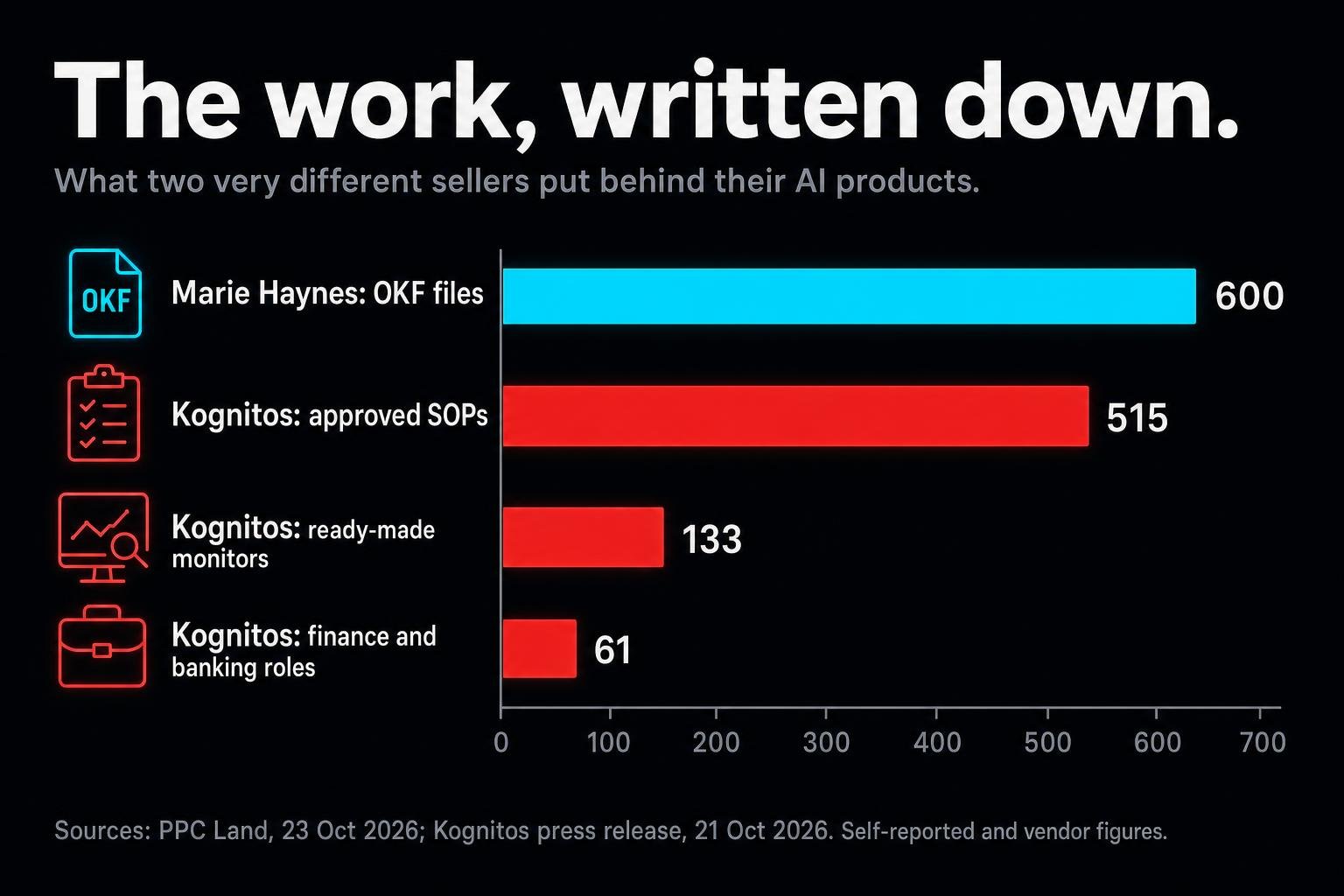
Three stories landed this week that look unrelated. One is about a frontier model being rationed. One is about an SEO consultant who stopped selling her hours. One is about a software company that sells "AI employees" and insists they never improvise. Put them side by side and they say the same thing: the model is the part you rent, and the written-down way you do the work is the part you own.
The model has a shelf life now
Sundar Pichai sat for the Sources podcast on 21 Oct, and PPC Land pulled out the numbers. Gemini 4 Argon processed almost 25 trillion tokens in its first 72 hours, roughly three times what Gemini 3.0 did. Google is, in Pichai's words, "capacity constrained." Consumer access is limited to paid tiers, and smaller distilled versions are coming with no date attached.
The detail that stuck with me: Gemini 3.5 Pro was dropped. It had a "very short shelf life," so Google folded the lessons into Argon instead of shipping it. Pichai also said he expects "the next 12 months to see continued acceleration because of RSI," meaning models already suggest training recipes and evaluate checkpoints, with humans in the loop.
Read that as a builder and it is unsettling. If you tuned everything to one model, the thing you tuned for can be throttled, repriced, or quietly retired. Capacity is a supply problem now, and releases are arriving faster than most teams can re-test their prompts.
A consultant who sells access, not files
Marie Haynes is an SEO consultant known for traffic-drop and helpfulness audits, the kind of reports she says she used to bill at "high five figures." This week, per PPC Land and her own 44-minute video, she showed what she built instead.
She broke her writing into about 600 files in Google's Open Knowledge Format: markdown with YAML frontmatter, an index file per folder, blog posts split into concepts, playbooks and entities, each file marked public or private, one folder per client. She connected that to Gemini 4 Argon and to her own MCP server that lists Google algorithm updates. The system drafts the report. She corrects it, runs a /learn command to record the correction, and the lesson goes back into the files.
Orders run through Stripe and an intake form. She says it "made its first $$$ this week." Her quoted running cost is $5 to $6 a day of heavy use, pennies per query, nothing for storage. Those figures are hers alone and nobody has audited them, so treat them as a sketch rather than a benchmark.
"Don't sell your knowledge bundles... sell access to your bundles."
That line is the whole business model. The files never leave her. What a customer buys is a report produced by her playbook, her calendar of changes, and her accumulated corrections, with a fresh model doing the typing.
A vendor that sells procedures and promises no improvising
Kognitos announced "AI Employees" on 21 Oct: 61 finance and banking roles, from AP Specialist to KYC Analyst, backed by 515 standard operating procedures. It is in preview for existing customers only, and every claim here is the vendor's own.
The design is the interesting part. Each role has a job description, approved SOPs, limits on what it may do without sign-off, and handoff rules. A deterministic engine runs each SOP, and the language model only reads documents and requests. In the company's words: "AI Employees never add a step that isn't in the approved SOP." When a case falls outside the procedure, the run pauses and asks a person. That answer becomes standing guidance only after an approver signs it off. A builder agent called Quill studies a customer's systems and recent transactions and drafts new SOPs, and nothing publishes until a human approves.
There are also 133 ready-made monitors, questions like "Are we paying any vendor twice?", that run as continuous controls.
Whether it performs as described is unverified. But look at what is actually for sale. Not intelligence. A role, a written procedure, a stop-and-ask rule, and a log an auditor can replay.
The recipe binder outlives the chef
Here is the analogy I keep coming back to. A restaurant can lose its head chef and survive, as long as the recipe binder stays in the kitchen. Lose the binder and the best chef in the city is improvising on your reputation.
Frontier models are the chefs now. They are brilliant, expensive, in short supply, and they rotate. Argon is rationed. Its predecessor never shipped. Haynes and Kognitos, from opposite ends of the market, both decided the binder is the business. One is a solo consultant with 600 markdown files. The other is an enterprise vendor with 515 SOPs. Same bet.
The second analogy is an airline checklist. Pilots are highly skilled, and they still read the card aloud, because the card is where the organisation's hard-won lessons live. Haynes's /learn loop and Kognitos's approval gate are both checklists that get a line added every time something goes wrong.
What this means if you do knowledge work
- Write it down in a form a machine can read. Markdown with metadata is enough. That is all the Open Knowledge Format is.
- Keep a change log. Haynes's edge is not the model. It is a tool that knows when Google's algorithm moved. Every field has its own calendar of changes.
- Sell access, not exports. The moment the files leave, so does the business.
- Build the stop-and-ask rule in. Pausing outside the procedure and letting a person decide is exactly what regulated buyers are asking for.
- Assume the model underneath will change. Keep the tests and the playbook. Swap the engine.
I find this genuinely exciting. For years the advice was to pick the best model. This week two very different operators showed that the durable asset is the part only you could have written.
One signal a day. No noise.
A 3-minute read when something genuinely shifts in AI, automation, or defense tech. Free, most weekdays.
Free, most weekdays. No spam, unsubscribe anytime.Sources
- PPC Land - Marie Haynes turns 600 OKF files into paid SEO audits on Gemini 4 Argon - https://ppc.land/marie-haynes-turns-600-okf-files-into-paid-seo-audits-on-gemini-4-argon/
- Marie Haynes - Video walkthrough of the OKF audit system - https://www.youtube.com/watch?v=VPIZ0LrHVBk
- Kognitos - Kognitos launches AI Employees and Context Graphs for finance and banking - https://www.kognitos.com/news/kognitos-launches-ai-employees-context-graphs-finance-banking/
- PPC Land - Gemini 4 Argon's 25 trillion tokens in 72 hours leave Google short of compute - https://ppc.land/gemini-4-argons-25-trillion-tokens-in-72-hours-leave-google-short-of-compute/
- Sources podcast - Sundar Pichai interview - https://www.youtube.com/watch?v=fJBSNEFdm8c
Quick answers
What is Google's Open Knowledge Format?
A way of storing knowledge as markdown files with YAML frontmatter and an index.md per folder. Marie Haynes uses it to split her writing into concepts, playbooks and entities, with public or private visibility per file and one folder per client.
What does Kognitos mean by an AI employee?
A named role (such as AP Specialist or KYC Analyst) with a job description, approved SOPs, limits on what it may do without approval, and handoff rules. A deterministic engine runs each SOP and the model only reads documents. Outside the SOP it pauses and asks a person. It is in preview for existing customers and the claims are the vendor's.
Why did Google drop Gemini 3.5 Pro?
Sundar Pichai said it had a very short shelf life, so Google applied the lessons to Gemini 4 Argon instead of shipping it. Argon processed almost 25 trillion tokens in its first 72 hours and Google says it is capacity constrained.
How much does it cost to run a knowledge-bundle service like Marie Haynes's?
Her own figures are $5 to $6 a day of heavy use, pennies per query and nothing for storage. These are self-reported and have not been independently checked.