Shopify Will Sell You Distribution, Not Software
Shopify's agentic storefronts put catalogs inside ChatGPT, Google, Copilot and Meta, and the new Agentic plan means you no longer have to be on Shopify to get there. The distribution layer just came unbundled from the platform.

For the last two years, every conversation about selling through AI assistants came with a tax attached. The tax was replatforming. If you wanted your products to show up when someone asked a chatbot for a recommendation, the practical answer was usually "get on the platform that has already wired this up." For a brand running on SAP, a custom ERP, or fifteen years of accumulated internal plumbing, that is not a marketing decision. That is an eighteen month project with a steering committee.
Shopify just removed the tax. Not by making replatforming easier, but by deciding it is optional.
What actually shipped
Shopify's own Help Center documentation for agentic storefronts is more useful than most of the coverage of it, so here is what it says. Agentic storefronts is active by default for eligible stores. The channels are ChatGPT, Google AI Mode and Gemini, Microsoft Copilot, and Meta. Products reach those surfaces through Shopify Catalog, or through the Google & YouTube sales channel and Google Merchant Center for the Google properties. You manage which channels are live under Sales channels, then Agentic, in the admin. Using it means agreeing to a separate set of supplemental terms.
Orders that arrive from AI channels show up in the Shopify admin with channel or referrer attribution, and the merchant keeps the customer relationship and the post-purchase experience. That last detail is the one people skip, and it is the one that makes the whole thing tolerable. You are not handing the customer to the assistant.
The channels are not the same shop
This is the part worth internalising, because it changes what you can measure and when.
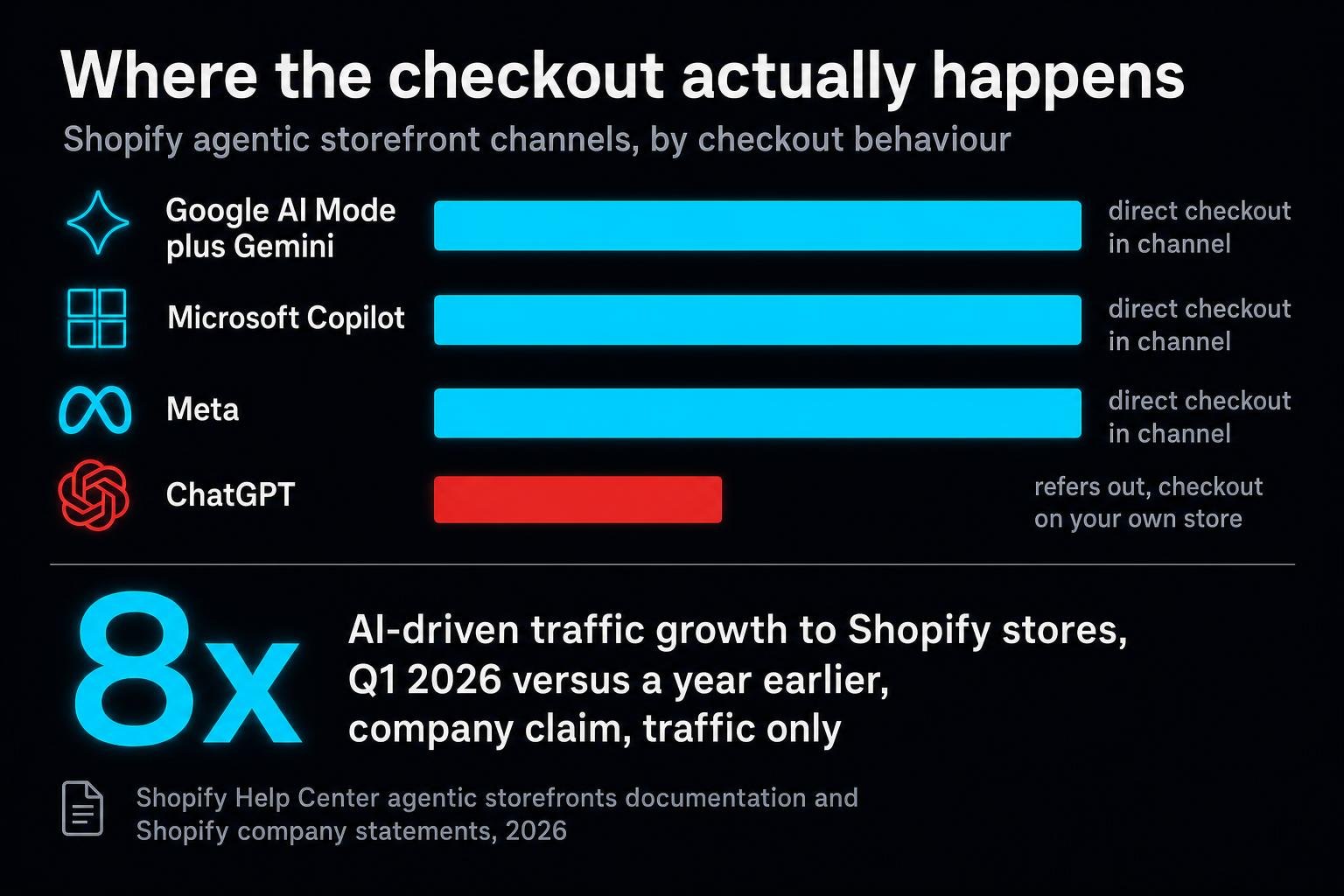
ChatGPT behaves as a discovery referrer. The assistant surfaces your product, and the customer completes checkout on your own store, either in a ChatGPT in-app browser or a new tab. Google, Copilot and Meta support Shopify-powered direct checkout inside the channel, if direct checkout has been activated.
Think of it as the difference between a flyer and a mall. ChatGPT hands the shopper a flyer with your address on it and points them down the street. Google, Copilot and Meta let the shopper pay at the mall's own till, while the goods still come out of your stockroom and the customer stays yours.
Practically, that means ChatGPT traffic is already visible in ordinary analytics as a referrer. No setup, no integration, no new dashboard. If you want a cheap first read on whether any of this is real for your catalog, that is where it is hiding right now.
The structural move: selling distribution alone
Here is the sentence from Shopify's documentation that reframes the whole announcement. The Agentic plan lets a business set up agentic storefronts and keep its existing online store. The docs note that setup differs on that plan and direct checkout is deactivated by default. Trade analysis extends the logic further, to brands on entirely non-Shopify stacks getting AI-channel visibility without replatforming.
Read that as a positioning decision rather than a feature. Shopify has spent a decade selling an integrated stack: storefront, checkout, catalog, apps, payments, all of it bundled. Agentic storefronts pulls one layer out of that bundle and offers it on its own, to businesses who have explicitly chosen someone else's storefront.
A company only unbundles the piece it is confident is the durable asset. Shopify is betting the catalog and the checkout rails outlive the storefront.
That is a company selling distribution to its competitors' customers, which is either very confident or very exposed, depending on how the next two years go.
The number everyone is quoting
Shopify has claimed that AI-driven traffic to Shopify stores grew eightfold year over year in Q1 2026. Executives spent time at the Goldman Sachs Communacopia + Technology conference in September 2026 framing agentic commerce as traffic feeding a centralised operating system for retail.
Eightfold is a great headline. It is also a vendor claim about a base nobody outside the company can see, and eightfold growth on a tiny base is still a tiny number. More importantly, it is a traffic figure. Nobody has published what agentic channels actually convert at for a mid-sized direct-to-consumer brand.
Traffic is the metric you publish when conversion is not ready. That is not an accusation, it is just how launch metrics work. The honest position today is that the channel exists, it is genuinely easier to reach than it was a month ago, and its value per visitor is unmeasured in public.
The awkward question for merchants
If agentic storefronts is active by default for eligible stores, and AI-channel orders carry channel or referrer attribution in the admin, then a lot of merchants are in an odd position: the data may already be sitting in their account, unlooked-at.
So the first question is not "should we switch this on." It is "is it already on, which channels are live, is direct checkout enabled, and what has come through in the last ninety days?" That is a ten minute check that produces a real number today, rather than a plan that produces one next quarter.
What would change the picture
Two things. First, whether Shopify publishes conversion or GMV data for agentic channels rather than traffic growth. That is the moment this stops being a promising surface and becomes a measurable one. Second, whether a competing commerce platform ships a catalog-only distribution product of its own. One company selling distribution without the platform is a strategy. Two is a market, and at that point the advantage moves to whoever structures their product data best.
Which, pleasingly, is the least glamorous work in the building. Clean attributes, complete fields, consistent naming. The AI-channel era may end up rewarding the people who took the catalog spreadsheet seriously.
One signal a day. No noise.
A 3-minute read when something genuinely shifts in AI, automation, or defense tech. Free, most weekdays.
Free, most weekdays. No spam, unsubscribe anytime.Sources
- Shopify Help Center - Agentic storefronts - https://help.shopify.com/en/manual/online-sales-channels/agentic-storefronts
- Shopify - Agentic Storefronts Supplemental Terms - https://shopify.com/legal/terms-agentic-storefronts
- The Paypers - Shopify launches agentic storefronts across major AI platforms - https://thepaypers.com/payments/news/shopify-launches-agentic-storefronts-across-major-ai-platforms
- Weaverse - Shopify's Agentic plan and non-Shopify merchants - https://weaverse.io/blogs/shopify-agentic-plan-non-shopify-merchants-2026
- Marketing Brew - Shopify is pushing forward with agents and AI - https://www.marketingbrew.com/stories/shopify-is-pushing-forward-with-agents-and-ai
Quick answers
What are Shopify agentic storefronts?
They are a way for a merchant's products to appear and be bought inside AI assistants. Shopify's documentation lists ChatGPT, Google AI Mode and Gemini, Microsoft Copilot, and Meta as the channels, with products reaching them via Shopify Catalog or the Google and YouTube sales channel and Google Merchant Center. It is active by default for eligible stores and managed in the admin under Sales channels, then Agentic.
Do I have to move my store to Shopify to use this?
No. Shopify's documentation says the Agentic plan lets a business set up agentic storefronts and keep its existing online store, and trade analysis extends that to brands on other stacks entirely. Note that setup differs on that plan and direct checkout is deactivated by default there.
Does the customer check out inside the AI assistant?
It depends on the channel. Google, Copilot and Meta support Shopify-powered direct checkout inside the channel when direct checkout is activated. ChatGPT works as a discovery referrer instead, sending the customer to complete checkout on your own store in an in-app browser or a new tab.
Can I tell which orders came from AI channels?
Yes. Shopify's documentation says orders from AI channels appear in the Shopify admin with channel or referrer attribution, and the merchant keeps the customer relationship and post-purchase experience. ChatGPT-referred traffic is also visible in ordinary analytics as a referrer with no setup.