Salesforce says the UI is the problem
At Dreamforce '26, the biggest enterprise software company in the world argued that its own screens get in the way, and shipped a toolkit to hand the interface to Claude and Slack instead. The second keynote was quieter and more important: proving the agents actually work.

The largest enterprise software company in the world spent three days in San Francisco arguing that its own screens are the problem. That is the honest summary of Dreamforce '26 (15 to 17 September, Moscone Center), where Salesforce launched AIforce under a slogan most vendors would never say out loud: AI replaces the UI.
Salesforce's framing, from a pre-announcement press briefing, is that customers "don't have to come to Salesforce to get work done." Salesforce comes to them, inside Claude, Slack, Lightning, or wherever they prefer to work.
The quote is the news
Patrick Stokes, Salesforce's President of Applications and Marketing, said it about as directly as a public company executive can:
"I think the value of Salesforce has never been in the UI. It's been in the platform that stores the way our customers encode their business."
He went further, saying the interface "often gets in their way and slows them down," and that AIforce "disaggregates the UI and brings AI in to kind of replace it."
Sit with how strange that is. For decades, enterprise software sold seats, and a seat meant a login, a screen, and a habit. The screen was the product. Now imagine a department store announcing that it was never really a store, it was always a warehouse and a logistics system, and that other people are welcome to build the shopfront. That is roughly the move. Salesforce is not consolidating its own surfaces. It is conceding that the surface belongs to somebody else.
What actually shipped
AIforce has four named parts:
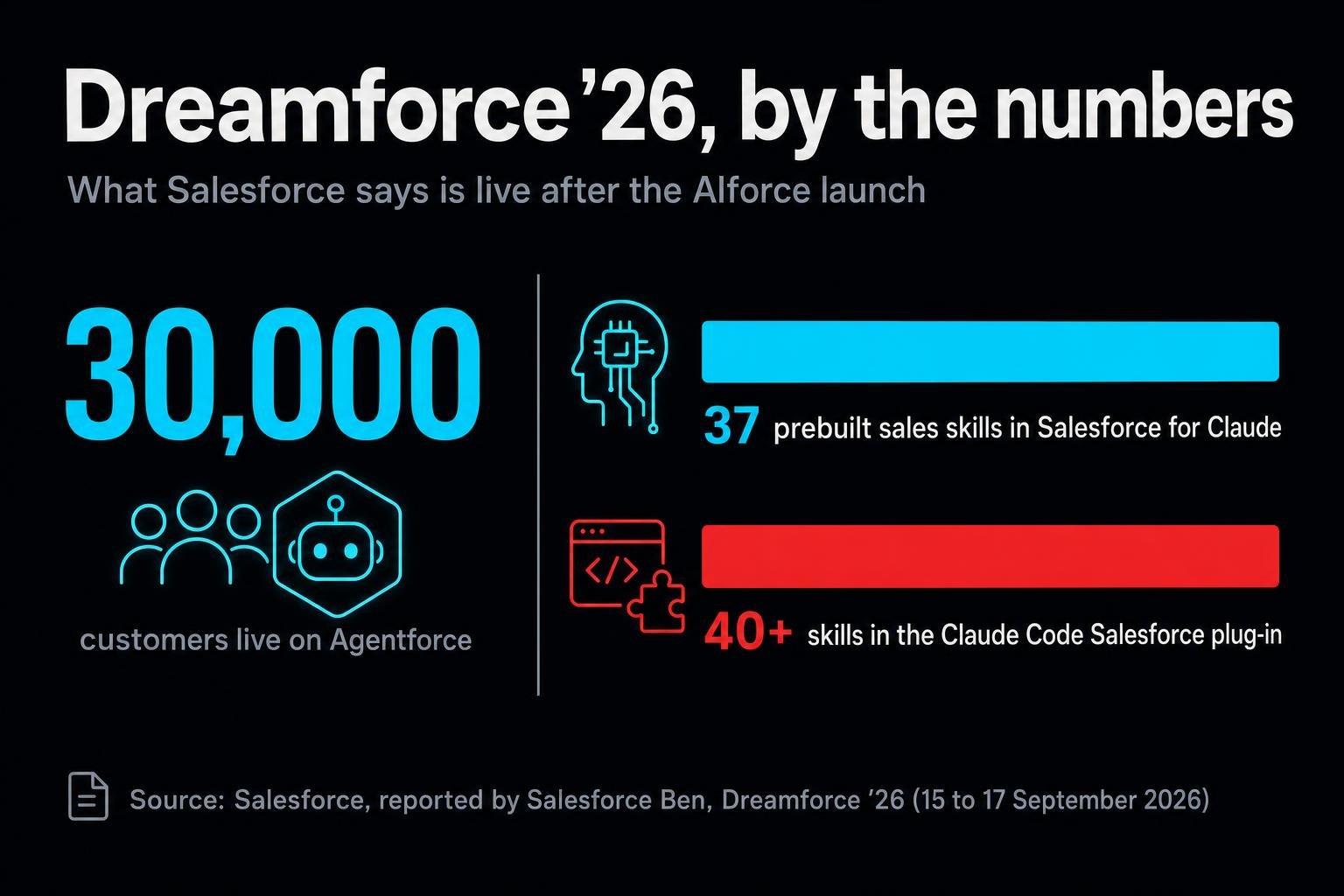
- Claudeforce. Salesforce in Claude is now available to all customers in beta, as a prebuilt MCP server inside Claude with 37 prebuilt sales skills. Tableau analytics, plus service, marketing, commerce and industry skills, are promised "in the near future." There is also a Claude Code Salesforce Development plug-in with 40+ skills and a public skills library on GitHub.
- Slackforce. Live interfaces built inside Slack from Salesforce data, plus Slack CRM, which lets someone create accounts, log notes and update records by prompt without ever opening Salesforce.
- Agentforce Coworker. An AI teammate inside Lightning, running inside the permissions the human already has.
- The Headless Toolkit. The architecture underneath, exposing "every element of the Salesforce platform" through MCPs, APIs, plug-ins, skills and developer tools.
The boldest claim is that anyone can now build their own interface by describing it: "compose customized live interfaces on the fly, simply by describing them, inside platforms like Slack, Claude, and Coworker." If that works even half as well as demoed, a whole layer of dashboard-building work becomes a sentence you type.
Two governance claims are worth writing down, because they will be quoted back at Salesforce for years. First, every request runs on existing permissions and business rules, so an agent only sees what the person sees. Second, zero data retention: business data answers the question but is not kept by the model provider. Both are vendor statements from a launch, not independently tested results.
The quieter keynote was the important one
The dedicated Agentforce keynote on 16 September was described by the trade coverage as light on major announcements and heavy on demos, with a clear focus on proving return on investment. That is a tell. When a vendor stops announcing and starts proving, the category has moved from curiosity to accountability.
Salesforce says 30,000 customers are now live on Agentforce. Mark Wakelin, GM of Agentforce, built the session around an "Agentic ROI Playbook": get agents into production, monitor how they perform, continuously improve them. The examples were specific. Southwest Airlines runs an Agent Router with separate narrow subagents for intake, document validation, reimbursements and ticket refunds on a single customer-name-change process. Vivint runs Agentforce Observability against live voice interactions, capturing session logs, response quality, action traces and latency. Fulton Bank claims 80,000 hours saved, $389M in loans and deposits attributed, and complaint resolution times cut by four days.
The most interesting demo was Agent Optimizer. Salesforce showed a real production problem, refund requests over $200 escalating at a much higher rate, traced it to a gap in the setup, proposed changes to the subagent and the router, and then generated smoke and regression tests for the proposed fix. That is not a feature announcement. That is a maturity bar, set publicly, for what running an agent in production is supposed to look like.
Read the numbers with your eyes open
Fulton Bank's $389M in "attributed" loans and deposits is a customer's claim, relayed by a vendor, at that vendor's own conference, with no published attribution method. The 80,000 hours is the kind of figure you get by multiplying a per-task saving by a task count, which is not the same as 80,000 hours of payroll disappearing. Even the reporter noted the demos were very polished and should be read as what is possible rather than what is typical. Take the structure seriously. Take the arithmetic with salt.
The part that generalises
Buried in the runtime diagram Salesforce published is a step that matters more than any number on stage: goal, plan, human in the loop, signal, continuous refinement. The largest agent vendor in enterprise software put human approval in the middle of its own architecture, not in a footnote about safety.
It is not alone. On 17 September, Comp AI raised a $34M Series A to make compliance continuous, and its CTO Mariano Fuentes described the artifact companies now need in almost the same breath: they "need to show what an agent accessed, what it tried to do, and whether it stayed within the boundaries given." Its CEO, Lewis Carhart, added the design principle: "An agent might draft a policy, but a person still reviews and approves it. As agents take on more consequential actions over time, we believe the level of safeguards and human approval should increase accordingly."
Here is the analogy I keep coming back to. Hiring an agent is like handing a new employee a company card on their first day. Enthusiasm is not the issue. The issue is that you need a receipt, a spending limit, and somebody who signs off on the big ones. Two unrelated companies, in the same week, shipped exactly that idea.
What I'm watching
- Whether Claudeforce's permission model holds under adversarial testing. Salesforce staked the whole architecture on "runs on existing permissions." The first published bypass attaches a security review to every deal in this category.
- Whether the Headless Toolkit's MCP surface gets a public, versioned specification rather than a partner-only one. A public spec is the difference between an ecosystem and a demo.
- Whether Agent Optimizer's test generation shows up in a customer's mouth rather than a vendor's. Generating regression tests for a proposed agent fix is either a genuinely hard capability shipped, or a keynote moment.
Either way, the framing has already shifted. For years the pitch was that AI would make software easier to use. Salesforce just argued that the software should get out of the way entirely, and then spent a second keynote admitting that the hard part is not building the agent. It is proving what the agent did.
One signal a day. No noise.
A 3-minute read when something genuinely shifts in AI, automation, or defense tech. Free, most weekdays.
Free, most weekdays. No spam, unsubscribe anytime.Sources
- Salesforce Ben - Salesforce launches AIforce at Dreamforce '26: AI replaces the UI - https://www.salesforceben.com/salesforce-launches-aiforce-at-dreamforce-26-ai-replaces-the-ui/
- Salesforce Ben - Complete roundup of the Agentforce keynote at Dreamforce '26 - https://www.salesforceben.com/complete-roundup-of-the-agentforce-keynote-at-dreamforce-26/
- TechCrunch - Comp AI sets eyes on a continuously agentic future for security and compliance - https://techcrunch.com/2026/09/17/comp-ai-sets-eyes-on-a-continiously-agentic-future-for-security-and-complaince/
Quick answers
What is AIforce?
AIforce is the package Salesforce announced at Dreamforce '26 (15 to 17 September 2026). It has four named parts: Claudeforce (Salesforce inside Claude), Slackforce (live interfaces and CRM actions inside Slack), Agentforce Coworker (an AI teammate inside Lightning), and the Headless Toolkit, which exposes the Salesforce platform through MCPs, APIs, plug-ins, skills and developer tools.
Can you use Salesforce inside Claude now?
Salesforce says Salesforce in Claude is available to all customers in beta, as a prebuilt MCP server inside Claude with 37 prebuilt sales skills. Tableau analytics plus service, marketing, commerce and industry skills are promised in the near future. There is also a Claude Code Salesforce Development plug-in with 40 or more skills and a public skills library on GitHub.
Does an AI agent see more company data than the employee using it?
Salesforce's claim is no: every request runs on existing permissions and business rules, so an agent only sees what the person sees. It also claims zero data retention, meaning business data answers the question but is not kept by the model provider. Both are vendor claims made at a launch, not independently verified results, so anyone relying on them should check the written terms.
How many companies are actually running Agentforce?
Salesforce said on stage that 30,000 customers are now live on Agentforce. Customer results quoted at the keynote, such as Fulton Bank's 80,000 hours saved and $389M in attributed loans and deposits, are customer claims relayed by the vendor with no published attribution method.