The defaults are flipping, and nobody asked
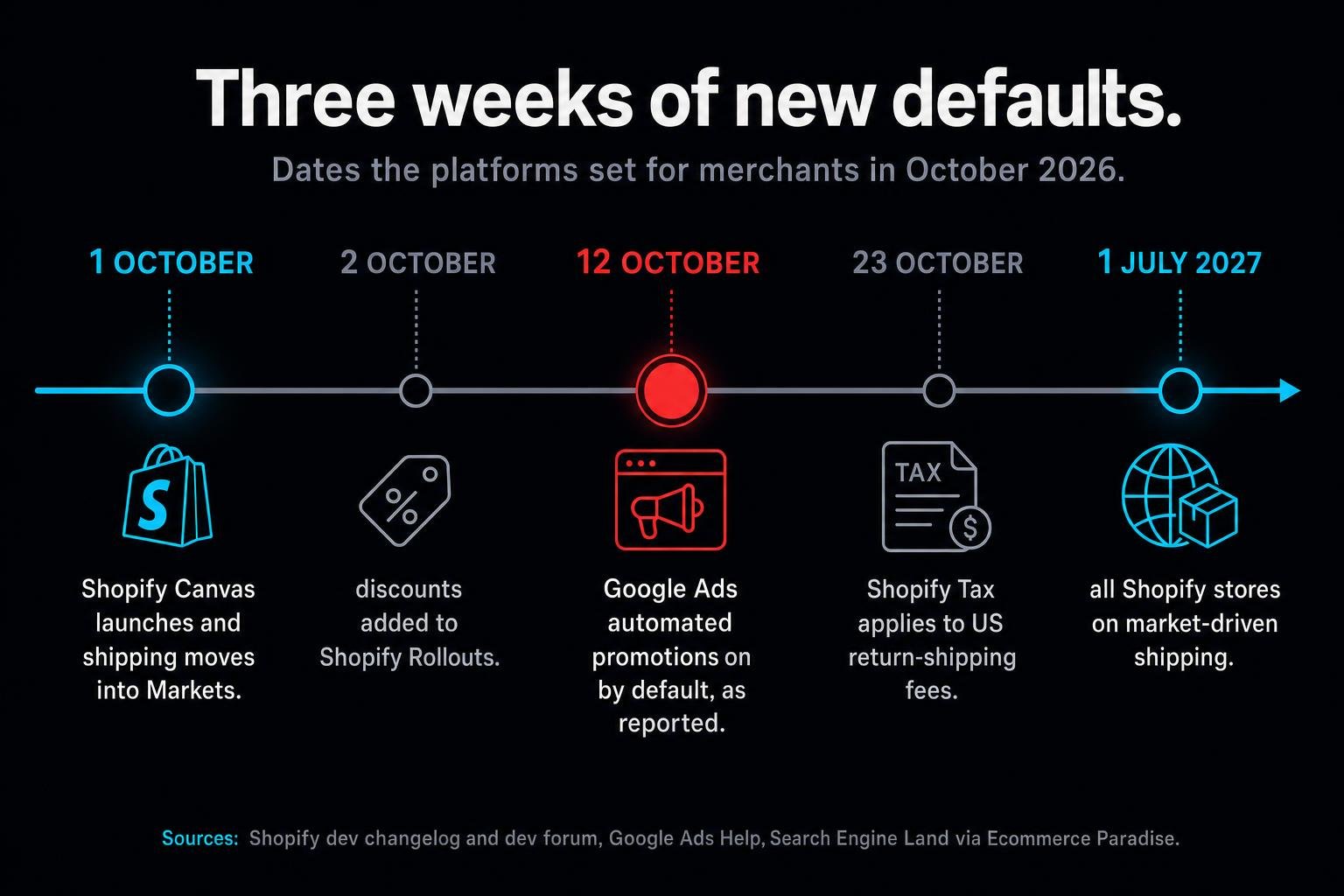
Shopify rebuilt its store editor around chat and moved shipping under Markets on 1 October. Google Ads starts lifting offers off your landing pages from 12 October. None of it throws an error.

Most platform news arrives as an invitation. This month it arrives as a notification. In the first days of October, Shopify changed how stores get built and how shipping gets calculated, and Google Ads set a date to start writing your own landing page offers into your ads. You do not have to adopt any of it. It adopts you.
Canvas: the store builder that talks back
Shopify launched Canvas on 1 October. It lays out every page of a store in one workspace, and the merchant either edits directly or just describes the change while Sidekick writes the live theme code. This is not a pilot: Shopify says Sidekick made over 25 million theme edits in the first half of 2026.
The catch is sitting in Shopify's own post to app developers. In a theme created or duplicated in Canvas, theme app extensions (app blocks and app embeds) are not available. Rollouts, Markets and Translations are not supported. The theme is not even visible to apps that list a store's themes. Existing themes edited in the normal theme editor are unchanged. A Shopify staffer said app support is planned "within the next few weeks". Secondary coverage adds that Canvas is desktop-only, limited to plans with theme customization, and that Canvas-edited themes stop receiving automatic theme updates (I could not confirm that last point on a Shopify page).
Translate that into plain shopkeeping. Every review widget, subscription app, upsell block and tracking embed your store leans on is simply not there in a Canvas theme. Not broken with a warning. Absent. So if anyone with theme access duplicates the theme, redesigns it by chat because the chat is genuinely good, and hits publish, the store comes out looking sharper and quietly selling less.
It is like being handed a beautiful new kitchen where the gas has not been connected yet. Everything looks right until dinner. Theme developers in the announcement thread said they got one hour's notice.
Shipping moved house
Also on 1 October, Shopify began rolling out market-driven shipping. Shipping options now attach to each market instead of to delivery profiles. Existing merchants opt in, new shops are enrolled automatically, and everyone moves by 1 July 2027. Shopify says merchants are not migrated while their apps are incompatible.
The quietest line is in Shopify's deprecation note. On stores already migrated, old delivery-profile API writes "may succeed without errors but will not update the merchant's live shipping settings". A success response that changes nothing is the most expensive kind of bug, because nobody goes looking for it.
Third-party guides report two more sharp edges: rates that share a name consolidate to the highest one instead of adding up, and rates can no longer target a single product, only collections (a Shopify staffer confirmed product selections become hidden [SHIPPING] collections). On the same date, script tag create and update API calls started failing. Two days later Shopify added discounts to Rollouts, so an offer can be tested on a share of traffic. From 23 October, Shopify Tax treats US return-shipping fees like other shipping charges.
Google reads your homepage and writes your ad
Then there is Automated promotions. Google reads the active offers on your landing pages, something like "20% off", and attaches them as promotion assets to eligible Search and Performance Max campaigns. Eligible means the campaign has location assets attached and no manual promotion running. Each sourced promotion serves for less than 24 hours and comes back only if Google still sees it on the site. Search Engine Land reported the setting goes on by default from 12 October; Google's own help page carries no date.
A banner on your homepage is no longer just a banner. From 12 October it is a claim in an ad, written by a machine that trusts your HTML more than it trusts your calendar.
Think about the expired sale banner nobody took down, or the regional offer that was only ever meant for one country. In a regulated category, that is not a pricing wrinkle, it is a compliance problem. The cleanest control is in Google's own eligibility rule: a manual promotion on the campaign blocks the automated one entirely. The off switch exists too, but it is account-level and buried under Assets, then Account level automated assets, then Advanced settings.
The pattern worth keeping
Three changes, one shape. The platform acts on your behalf, in your name, and the failure mode is silence.
Old failures shouted at you. A 404. A red error. A rejected ad. These ones say success and keep walking: an API write that returns fine and does nothing, a shipping rate that stops stacking, a theme that renders beautifully minus every app, an ad asset you never wrote. The nearest analogy is a thermostat that someone else can set remotely. The house is still warm, so you do not check, and the bill arrives in Q4.
If you run a store or an ad account, the general version of the homework is short:
- Write down which apps inject anything into your theme, and agree that nobody publishes a Canvas theme until app support ships.
- Export your shipping rates and look for duplicate names before opting into market-driven shipping.
- Check whether anything you own still creates script tags, since those calls now fail on create and update.
- Decide before 12 October whether Google should be sourcing promotions from your site, and remember a manual promotion is the override.
The skill gaining value here is not building the template. Chat can do the template now, 25 million edits' worth. The value is knowing what the default did while you were not watching, and being the person who checked.
One signal a day. No noise.
A 3-minute read when something genuinely shifts in AI, automation, or defense tech. Free, most weekdays.
Free, most weekdays. No spam, unsubscribe anytime.Sources
- Shopify dev forum - Meet Canvas, a new way for merchants to design their online store with Sidekick - https://community.shopify.dev/t/meet-canvas-a-new-way-for-merchants-to-design-their-online-store-with-sidekick/38212
- Unite.AI - Shopify rolls out Canvas, a Sidekick-powered store design surface - https://www.unite.ai/shopify-rolls-out-canvas-a-sidekick-powered-store-design-surface/
- AI Weekly - Shopify launches Canvas, chat-driven store builder on Sidekick - https://aiweekly.co/alerts/shopify-launches-canvas-chat-driven-store-builder-on-sidekick
- Shopify dev changelog - Market-driven shipping now available in feature preview - https://shopify.dev/changelog/posts/market-driven-shipping-now-available-in-feature-preview
- Ecommerce Paradise - Shopify market-driven shipping rollout - https://ecommerceparadise.com/shopify-market-driven-shipping-rollout/
- Ecommerce Paradise - Paradise Report, 3 October 2026 - https://ecommerceparadise.com/paradise-report-2026-10-03/
- Google Ads Help - About automated promotions - https://support.google.com/google-ads/answer/18057626
- Ecommerce Paradise - Google Ads automated promotions - https://ecommerceparadise.com/google-ads-automated-promotions/
Quick answers
What is Shopify Canvas?
Canvas launched on 1 October 2026. It shows every page of a store in one workspace, and the merchant can either edit directly or describe a change in chat while Sidekick writes the live theme code. Shopify says Sidekick made over 25 million theme edits in the first half of 2026.
Will Canvas break my Shopify apps?
In a theme created or duplicated in Canvas, theme app extensions (app blocks and app embeds) are not available at launch, and Rollouts, Markets and Translations are not supported. Existing themes edited in the normal theme editor are unchanged. A Shopify staffer said app support is planned within the next few weeks.
When does market-driven shipping become mandatory on Shopify?
The rollout began on 1 October 2026. Existing merchants opt in, new shops are enrolled automatically, and all stores move by 1 July 2027. On migrated stores, writes to the old delivery-profile APIs may succeed without errors while changing nothing in the live shipping settings.
How do I turn off Google Ads automated promotions?
The opt-out is account-level: Assets, then Account level automated assets, then Advanced settings, then Automated promotions, then Off. Alternatively, keep it on and run a manual promotion on the campaign, since a manual promotion makes the campaign ineligible for the automated one.