The Leak Was in the Logs
A poisoned AI library was traced back to tokens sitting in a gateway's logs. In a separate campaign, AI agents broke into 100+ companies for about $50 per success. The model isn't the weak spot. The plumbing around it is.

For two years, most of the talk about AI safety has been about the model. Will it make things up? Will it say something awful? Can someone jailbreak it? Those are fair questions. But two stories from the past week point at something less glamorous and much more practical: the pipes around the model.
The first is a poisoned open-source package, and the trail starts at a log file. The second is a group of AI agents that broke into more than 100 companies for roughly $50 per successful break-in. Read them together and the message is plain. The model is rarely where you get hurt. The plumbing is.
The mailroom that photocopied the keys
LiteLLM is a popular open-source AI gateway. It's a single doorway between apps and the models they call, and it meters and logs the traffic that passes through. On 21 October, LiteLLM version 1.107.0 went out on PyPI, Docker and GitHub's container registry with a credential stealer and an hourly remote-code loader built in. It was live for roughly two to three hours.
How it got there is the part worth studying. According to LiteLLM, Claude Code can embed a user's GitHub CLI OAuth token in a response body. LiteLLM logs response bodies. An internal LiteLLM deployment was reachable from the internet, so the attacker could read those logs. From them they took tokens belonging to three developers, turned off branch protection and signed a build from a lookalike repository, Berri-AI/litellm.
Picture a company mailroom that photocopies every letter for its records. That sounds sensible until someone mails a house key. Now the filing cabinet holds a copy of every key that ever came through, and the cabinet sits in the lobby with the door open.
The fallout was fast. Wiz saw stolen AWS role credentials being tested about 4.5 hours later with a call that lists the available Bedrock foundation models. That fits LLMjacking, where attackers take over someone's cloud account to run AI on that account's bill. Wiz and Endor Labs both found that the payload hooks into Python's startup process through files named cook.pth and sitecustomize.py. That means it runs every time Python starts in an affected environment, even if nothing ever imports LiteLLM. The last safe version is 1.106.2.
The model didn't leak anything. The tool watching the model did.
A break-in now costs less than dinner
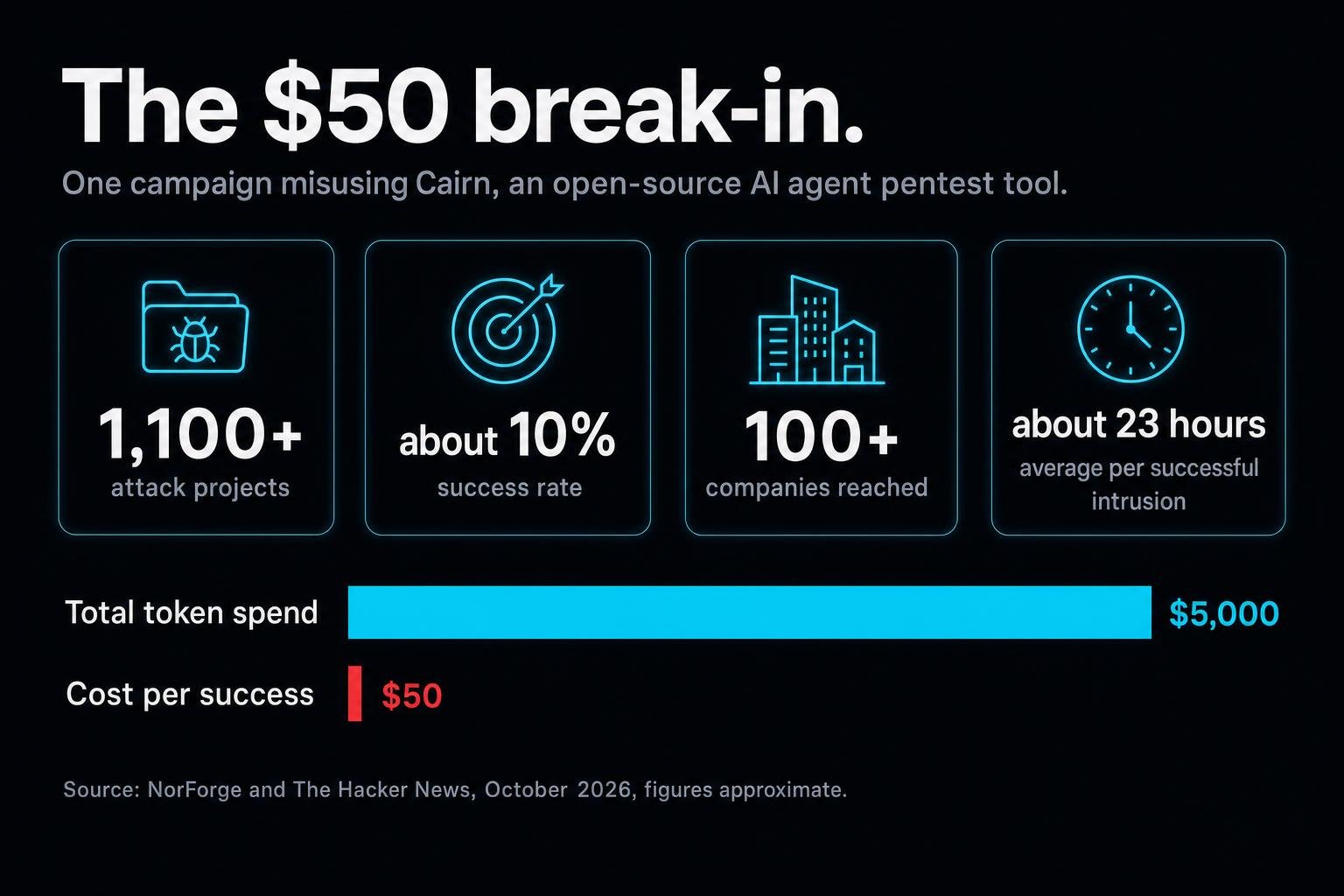
The second story is about the attackers' plumbing. Security firm NorForge found about two dozen exposed control panels for Cairn, an open-source tool that uses AI agents for penetration testing, and someone was using them for real attacks. The largest cluster ran more than 1,100 attack projects against shops and payment systems in the US, Japan and Australia. Reuters named Deere, SharkNinja and Cummins among the more than 100 companies reached.
Look at the economics. About 10 percent of attempts succeeded. A successful intrusion took just under 23 hours on average. The whole campaign spent roughly $5,000 on AI tokens, which works out to about $50 per success.
That number changes who counts as a target. When a tailored break-in needed a skilled person working for days, attackers went after big prizes. At $50 a win, almost anything is worth a try: the staging server nobody cleaned up, the old marketing microsite, the admin panel someone set up three years ago and forgot. An agent doesn't get bored. It keeps trying doors.
There's an irony here too. The attackers' own exposed panels leaked secrets they had stolen from victims, and 11 percent of the secrets found were still valid. The criminals got caught by the same unlocked plumbing.
Same lesson on both sides
One story is a defender's mistake and the other is an attacker's campaign, but the root cause is the same. Everything around the AI gets treated as boring infrastructure, so nobody protects it as if it matters.
- Gateways are secret stores. Prompts and responses carry tokens, keys and customer data. If you log full request and response bodies, your logs are a vault. Protect them like one.
- Calling something internal doesn't protect it. The LiteLLM deployment was internal and still reachable from the internet. The Cairn panels were tooling and were exposed too.
- Cheap attacks find forgotten doors. At $50 per success, your oldest and most neglected web property is effectively your front door.
What I'd do this week
- Check your Python environments for LiteLLM 1.107.0. If you find it, treat the machine as compromised and rotate every credential it could reach. Pin dependency versions instead of pulling the latest release automatically.
- Redact before you log. Scan request and response bodies for token patterns (GitHub tokens, API keys, cloud keys) before anything is written to disk.
- Put every AI dashboard behind a login. That includes gateways, observability tools and agent control panels. If a dashboard opens without asking who you are, so will everyone else's.
- List your public hostnames. Write down every subdomain and old site. If nobody owns one, patch it or shut it down.
Where this is heading
Larger companies are already moving toward a single, watched entrance. On 27 October, NeuBird made its Agentic Reliability Centre generally available. It sends engineers and agents (Claude Code, Cursor, Codex and in-house ones) to telemetry and models through one metered MCP connection. Every recommended action needs human approval, and everything goes into one audit trail. That's the right design: fewer doors, and every one of them watched.
The model is the exciting part of AI. The plumbing decides whether you sleep at night. This week, the companies that got hurt didn't lose to a smarter model. They lost to a log file and a forgotten door.
One signal a day. No noise.
A 3-minute read when something genuinely shifts in AI, automation, or defense tech. Free, most weekdays.
Free, most weekdays. No spam, unsubscribe anytime.Sources
- The Hacker News: LiteLLM suspects GitHub token leak in supply chain compromise - https://thehackernews.com/2026/10/litellm-suspects-github-token-leak-in.html
- Wiz: LiteLLM compromised, steals credentials - https://www.wiz.io/blog/litellm-compromised-steals-credentials
- Endor Labs: LiteLLM 1.107.0 compromised, Python startup hooks steal cloud, AI and proxy credentials - https://www.endorlabs.com/learn/litellm-1-107-0-compromised-python-startup-hooks-steal-cloud-ai-and-proxy-credentials
- The Hacker News: Hackers use autonomous AI agents to breach companies - https://thehackernews.com/2026/10/hackers-use-autonomous-ai-agents-to.html
- NorForge: Inside Cairn - https://norforge.com/blog/inside_cairn
- IT Brief: NeuBird launches governed hub for AI production agents - https://itbrief.com.au/story/neubird-launches-governed-hub-for-ai-production-agents
Quick answers
What happened to LiteLLM version 1.107.0?
On 21 October, LiteLLM 1.107.0 was published on PyPI, Docker and GitHub's container registry with a credential stealer and an hourly remote-code loader. It was live for roughly two to three hours. The last safe version is 1.106.2.
How did attackers get access to publish a malicious LiteLLM build?
According to LiteLLM, Claude Code can embed a user's GitHub CLI OAuth token in a response body, and LiteLLM logs response bodies. An internal LiteLLM deployment exposed to the internet let the attacker read those logs, take three developers' tokens, disable branch protection and sign a build from a lookalike repository.
How much did it cost attackers to break into companies with AI agents?
NorForge found a campaign misusing the open-source Cairn agent tool that spent roughly $5,000 in tokens with about a 10% success rate. That works out to about $50 per successful break-in. Successful intrusions took just under 23 hours on average.
How can I protect an AI gateway or proxy from leaking credentials?
Treat its logs as a secret store. Redact tokens and keys from request and response bodies before they are written, put every gateway and observability dashboard behind authentication, pin dependency versions, and rotate credentials on any machine that ran a compromised package.