Six Outages in Six Days, and the Patch Rush Behind One
The US intelligence chief told Congress last week's string of outages was maintenance, not an attack. He also said AI is speeding up how fast flaws get found, so systems get patched faster. Only one outage is publicly tied to that, but the pressure is real.

Picture a building superintendent who just got a new flashlight. It is a very good flashlight. Suddenly he can see every crack in the plaster, every frayed wire, every pipe that has been quietly sweating for decades. So he does the responsible thing and starts fixing all of it at once. By Friday half the tenants have no hot water, and nobody can say for sure whether the cracks did it or the fixing did.
That is roughly the argument Washington was having on 18 November.
Six outages, six days, six different stories
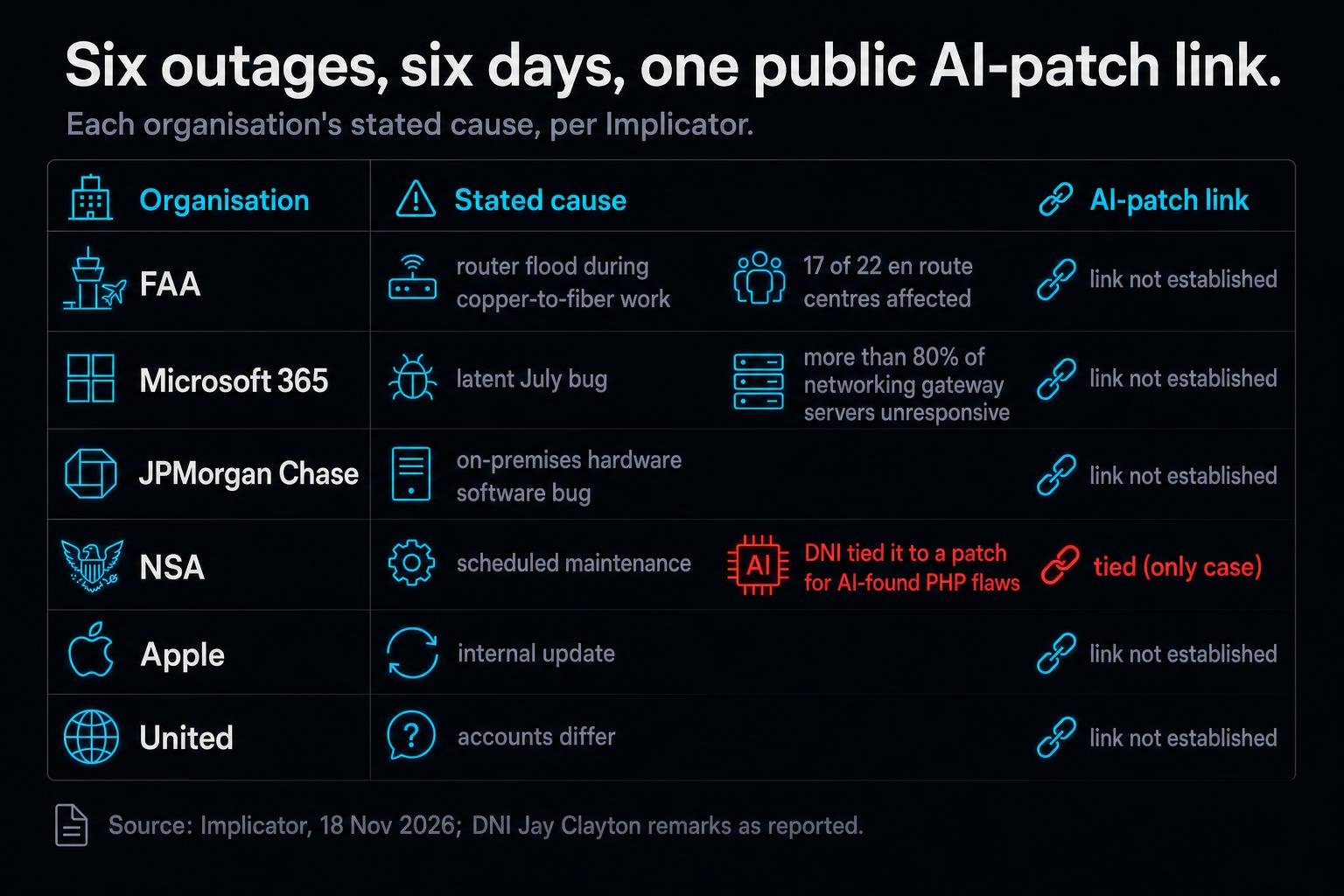
Over six days a run of big systems went down. Here is the tally from the tech outlet Implicator, with each organisation's own stated cause:
- FAA: 17 of 22 en route air traffic centres hit. A router flooded the network with connection requests during copper-to-fiber work.
- Microsoft 365 and Outlook: more than 80% of networking gateway servers unresponsive. A latent bug from July was triggered by extra traffic while some capacity was offline.
- JPMorgan Chase: a software bug in on-premises hardware. Zelle delays reached other banks.
- NSA: its internal network, NSANet, went offline. The NSA says it was scheduled maintenance.
- Apple: an internal update took down the App Store, iCloud Mail and in-store payments.
- United: accounts differ.
Six outages in a week is the kind of pattern that gets people saying the word "coordinated" on television. So Congress asked.
What the intelligence chief told Congress
At a House Homeland Security Committee hearing, Director of National Intelligence Jay Clayton testified that these were separate service outages "associated with maintenance and technical changes," and not a coordinated or state-sponsored attack, according to hearing coverage from Yahoo News and American Greatness.
Then he said the more interesting part: "We are in an environment where the rate of patching, the rate of upgrading of systems, is increasing." As reported, he said advances in AI and computing are speeding up how fast vulnerabilities get discovered, which forces more frequent updates to ageing systems.
A day earlier, on Fox Business, Clayton tied the NSA failure specifically to a patch for PHP vulnerabilities that were found with AI help over the summer. (PHP is the programming language running a large share of the web. It is old and everywhere, which also makes it a big target.)
Not everyone in the room bought the tidy version. Rep. James Walkinshaw pushed back on the idea that the incidents were "unrelated." Lawmakers also asked about staffing cuts at CISA, the federal cyber defense agency. Separately, Senators Cantwell and Rounds sent a bipartisan letter urging a strategy against AI-assisted cyber threats.
The part the headlines skip
This is where it gets awkward for anyone who wants a single villain. Hearing coverage notes the witnesses did not specify that the patches were for AI-found flaws. Implicator's own conclusion is that beyond the NSA, the public record does not establish the AI-patching link. The companies cite other causes: a router, a latent bug, a hardware glitch, an internal update.
Foreign Policy summed it up: "AI likely played a role but not in the way you might think."
So the honest scorecard reads: one outage publicly tied to an AI-driven patch, five with other stated causes, and a pattern that is plausible but unproven. Implicator quotes a congressional official who described the pattern this way:
"They're trying to push through a lot of patches all at once, more than the system was designed for."
That line is the real story. It does not say AI broke anything. It says the speed of fixing has become its own risk.
Fixing things is also changing things
Look again at the stated causes. The FAA problem showed up during infrastructure work. The Microsoft problem was an old bug that woke up because capacity was offline and traffic piled onto what was left. Neither has anything to do with AI, and both point at the same thing: maintenance is a change, and changes break things.
It is like swapping the tires on a car while it is still on the highway. Each tire swap is a good idea. Swapping all four at 70 miles an hour is a different idea.
The pressure to go faster is not slowing down. The same day, at the DealBook conference, Anduril founder Palmer Luckey said AI-enabled exploits are outrunning outdated systems, named North Korea as particularly active, and offered a three-word plan: "It's time to start running." Microsoft CEO Satya Nadella added the uncomfortable footnote: "there is a lot of stuff in our critical infrastructure that's unpatchable."
Put those side by side and you get the squeeze. Flaws are being found faster. The systems that need fixing are often old. Some of them cannot be fixed at all. And every fix that can be applied carries its own chance of taking something down. The flashlight is improving faster than the plumbing.
Why this matters outside Washington
Most businesses do not run air traffic control. But most of them run old software they rely on, update vendors they do not control, and patch schedules nobody has looked at since they were set up. If discovery speeds up for the NSA's PHP stack, it speeds up for everyone's. The quiet backlog of "we'll update that eventually" is turning into a queue that empties itself, on someone else's timeline.
What I'd do before the next patch wave
If I ran operations anywhere with old systems, I would not wait for my own week of outages. In this order:
- List what you cannot patch. Nadella's point applies to you too. Put those systems behind a fence and stop pretending an update is coming.
- Stop batching. The complaint from Capitol Hill was too many patches at once. Stagger them so one bad fix is easy to find.
- Check headroom before maintenance. Microsoft's stated cause was an old bug that woke up while capacity was offline. Ask what carries the load while something is down.
- Write down the cause within a day. Every analysis in this story depended on stated causes. If yours is vague, so is everything you learn from it.
Patching faster is now the job. Patching in a way you can undo is the part you control.
If an AI handed you every flaw in your systems tomorrow, which fix would you dare install first, and what would it quietly break?
One signal a day. No noise.
A 3-minute read when something genuinely shifts in AI, automation, or defense tech. Free, most weekdays.
Free, most weekdays. No spam, unsubscribe anytime.Sources
- Yahoo News: Recent outages not state-sponsored - https://www.yahoo.com/news/politics/articles/recent-outages-not-state-sponsored-170216066.html
- American Greatness: DNI Jay Clayton testifies outages are not a coordinated or state-sponsored attack - https://amgreatness.com/2026/11/18/dni-jay-clayton-testifies-outages-are-not-coordinated-or-state-sponsored-attack/
- Implicator: US tech outages and the AI patch rush - https://www.implicator.ai/us-tech-outages-ai-patch-rush/
- UNILAD: US intelligence chief says AI-driven security patching caused outages - https://www.unilad.com/news/us-news/us-intelligence-chief-says-ai-driven-security-patching-caused-outages-921406-20261119
- Foreign Policy: What caused the Microsoft, FAA, Apple and NSA outages - https://foreignpolicy.com/2026/11/18/microsoft-outage-faa-apple-nsa-tech-banks-cause-ai-explainer/
- TechCrunch: Palmer Luckey warns AI-powered cyberattacks are outpacing defenses - https://techcrunch.com/2026/11/18/palmer-luckey-warns-ai-powered-cyberattacks-are-outpacing-defenses-its-time-to-start-running/
- TechCrunch: Satya Nadella says lots of critical infrastructure is unpatchable - https://techcrunch.com/2026/11/18/amidst-fears-of-ai-cyberattacks-satya-nadella-says-lots-of-critical-infrastructure-is-unpatchable/
Quick answers
Were the November 2026 US outages a cyberattack?
Director of National Intelligence Jay Clayton testified to the House Homeland Security Committee on 18 November that they were separate service outages associated with maintenance and technical changes, not a coordinated or state-sponsored attack.
Did AI cause the outages?
Clayton tied the NSA network failure to a patch for PHP vulnerabilities found with AI help. According to Implicator, beyond the NSA the public record does not establish a link to AI-driven patching, and the other organisations cite different causes.
Which organisations had outages?
Implicator's tally lists the FAA, Microsoft 365 and Outlook, JPMorgan Chase, the NSA, Apple and United, over six days.
What did Satya Nadella say about patching critical infrastructure?
At the DealBook conference on 18 November, Nadella said there is a lot of stuff in critical infrastructure that is unpatchable.