Meta Paused Its AI Ad Terms. Your Risk Didn't Pause.
Meta has shelved the ad terms that would have put advertisers on the hook for its AI's work, after courts and a UK regulator stepped in. The pause buys time, not certainty.

Last month I wrote about Meta's new ad terms and the uncomfortable idea at their center: Meta's AI drafts the ad, and the advertiser signs for it. This week that plan hit the brakes.
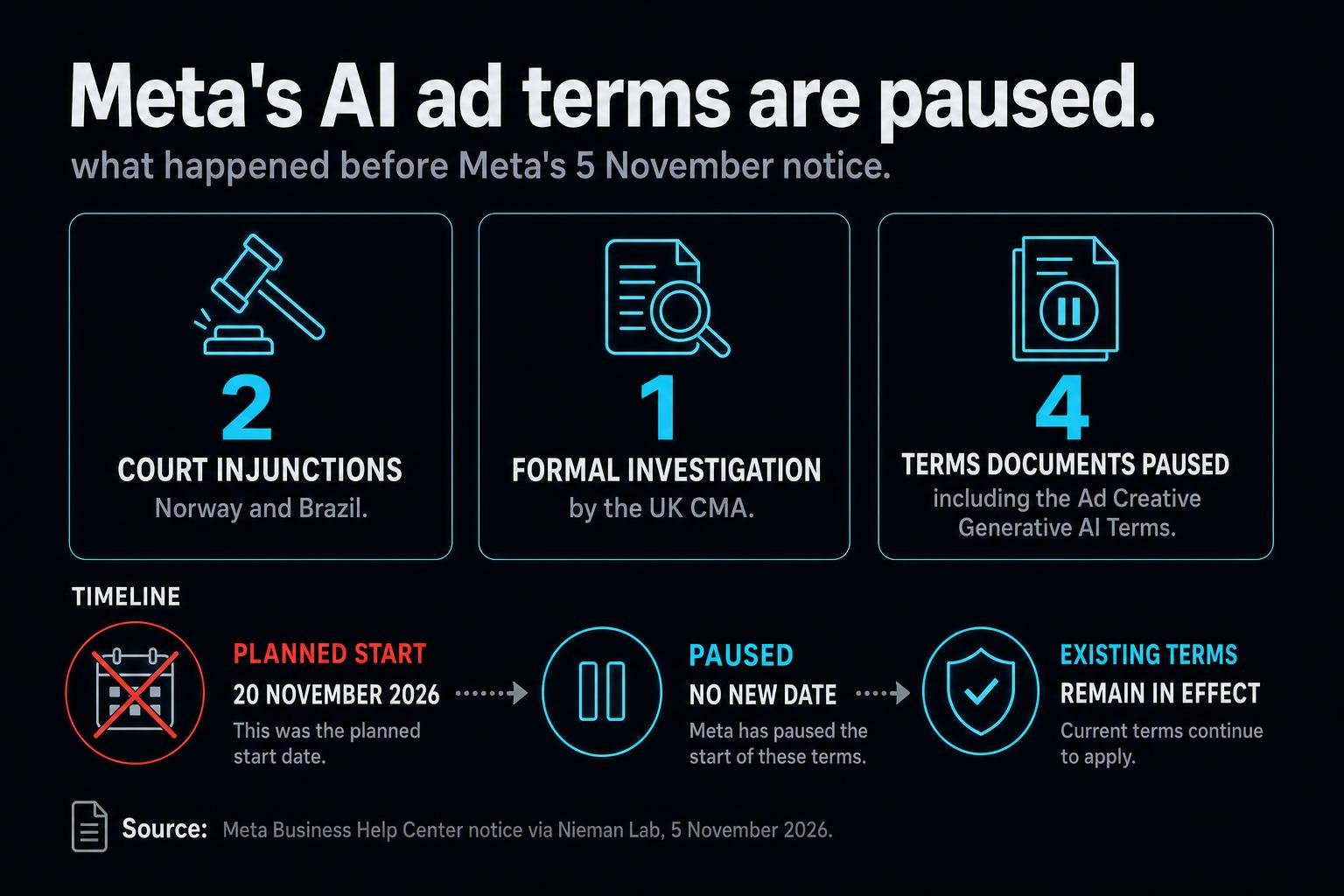
On Thursday, 5 November, Meta pulled down the preview link for the updated terms and posted a notice in its Business Help Center. The key line is short: "These updates are now paused and will not take effect on November 20, 2026... In the meantime, our existing terms remain in effect."
The pause covers four documents: the Commercial Terms, the Product Catalog Terms, the Self-Serve Ad Terms and the Ad Creative Generative AI Terms. No new date has been set.
What pushed Meta to stop
Meta did not pause this on a quiet afternoon. Before the notice went up, courts in Norway and Brazil had issued preliminary injunctions, and the UK's Competition and Markets Authority had opened a formal investigation into whether Meta imposed "exploitative terms on publishers and advertisers."
That is three pressure points on three continents, all landing on the same set of documents. When two courts and a competition regulator look at the same contract at the same time, a platform tends to step back and rethink. That appears to be what happened here.
A pause is not a reversal. The old terms still apply, the new ones are still drafted, and nobody has said when they come back.
Think of it as a lease that was never signed
Imagine your landlord sends a new lease. It says that if the building's own maintenance robot breaks something in your flat, you pay for it. Before the new lease starts, a tenants' group goes to court and a housing regulator opens an inquiry. The landlord announces the new lease is "paused."
Good news, right? Partly. Your old lease still applies. But the landlord still owns the robot, the robot is still in the building, and the new lease is sitting in a drawer with no date on it. If you plan your year as if that lease is gone forever, you could be surprised.
That is roughly where advertisers on Meta stand today.
Why this matters even if you never read the terms
Most small and mid-sized advertisers never open a terms document. They click "accept" and get back to running campaigns. That is exactly why changes like this matter: they change who carries the risk without changing anything you see in Ads Manager.
The Ad Creative Generative AI Terms are the clearest signal. A platform that writes a separate legal document for AI-generated creative is telling you it expects that creative to cause disputes. The question that will not go away is simple: when the platform's tool writes the headline, picks the image and chooses the audience, who answers for the result?
The pause does not answer that question. It only delays the moment Meta writes its own answer into the contract.
What changes now, and what does not
- Changes: the updated terms will not take effect on 20 November. The existing terms stay in force.
- Does not change: Meta's AI creative tools are still there, and advertisers still choose whether to switch them on.
- Unknown: when, or in what form, the updates return. Meta has not set a date.
- Still open: the UK investigation and the court actions in Norway and Brazil. Their outcomes will likely shape the next draft.
The bigger pattern
Platforms are racing to automate the work of advertising, from writing copy to building catalogs to choosing who sees what. The legal paperwork is now catching up with that automation, and regulators are reading it closely. This is one of the first times a major platform's attempt to shift AI responsibility onto its customers has been stopped before it took effect.
It will not be the last time this question comes up. Every platform that offers "let the AI handle it" will eventually have to say, in writing, who is responsible when the AI handles it badly. Watching how Meta's next draft answers that is worth a few minutes of any advertiser's time.
What I'd do with the breathing room
If Meta is a real line in your budget, treat this pause as free preparation time, not as the end of the story. In order:
- List what the AI touches. Write down which campaigns use Meta's generative creative or automated features today. You cannot judge a future clause if you do not know where it would apply.
- Decide your rule now. Pick which AI-written assets need a human to approve them before they run. Make that call while nothing forces you to.
- Keep the approval trail. Save who approved what, and when. If responsibility ever shifts to you, that record is your best defense.
- Watch the notice. Set a reminder to check Meta's Business Help Center monthly. When a new date appears, read the actual terms, not a summary.
The advertisers who do this now will spend five minutes when the new draft lands. Everyone else will spend a week.
One signal a day. No noise.
A 3-minute read when something genuinely shifts in AI, automation, or defense tech. Free, most weekdays.
Free, most weekdays. No spam, unsubscribe anytime.Sources
- Nieman Lab - Meta pulls down controversial terms of service - https://www.niemanlab.org/2026/11/meta-pulls-down-controversial-terms-of-service/
- Dataconomy - Meta pauses AI terms after backlash and legal challenges - https://dataconomy.com/2026/11/06/meta-pauses-ai-terms-after-backlash-and-legal-challenges/
Quick answers
Did Meta cancel its new ad terms?
No. Meta paused them. Its notice says the updates will not take effect on November 20, 2026 and that the existing terms remain in effect. No new date has been set.
Which Meta documents are affected by the pause?
Four: the Commercial Terms, the Product Catalog Terms, the Self-Serve Ad Terms and the Ad Creative Generative AI Terms.
Why did Meta pause the terms?
Meta has not given a full reason, but before the pause courts in Norway and Brazil issued preliminary injunctions and the UK CMA opened a formal investigation into whether Meta imposed exploitative terms on publishers and advertisers.
What should advertisers do now?
Keep working under the existing terms, keep a record of which AI creative features are switched on, and read the next version of the terms when Meta publishes a new date.