Meta Just Made Ad Creative a Platform Default
Meta introduced Muse Image, its first in-house image model, and is wiring it straight into Advantage+ creative. Generated ad visuals are shifting from a tool you buy to a feature that comes with the platform.

On July 7, Meta introduced Muse Image, the first image-generation model built by its Meta Superintelligence Labs. It is live now inside Meta AI, and here is the part that should make every advertiser sit up: it is rolling out to advertisers and agencies through Advantage+ creative in the coming weeks. Read that again slowly. The company that already decides who sees your ad and what you pay for it is now going to draw the ad too.
For years, the ad machine handled targeting and bidding while a human (or an outside tool) supplied the picture. Muse Image closes that last gap. The creative is no longer something you bring to the platform. It is something the platform hands you, for free, on the way to spending your budget.
What Muse Image actually does
The headline feature is not just that it makes images. Plenty of models do that. The difference Meta is selling is agentic reasoning inside the creative process. You give it a brief, and instead of spitting out one static image, it parses the intent, adjusts individual elements, swaps styles, and produces on-brand variations with fewer back-and-forth rounds. Think less "vending machine" and more "junior designer who takes notes and iterates."
That matters because the bottleneck in advertising has never been targeting math. It has been feeding the machine enough fresh creative to keep it hungry. A single campaign can burn through dozens of visual variations a week. If the platform generates those variations itself, the slowest, most expensive step in the funnel just got absorbed into the plumbing.
Why this is a big deal, in one number
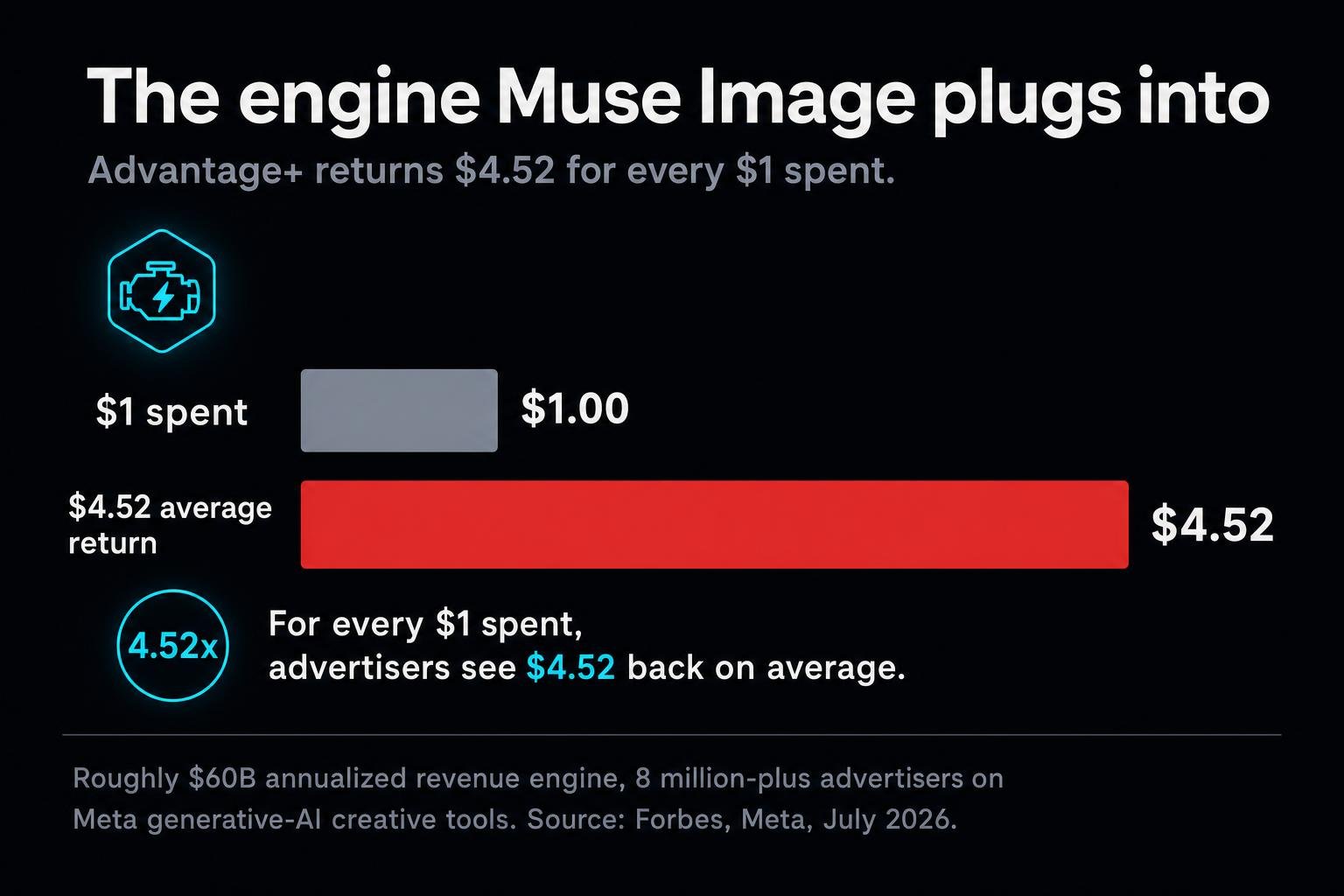
Advantage+ is not a science project. It is a roughly $60 billion annualized revenue engine reporting an average return of $4.52 for every $1 spent, and more than 8 million advertisers already use at least one of Meta's generative-AI creative tools. Bolting a native image model onto that is like adding a free espresso machine to a coffee shop that already has a line out the door. The demand was there. Now the supply side got cheaper for the house.
When the tool that makes your ad is built into the platform that sells your ad, the creative stops being a purchase and becomes an amenity. The question shifts from "what do we make?" to "what do we approve?"
That is the real inversion. If generation is free platform inventory, the scarce, valuable human work moves downstream to judgment: brand fit, taste, and compliance. Anyone can now produce fifty on-brand variants in a minute. Deciding which ones are actually on-brand, legally safe, and worth spending money behind is where skill concentrates.
The regulated-advertising problem nobody has solved
Here is the catch a model cannot fix by itself. A generated image can imply things words never said. A before-and-after visual, a body depiction, a subtle suggestion of an outcome: regulators read pictures as claims, not decoration. Meta's model is very good at making an image look persuasive. It does not know the advertising rules of your industry or your country.
So for anyone in a regulated category (health, finance, supplements, anything with fine print), the free creative firehose comes with a matching firehose of risk. Every autogenerated variant is a potential claim that needs a human gate before it spends a cent. The cost did not disappear. It moved from "making the image" to "vetting the image," which is harder to automate and easier to get wrong.
The quiet business model underneath
Meta paired this with a second move worth noticing. Its new Meta Business Agent is expanding globally to businesses of all sizes, with integrations for tools like Shopify and Zendesk on the roadmap. The rollout detail is the tell: it is free at first, with paid tiers arriving within months.
That is the entire platform playbook compressed into one sentence. Give the capability away, let everyone wire their workflow around it, and price the dependency once leaving would hurt. It is the classic "first hit is free" pattern, applied to the core of how millions of businesses market themselves. If you adopt Muse-generated creative as your default now, you are also quietly choosing where a future line item will land.
What to actually take from this
Generated creative going native is not a gimmick. It is a structural change in who owns the most expensive part of advertising. Two things follow for anyone spending on these platforms. First, measure your current creative performance before the generated variants enter the mix, so you can tell whether the new stuff actually beats what you had. Second, treat the gate, not the generation, as your competitive edge. The images are becoming a commodity. The judgment about which images to run is not.
The creative layer just went native. That is genuinely exciting: it lowers the cost of experimentation for everyone. It is also a reminder that when a platform gives you a superpower for free, the platform is usually the one that gets stronger.
One signal a day. No noise.
A 3-minute read when something genuinely shifts in AI, automation, or defense tech. Free, most weekdays.
Free, most weekdays. No spam, unsubscribe anytime.Sources
- Meta newsroom - Introducing Muse Image - https://about.fb.com/news/2026/07/introducing-muse-image-meta-ai/
- CNBC - Meta AI Muse Image - https://www.cnbc.com/2026/07/07/meta-ai-muse-image.html
- Axios - AI Meta image generator - https://www.axios.com/2026/07/07/ai-meta-image-generator
- Forbes - Meta's new image model is competing for ad budgets - https://www.forbes.com/sites/gabrielalinzainescu/2026/07/08/metas-new-image-model-is-competing-for-ad-budgets/
- BestMediaInfo - Meta brings Muse Image AI to Advantage+ creative - https://bestmediainfo.com/mediainfo/mediainfo-digital/meta-brings-muse-image-ai-to-advantage-creative-to-help-advertisers-generate-smarter-ad-creatives-12144269
- Productsup - Agentic commerce tracker - https://www.productsup.com/agentic-commerce-tracker/
Quick answers
What is Meta Muse Image?
Muse Image is the first image-generation model built by Meta Superintelligence Labs, introduced on July 7, 2026. It is live in Meta AI and is rolling out to advertisers and agencies through Advantage+ creative in the coming weeks.
How is it different from other AI image generators?
Meta highlights agentic reasoning in the creative process: it parses a brief, adjusts individual elements, swaps styles, and produces on-brand variations with fewer round trips, rather than returning a single one-off image.
Why does wiring it into Advantage+ matter?
Advantage+ is a roughly $60 billion annualized revenue engine reporting an average return of $4.52 per dollar spent, with over 8 million advertisers already using Meta gen-AI creative tools. Native image generation means the creative becomes a platform feature rather than a separate purchase.
What is the catch for advertisers?
Generated images can imply claims that copy never states, which is a real risk in regulated categories. The cost of vetting each variant for brand and compliance moves to the advertiser, and Meta's related Business Agent is free at first with paid tiers expected within months.