ChatGPT Ads Got a Scoreboard. Organic Went Dark.
In the same week, ChatGPT's paid ads got real measurement partners and its free links appear to have stopped saying where visitors came from. AI answers are becoming ad space, and only the paid side comes with a receipt.

Two stories crossed my radar this week. Read one at a time, each looks like routine product news. Read together, they say a lot about where AI search is going.
First, OpenAI gave ChatGPT Ads the tools serious advertisers ask for before they spend real money: attribution partners, a proper conversions dashboard and bigger ad formats. Second, ChatGPT's ordinary, unpaid links appear to have stopped telling websites that the visitor came from ChatGPT.
So the paid channel just got a scoreboard, and the free one lost its name tag.
The paid side grew up fast
According to Search Engine Land, OpenAI added measurement integrations with Northbeam, DV Rockerbox and INCRMNTAL, plus the mobile attribution partners Kochava, Tenjin and Airbridge. If you don't work in ads, those names won't mean much. To a direct-to-consumer brand, they're the referees. They are the tools that answer the only question a CFO cares about: did this ad make us money?
The Ads Manager also got a redesigned Conversions page that shows event volume, the share of campaigns optimizing for conversions, and diagnostic warnings. There are weekly performance emails. OpenAI is testing wider ad cards, larger images and full-width mobile images built from creative advertisers already have. A multi-image format that shows up during image generation is planned for selected US advertisers.
Targeting has grown up too. Since July, advertisers have been able to upload raw or hashed email addresses and phone numbers as "Audiences." 404 Media ran its own tests and confirmed that ads can be targeted by email, phone number or mobile identifier. It also reported that targeting draws on what users type into their prompts.
That last detail matters. A search keyword is a few words. A prompt is often a paragraph about your problem, your budget, your health or your plans. Advertisers have never had context that rich, and privacy questions are going to follow.
Meanwhile, the free traffic lost its name tag
In June, OpenAI started adding utm_source=chatgpt.com to links in ChatGPT answers. That small tag is how analytics tools know a visitor came from ChatGPT rather than from nowhere in particular. After the GPT-6 release, Search Engine Land reports, the tag appears to be gone. Links also seem to open in a way that suppresses the referrer, the other clue browsers normally pass along.
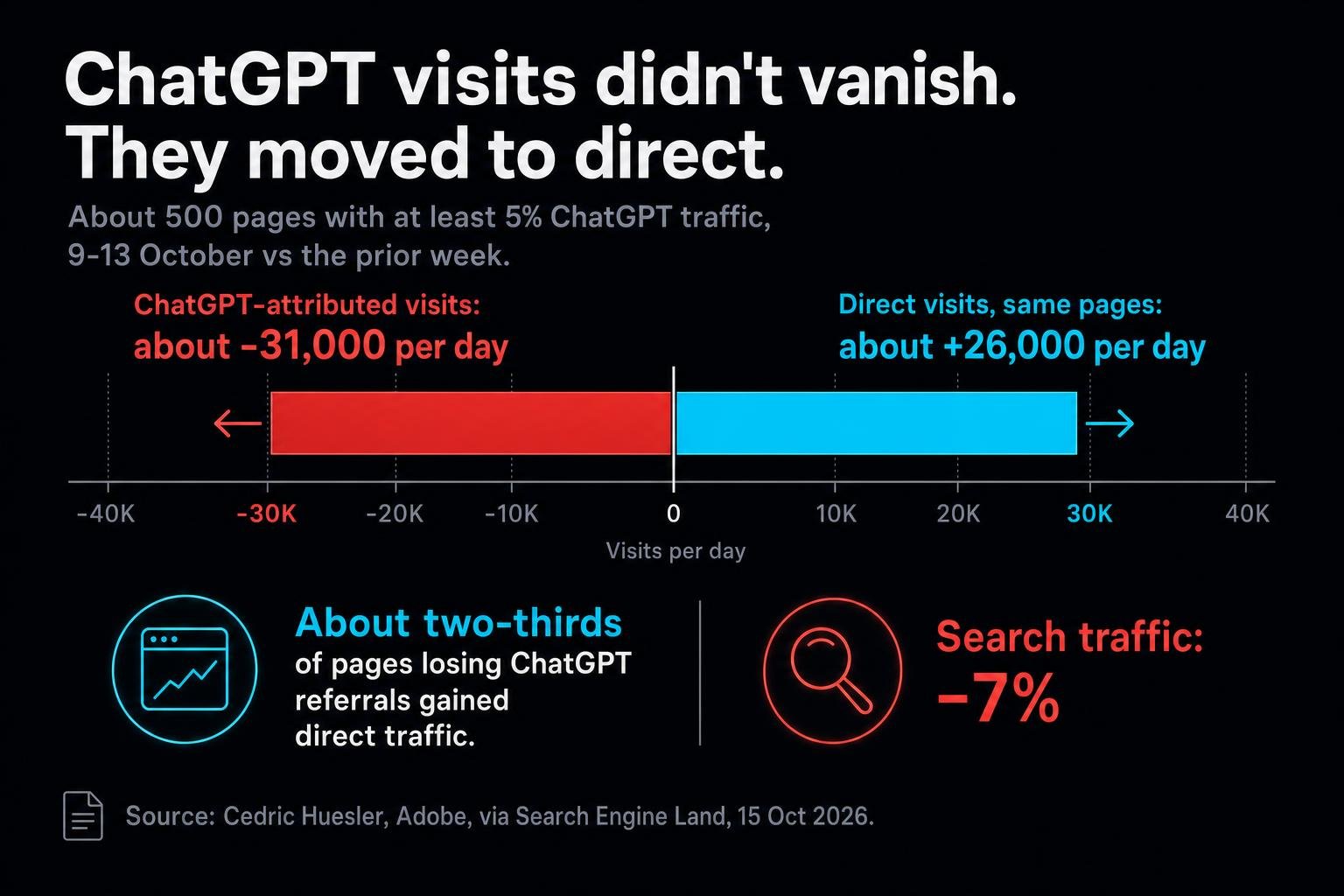
Adobe's Cedric Huesler checked the effect. He compared about 500 pages where ChatGPT accounted for at least 5% of visits, looking at 9-13 October against the week before:
- ChatGPT-attributed visits fell by about 31,000 per day.
- Direct visits to the same pages rose by about 26,000 per day.
- Search traffic fell 7%, in line with the broader trend.
- About two-thirds of the pages that lost ChatGPT referrals gained direct traffic.
Picture a shop that greets every customer with "who sent you?" For months, a growing crowd answered "ChatGPT." This week, most of those people still walked in. They just stopped answering, and the shop logged them as walk-ins.
The visitors didn't vanish. The label did. That makes the paid channel easier to prove than the organic one, at the exact moment the paid channel opened for business.
One caveat matters here. OpenAI has not confirmed whether the change is intentional, and Huesler's numbers come from a single analyst's sample of about 500 pages. It could be a side effect of how the new release opens links. Still, the outcome is the same either way: organic AI traffic just got much harder to see.
Google is walking the same road
The pattern isn't limited to OpenAI. Google confirmed it is testing ads inside AI Mode for users who opted into Personal Intelligence, the feature that lets AI Mode use limited insights from connected Google apps. That feature launched without ads. Now the test personalizes ads using connected-app context, the query and the AI answer itself.
Google says ads won't be based directly on Gmail or Photos contents, that advertisers get no access to connected apps, and that sensitive information is excluded. No new advertiser controls or rollout dates were announced. Delivery runs through existing Google Ads campaigns.
Put the stories side by side and the direction is clear. AI answer surfaces are turning into ad inventory, and the targeting signal is no longer a keyword. It's your own context: what you asked, what the AI said back, and in some cases what you've connected.
Why this matters if you're not in ads
Think of a city that tears out its free street signs while selling illuminated billboards along the same road. Drivers still find their way, but anyone measuring traffic now sees one clearly labeled stream (paid) and one murky one (everything else).
For marketers, the practical takeaway is simple. If your dashboards show AI referral traffic falling off a cliff from around 9 October, don't assume people stopped finding you. Check whether your "direct" traffic to deep pages, like blog posts and product pages that nobody bookmarks, rose at the same time. Direct visits to pages like that are a strong hint that the visitor came from somewhere that stopped introducing itself.
For everyone else, it's a reminder of how platforms mature. First they send you free traffic. Then they sell ads. Somewhere along the way, the free traffic gets harder to count, and the paid traffic is the only kind that arrives with a receipt. Whether OpenAI meant this or not, the incentive is plain to see.
I find this exciting and a little unsettling at once. Conversational ads could be far more useful than banner ads, because they show up while someone is mid-question about the exact problem. But that same intimacy is why the measurement and privacy rules matter so much. Now is the time to pay attention, while the rules are still being written.
One signal a day. No noise.
A 3-minute read when something genuinely shifts in AI, automation, or defense tech. Free, most weekdays.
Free, most weekdays. No spam, unsubscribe anytime.Sources
- Search Engine Land - ChatGPT Ads introduces new measurement tools and visual ad formats - https://searchengineland.com/chatgpt-ads-introduces-new-measurement-tools-and-visual-ad-formats-496998
- Search Engine Land - ChatGPT appears to drop UTM tracking - https://searchengineland.com/chatgpt-appears-to-drop-utm-tracking-making-ai-referral-traffic-harder-to-measure-496552
- Search Engine Land - ChatGPT Ads rolling out audience lists - https://searchengineland.com/chatgpt-ads-rolling-out-audience-lists-481712
- 404 Media - How ChatGPT targets ads to you based on your prompts, phone number and email - https://www.404media.co/how-chatgpt-targets-ads-to-you-based-on-your-prompts-phone-number-and-email/
- Search Engine Land - Google begins testing ads in AI Mode for users with Personal Intelligence enabled - https://searchengineland.com/google-begins-testing-ads-in-ai-mode-for-users-with-personal-intelligence-enabled-496990
Quick answers
Did ChatGPT stop adding utm_source=chatgpt.com to links?
According to Search Engine Land, after the GPT-6 release, ChatGPT links appear to have dropped the utm_source=chatgpt.com parameter OpenAI added in June, and links seem to suppress the referrer. OpenAI has not confirmed whether the change is intentional.
Did traffic from ChatGPT actually drop?
Probably not by much. An Adobe analyst's sample of about 500 pages showed ChatGPT-attributed visits down about 31,000 per day while direct visits to the same pages rose about 26,000 per day, which suggests most of the traffic was relabeled as direct.
How do advertisers measure ChatGPT Ads?
OpenAI added measurement integrations with Northbeam, DV Rockerbox and INCRMNTAL, plus mobile partners Kochava, Tenjin and Airbridge. Ads Manager also has a redesigned Conversions page and weekly performance emails.
Is Google showing ads in AI Mode?
Google is testing ads in AI Mode for users who opted into Personal Intelligence. Ads use connected-app context, the query and the AI answer. Google says they won't be based directly on Gmail or Photos contents and advertisers get no access to connected apps.