Meta Sells AI the Week Its Ad AI Backfired
Meta launched its first paid AI model, Muse Spark 1.1, at a bargain price built for agents. The same week, brands started calling Meta's automated ad tools "a nightmare." Both stories are the same story.

In the span of a single week in July, Meta told two very different stories about artificial intelligence. In one, it stepped on stage as a serious AI vendor. In the other, its own AI walked into a wall in front of the whole advertising industry. Both happened. Both are true. And read together, they say something important about where we are with this technology.
Story one: Meta starts selling the brains
On July 9, Meta Superintelligence Labs launched Muse Spark 1.1 along with the Meta Model API in public preview for US developers. It is Meta's first paid model offering, which is a bigger deal than it sounds. Meta has spent years giving its AI away to win developers. Now it is putting a price tag on the intelligence itself.
The model is built for what people in the field call agentic work, meaning AI that does not just answer questions but takes actions. Muse Spark 1.1 ships with a 1 million token context window (think of it as a very large short-term memory), the ability to operate a computer across multiple applications, and native multi-agent orchestration. That last phrase means one AI can act as a lead, plan a job, and hand pieces of it to a team of smaller AI helpers running in parallel, then pull the results back together.
Here is the part that will move the market: the price. Muse Spark 1.1 costs $1.25 per million input tokens and $4.25 per million output tokens, with $20 in free credits to start and free consumer access inside Meta AI's Thinking mode. Meta did not launch at the top of the price chart trying to be the smartest model in the world. It launched in the middle, at the price point where real production work actually gets done, but with orchestration features that cheaper models have not offered before.
Think of it like a car company that skips the supercars and instead drops a well-equipped family sedan at the price of a stripped-down econobox. That is where the volume is. If the orchestration claims hold up under independent testing, the going rate for running a team of AI agents just moved down a floor.
Story two: the ad tools become "a nightmare"
Then, on July 14, the other Meta showed up. MediaPost reported that eight advertisers and agency executives were describing Meta's AI advertising tools as chaotic, generating what they called "absurdities and misrepresentations."
Some brands are calling Meta's AI ad tools "a nightmare."
The examples are almost comic until you remember real money and real brands are attached. One case: an Instagram ad for REI showing a bicycle with two handlebars, generated after Meta automatically enrolled the brand into a new AI feature. Another: a campaign for a women's networking group that somehow centered a man. AdExchanger ran the same reporting under the blunt headline "Meta's Slop Problem."
The word that matters here is auto-enrolled. These features were switching on without the advertiser choosing them. A brand did not decide to let a machine reinvent its product. The machine just started, and the brand found out when a two-handlebar bike showed up in its feed.
The plumbing was already shaky
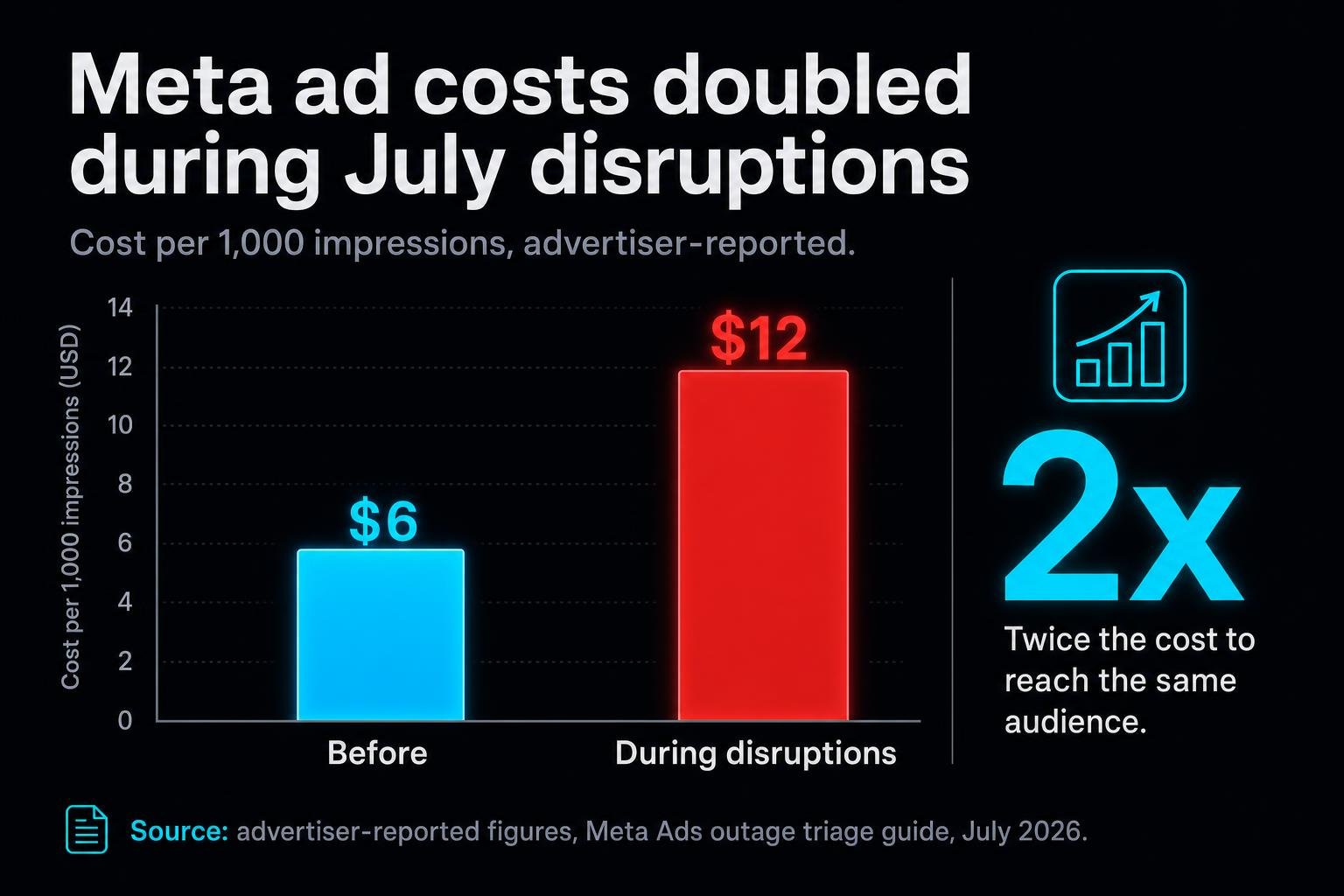
This landed on top of a rough stretch for Meta's ad platform. During early-July delivery disruptions, advertisers widely reported CPMs jumping from around $6 to around $12, effectively doubling the cost to reach a thousand people, with cost-per-click up nearly a dollar. That is not a rounding error. That is a budget cut in half overnight, with no change on the advertiser's side.
Behind that spike is a pattern. According to a triage guide compiled from advertiser reports, there were more than 60 Meta Ads outages between October 2024 and March 2026, with 53 percent of them being delivery issues, and outage frequency up 316 percent from early to late 2025. During one June incident, an advertiser documented the platform making changes it was never asked to make, switching on a shop destination and enabling promotions on ads that never had them.
Why these two stories are one story
It is tempting to file the model launch under "Meta wins" and the ad mess under "Meta loses" and move on. That misses the point. The same company is telling you, in the same week, that AI is ready to run your workflows automatically and that AI running things automatically just put a two-handlebar bike in a national ad.
The lesson is not that the technology is bad. Muse Spark's orchestration is genuinely impressive, and the price is aggressive in a good way. The lesson is about the difference between capability and control. An AI that can act on its own is powerful exactly to the degree that a human decides when it acts. The REI bike is what capability without control looks like. The gap between the two Meta stories is the gap between an AI you point at a job and an AI that decides the job for you.
For anyone running ad budgets, the takeaway is simple and old-fashioned: check what is turned on. The most dangerous setting is the one you never chose. For everyone else watching AI arrive in the tools they use every day, this week is a clean preview of the tradeoff. The intelligence is getting cheap. Deciding when to let it loose is still the whole game.
One signal a day. No noise.
A 3-minute read when something genuinely shifts in AI, automation, or defense tech. Free, most weekdays.
Free, most weekdays. No spam, unsubscribe anytime.Sources
- Meta AI - Introducing Muse Spark and the Meta Model API - https://ai.meta.com/blog/introducing-muse-spark-meta-model-api/
- TechCrunch - Meta enters the crowded AI coding battle with Muse Spark 1.1 - https://techcrunch.com/2026/07/09/meta-enters-the-crowded-ai-coding-battle-with-muse-spark-1-1/
- explainx - Muse Spark 1.1 and the Meta Model API - https://explainx.ai/blog/muse-spark-1-1-meta-model-api-july-2026
- MediaPost - Meta's AI ad tools are 'a nightmare,' some brands allege - https://www.mediapost.com/publications/article/416505/metas-ai-ad-tools-are-a-nightmare-some-brands-al.html?edition=143196
- AdExchanger - Meta's Slop Problem; What's a Media Buyer To Do? - https://www.adexchanger.com/daily-news-roundup/tuesday-14072026/
- holito - Meta Ads Outage July 2026 Triage Guide - https://holito.app/resources/meta-ads-outage-july-2026-triage-guide/
- Dallas Express - Meta Ads Manager hit with high disruptions after week of major tech outages - https://dallasexpress.com/business-markets/meta-ads-manager-hit-with-high-disruptions-after-week-of-major-tech-outages/
Quick answers
What is Muse Spark 1.1?
It is Meta's first paid AI model, launched July 9 alongside the Meta Model API in US public preview. It is built for agent-style work, with a 1 million token context window, computer use across applications, and multi-agent orchestration, priced at $1.25 per million input tokens and $4.25 per million output tokens.
Why are brands unhappy with Meta's AI ad tools?
On July 14, MediaPost reported advertisers calling the tools 'a nightmare' after Meta auto-enrolled brands into generative features. Examples included an REI ad showing a bicycle with two handlebars and a men-centered creative for a women's networking group.
How much did Meta ad costs rise during the July disruptions?
Advertisers widely reported CPMs (the cost to reach 1,000 people) roughly doubling from about $6 to about $12 during early-July delivery disruptions, with cost-per-click up nearly a dollar.
What is the common thread between the two stories?
Both are about AI acting automatically. Meta is selling AI that can run workflows on its own, while its own automated ad features misfired because they switched on without the advertiser choosing them. The gap between the two is the difference between capability and human control.