Defense's Biggest Bet Is Software, Not Steel
Anduril just closed $5B at a $61B valuation, and the contracts that got it there were built around its Lattice software, not its airframes. Here is what that says about where the real value in autonomy lives.

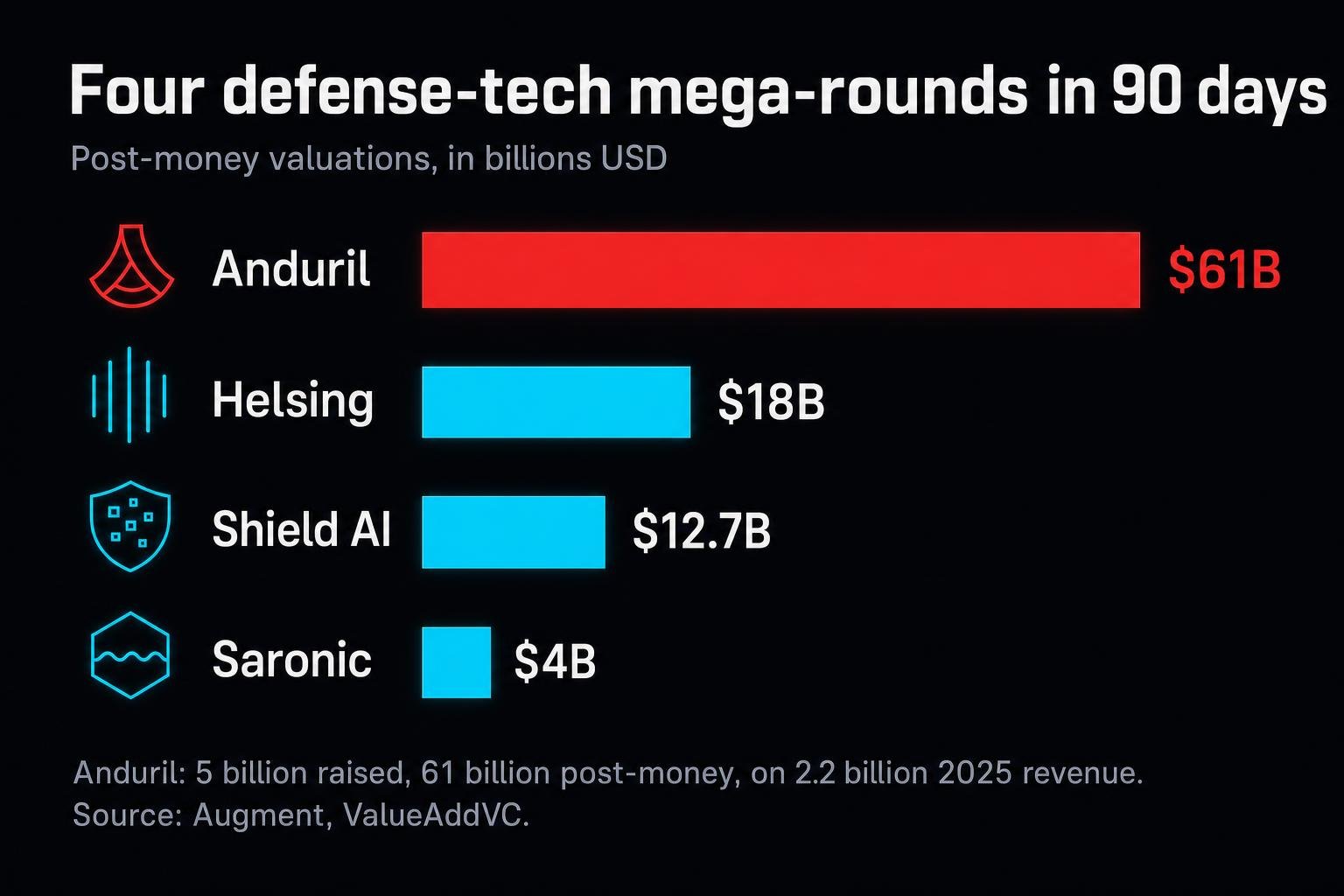
Here is a number that should stop you: Anduril just closed a $5 billion funding round at a $61 billion valuation, with Thrive Capital and a16z leading. The company disclosed $2.2 billion in 2025 revenue, doubled year over year. For a company most people have never bought anything from, that is a staggering price tag.
But the valuation is not the interesting part. The interesting part is why.
The contracts were about the software
Anduril makes drones, sensors, and hardware. Yet the two new contracts that closed alongside this round, a Dutch Ministry of Defense counter-drone deal and a US Army Indo-Pacific missile-defense task order, were both described as built around Lattice, the company's command-and-control software layer. Not around any specific vehicle. The software is the product. The hardware is just how it gets delivered.
Think of it like this. For a century, defense companies sold you the jet, the ship, the missile. The metal was the asset. Anduril is being priced like a company that sells the brain that coordinates all of it, and treats the metal as interchangeable limbs. In March, that same Lattice-first logic won it a $20 billion Army contract, the largest ever issued to a non-traditional defense contractor.
At $61 billion, the market is pricing Anduril as a software company whose hardware happens to fly. The value concentrates in the layer that orchestrates, not the thing that moves.
This is not one company getting lucky
Anduril's round is the fourth defense-tech mega-financing in ninety days. Consider the company it is keeping:
- Shield AI: $1.5 billion raised at a $12.7 billion valuation
- Helsing: $1.2 to $1.8 billion at an $18 billion valuation
- Saronic: $600 million at a $4 billion valuation
Four rounds. Ninety days. All of them autonomy-and-software companies, not traditional prime contractors bending metal. When capital moves in a pattern this tight, it is not chasing a story, it is pricing a structural shift. The money is betting that the next generation of military power is defined by who can sense, sort, and decide across a battlefield, not by who has the biggest airframe.
The same week, the doctrine caught up
What makes this more than a venture-capital story is what happened in parallel. The Department of Defense formalized Palantir's Maven Smart System as a long-term program, graduating it from experiment to permanent infrastructure. Maven started in 2017 as the Pentagon's computer-vision pathfinder. Becoming a program of record means its budget survives changes in administration, and its testing and audit obligations become contractual rather than optional.
That word, audit, matters. Experiments answer to nobody. Programs of record answer to oversight. As AI moves from pilot to permanent in defense, mandatory verification comes with it. The durable skill is not building a detection model, which is fast becoming a commodity. It is the human-review, assurance, and audit workflow wrapped around the model, which is scarce and now institutionally required.
Human-in-the-loop just went local
The clearest sign that this doctrine is spreading came from an unexpected direction. DOJ and DHS issued an interim rule giving local law enforcement and correctional agencies counter-drone authority. Before any agency can act against a drone, personnel closest to the situation must determine in real time whether a credible threat exists, judged by specific intelligence, behavioral indicators, and the drone's physical configuration. Any response must be proportionate to the threat.
Read that structure carefully, because it is the exact loop the big defense platforms are built around, now written into federal regulation for thousands of local agencies: human determines threat, tiered assessment sorts the evidence, proportionate response follows, accountability trail records it. The multi-billion-dollar orchestration logic and the small-town police department now share the same decision skeleton. The difference is only budget and scale.
Why this matters if you are not in defense
Strip away the missiles and the pattern is a general one about AI everywhere. Value is migrating from the thing that acts to the layer that decides and coordinates. In defense that layer is Lattice or Maven. In your business it is whatever orchestrates your models, keeps a human in the approval seat, and leaves an audit trail. The companies raising billions and the regulators writing rules are converging on the same conclusion at the same time: capability is cheap, and coordination plus accountability is where the money and the mandate live.
The steel still matters. It just is not the point anymore.
One signal a day. No noise.
A 3-minute read when something genuinely shifts in AI, automation, or defense tech. Free, most weekdays.
Free, most weekdays. No spam, unsubscribe anytime.Sources
- Augment - Anduril at $61B and defense tech's 2026 reset - https://augment.market/pulse/anduril-at-61b-and-defense-techs-2026-reset
- ValueAddVC - Defense tech - https://valueaddvc.com/defense-tech
- AI Business - AI defense contracts - https://aibusiness.vc/startups/ai-defense-contracts
- ASIS - US Issues Rule on Local Law Enforcement C-UAS - https://www.asisonline.org/security-management-magazine/latest-news/today-in-security/2026/july/US-Issues-Rule-On-Local-Law-Enforcement-CUAS/
Quick answers
How much did Anduril raise and at what valuation?
Anduril closed a $5 billion Series H at a $61 billion post-money valuation, led by Thrive Capital and a16z, on $2.2 billion of 2025 revenue that doubled year over year.
Why is Anduril's software important?
Its two new contracts, a Dutch counter-drone deal and a US Army Indo-Pacific missile-defense task order, were built around Lattice, Anduril's command-and-control software, rather than any specific vehicle. The market is pricing the orchestration layer, not the hardware.
What is the Maven Smart System?
Maven began in 2017 as the Pentagon's computer-vision pathfinder. In 2026 the Department of Defense formalized Palantir's Maven Smart System as a long-term program of record, moving it from experiment to permanent infrastructure with formal testing and audit obligations.
What did the DOJ and DHS counter-drone rule change?
An interim rule gave local law enforcement and correctional agencies counter-drone authority. Before acting, personnel must determine in real time whether a credible threat exists, and any response must be proportionate to that threat, extending human-in-the-loop doctrine to thousands of local agencies.