The Missile Shield Is Now a Software Problem
America's next anti-missile shield is being built less like a weapon and more like an app. The interesting part is who still gets to pull the trigger.

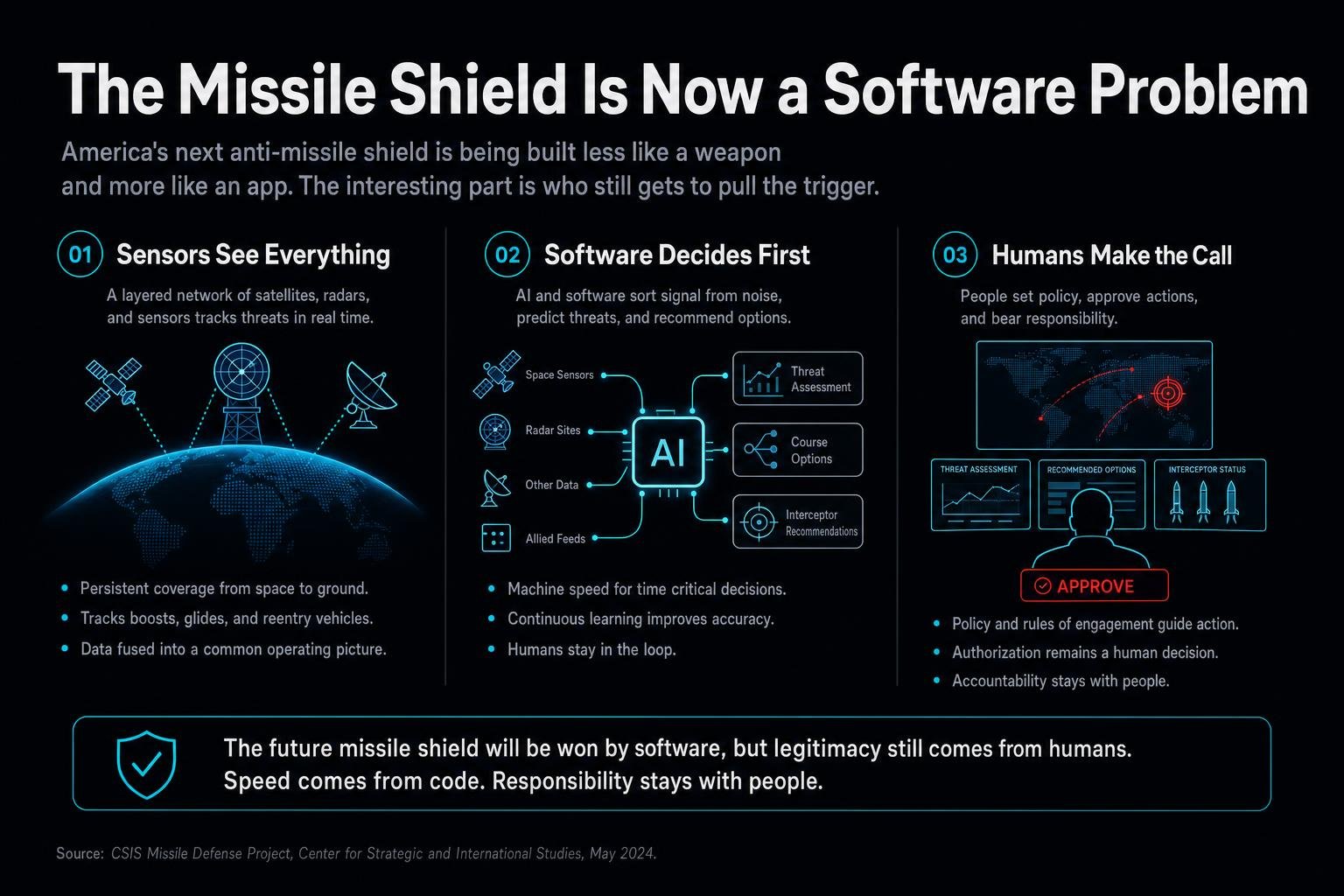
For most of the last century, building a missile defense meant building hardware: interceptors, radars, launchers, the physical stuff that catches things falling out of the sky. In 2026, the most important layer of that shield is something you cannot touch. It is code.
The clearest sign is the program nicknamed Golden Dome. According to public reporting, the software for this anti-missile shield is being developed by two companies most people associate with screens, not steel: Anduril and Palantir. Anduril's roughly $20B Army contract has been folded into a job that sounds more like enterprise IT than artillery, integrating commercial technology into one unified, AI-driven operational system.
Think of it as plumbing, not bullets
Here is an analogy. A modern missile shield has dozens of sensors scattered across land, sea, and space, all shouting at once. On their own, they are like a hundred smoke detectors going off in different rooms with no one in the hallway to figure out whether the house is actually on fire. The hard, valuable work is not buying more detectors. It is the wiring that fuses every signal into one clear picture: what is that object, where is it going, and how sure are we?
That wiring is software. And the market is reorganizing around that fact. The Army has reportedly consolidated more than 120 Anduril contracts and 75 Palantir contracts into a handful of enterprise agreements, an 88% reduction in the number of contract vehicles. Anduril added more than 1,000 staff in nine months and now sits above 6,200 people. Those two firms, plus Shield AI and Saronic, are reported to have raised over $7B in 18 months. Defense-tech funding hit $14.6B in just the first five months of 2026, already past 2025's full-year record.
The pattern repeats everywhere
Once you see defense as a software-integration problem, you spot the same shape in every corner of it.
- Counter-drone systems. Industry analysts say procurement has gone "generational," with multi-modal fusion now the favored architecture: radio-frequency sensing, computer vision, thermal, and AI classification stitched into one decision pipeline. The reason is blunt. Any single sensor throws off too many false alarms for a human to act on quickly.
- Drone swarms. Shield AI was tapped to put its Hivemind autonomy software onto the Army's Low-Cost Uncrewed Combat Attack System, with an operational demo planned for fall 2026. Hivemind acts as an "AI pilot" that reroutes around no-go zones in comms-constrained conditions. The company is also extending it to the water with a maritime demo this summer.
- Targeting. Palantir's Maven Smart System became an official Department of Defense program of record in 2026, with the contract ceiling reportedly raised by about $795M and the system extended to NATO's Allied Command Operations. Maven uses computer vision to spot objects in satellite and drone feeds.
The detail that should reassure you
It would be easy to read all this as "the machines are taking over." The public framing says the opposite, loudly and on purpose.
The software surfaces. A person decides.
Maven flags potential targets for human approval; it does not fire. The LUCAS swarm program states explicitly that a single human operator controls any decision to strike. The autonomy handles the overwhelming, boring, fast parts (watch a thousand feeds, route around hazards, rank what matters) and then hands a person a clean choice with a confidence score attached.
That design is not just an ethics talking point. It is good engineering. A system that asks a human to approve the consequential action is auditable, contestable, and far easier to trust than a black box that acts on its own. And it is the same pattern showing up far outside defense: the most useful AI tools in ordinary work are the ones that propose and let you approve, not the ones that quietly act behind your back.
Why this matters even if you never touch a defense contract
The big lesson here is portable. In autonomy, the durable value is moving away from the raw capability (the smarter model, the faster drone, the better sensor) and toward the layer that fuses noisy inputs into a single clear picture and puts a human at the decision point. "Interfaces, not smarter machines" is becoming the bottleneck.
If you build software for a living, that is the skill worth having: correlate messy signals, attach honest confidence, and design the moment where a person says yes or no. It happens to be exactly what a national missile shield now needs. It is also what your next dashboard needs.
One signal a day. No noise.
A 3-minute read when something genuinely shifts in AI, automation, or defense tech. Free, most weekdays.
Free, most weekdays. No spam, unsubscribe anytime.Sources
- Jerusalem Post - Anduril and Palantir developing Golden Dome software - https://www.jpost.com/defense-and-tech/article-891121
- Kore1 - Defense tech hiring and contract consolidation 2026 - https://www.kore1.com/defense-tech-hiring-2026/
- PR Newswire - Counter-drone procurement goes generational - https://www.prnewswire.com/news-releases/counter-drone-procurement-goes-generational-302783555.html
- PR Newswire - Sensor fusion is the new defense frontier - https://www.prnewswire.com/news-releases/sensor-fusion-is-the-new-defense-frontier-ai-video-joins-rf-in-the-race-to-counter-drones-302740367.html
- Breaking Defense - Shield AI tapped to integrate Hivemind on LUCAS drone - https://breakingdefense.com/2026/05/shield-ai-tapped-to-integrate-autonomous-software-on-lucas-drone/
- Army Recognition - LUCAS drone gets Shield AI Hivemind control - https://www.armyrecognition.com/news/aerospace-news/2026/u-s-lucas-drone-gets-shield-ai-hivemind-control-for-long-range-swarm-strike-missions
- ASD News - Shield AI expands Hivemind maritime autonomy - https://www.asdnews.com/news/defense/2026/05/13/shield-ai-expands-hivemind-maritime-autonomy-taiwan-with-thunder-tiger-partnership
- Tech Times - Defense-tech funding smashes records - https://www.techtimes.com/articles/318372/20260615/defense-tech-funding-smashes-records-autonomous-weapons-startups-raise-146b.htm
- Military.com - Pentagon expands Palantir's role, Maven program of record - https://www.military.com/feature/2026/03/22/pentagon-expands-palantirs-role-ai-contract.html
- DefenseScoop - DoD raises Maven Smart System contract ceiling - https://defensescoop.com/2025/05/23/dod-palantir-maven-smart-system-contract-increase/
Quick answers
What is Golden Dome?
It is a U.S. anti-missile shield whose software is reportedly being developed by Anduril and Palantir, framed primarily as an AI-driven software-integration effort layered over existing hardware.
Does AI decide who gets targeted?
No. Public framing is explicit that systems like Palantir's Maven flag potential targets for human approval, and the LUCAS drone-swarm program states a single human operator controls any decision to strike.
How big is defense-tech funding in 2026?
Reports put defense-tech funding at $14.6B in the first five months of 2026, already past 2025's full-year record.
Why call missile defense a software problem?
The hard work is fusing many noisy sensor feeds (radar, vision, thermal) into one clear, confident picture for a human to act on. That fusion-and-decision layer is software, and it is where the value is concentrating.