Europe's Defense Money Quadrupled. The Exits Didn't.
European defense startups are on track to raise about four times last year's total. But exit value is shrinking, and the people buying the technology are asking for evidence before they ask for demos.

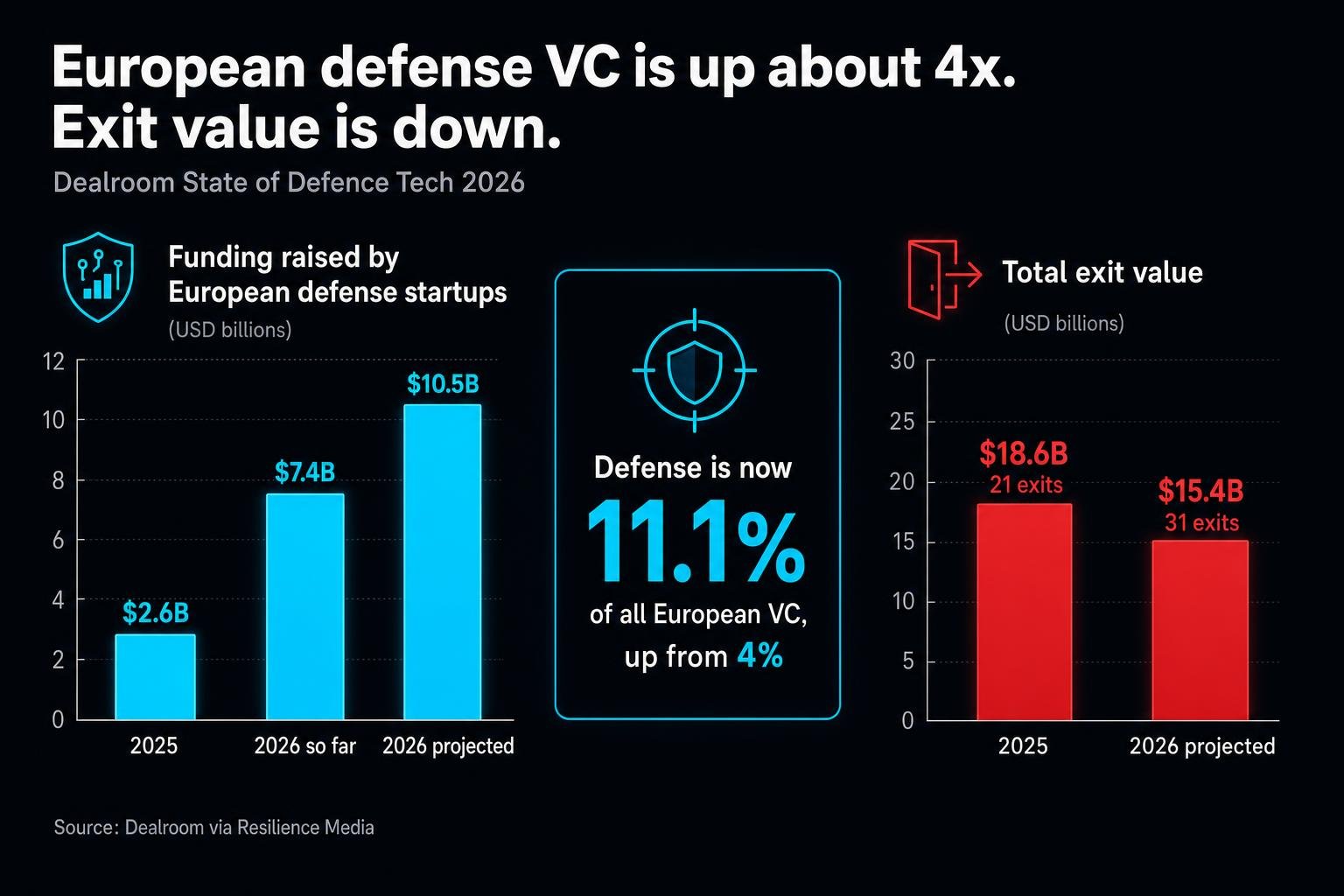
One number from this week stuck with me. In all of 2025, European defense startups raised $2.6 billion. By early October 2026 they had already raised $7.4 billion, and Dealroom projects about $10.5 billion by year end. That is roughly four times last year's total, inside twelve months.
The figures come from Dealroom's State of Defence Tech 2026, presented at Resilience Conference London on 5 October. Defense now makes up 11.1% of all European venture capital, up from 4%. Not long ago a lot of European funds wouldn't touch the sector. Now it gets more than one in every ten venture dollars.
Read further into the same report, though, and the story changes. Raising money has stopped being the hard part. The hard part now is getting out, and before that, proving the product works.
Where the money is going
Most of it goes to things that fly. Drones took $4.7 billion across 40 European rounds. Counter-drone systems took $1.2 billion and maritime robotics about $800 million. Across NATO and its allies, defense startups have raised $27.1 billion so far in 2026, and the US accounts for 75% of it.
A separate analysis of 646 defense and govtech AI rounds since 2023, published by Bot Memo on 7 October, shows what that imbalance looks like. Europe closed more seed rounds than the US this year. The typical European round was about $11 million, though, and the US closed 18 Series B rounds to Europe's 5. In that dataset, Anduril alone took 22% of 2026's money.
Picture a garden. Europe is planting a lot of seeds, more than its neighbor this season. Far fewer of them are growing into trees, and one giant oak next door is taking a big share of the water.
More exits, less value
This is where it gets uncomfortable. Dealroom counted 21 exits in 2025 and projects 31 for 2026, which sounds healthy. Total exit value is going the other way, from $18.6 billion down to a projected $15.4 billion. So more companies are getting out, and they are getting out for less.
Bessemer's Alex Ferrara explained why in one line: in defense, "there are only a small number of strategic acquirers."
Think of a farmers market with dozens of new stalls and only a few buyers who show up with trucks. The buyers set the price. A flood of new sellers doesn't change that. It makes it worse. Capital is pouring in at the front of the pipeline while the back end stays narrow.
Getting funded is no longer the hard part of defense tech. Proving the product works is.
Buyers want evidence before demos
Two talks at the same conference made this concrete.
Sally Pfenning of US European Command (USEUCOM) said startups historically had "no obvious route" into the command. It is reorganizing around mission engineering, requirements, experimentation and capability innovation. The part I found most telling is that it specifically wants modelling and simulation tools to assess technologies virtually before physical experimentation, to build a case the Pentagon "can't say no to." Instead of big industry days, it plans to run small groups of companies, investors and operators built around a single problem.
It works like a flight simulator. Pilots don't learn on a real aircraft full of passengers. They log hours in a simulator first, and only then get the real thing. USEUCOM wants new technology to go through the same order: test it virtually, then test it in the field.
Ukrainian unit representatives were blunter. They said products can become obsolete within months because electronic warfare and tactics keep changing. They don't want sales reps. They want engineers working alongside their engineers. They also named what they need: systems that let fewer operators control more platforms, and AI tools that help staffs process growing battlefield data and decide faster.
Notice what is missing from both lists. Neither one asks for a better pitch deck or a slicker demo. They ask for evidence, for speed of iteration, and for software that helps people make decisions without taking the decision away from them.
Why this matters beyond defense
It's tempting to read a funding boom as a success story. Funding measures how much investors believe. It doesn't measure outcomes. Right now European defense has plenty of belief and a narrow road to outcomes: few large rounds, few acquirers, and buyers who want proof before they commit.
That points to a few things I expect to see:
- Evidence becomes the product. Teams that can show, in simulation and then in the field, how their system performs will move faster than teams that only show features.
- Speed of iteration beats feature lists. When products can go stale in months, the ability to update and redeploy matters more than how a product looks on launch day.
- Human-centered software gets pulled forward. Both buyers asked for tools that help people handle more data and more platforms while people still make the calls.
- Exit math shapes strategy. With few strategic acquirers, founders and investors will have to plan for a smaller set of buyers from day one.
Europe has proven it can raise money for defense. The next test is quieter and harder. It has to show the technology works before anyone takes it into the field, and it needs a way out for the people who funded it. If this year's buyers are any guide, simulation is where that proof starts.
One signal a day. No noise.
A 3-minute read when something genuinely shifts in AI, automation, or defense tech. Free, most weekdays.
Free, most weekdays. No spam, unsubscribe anytime.Sources
- Resilience Media: State of Defence Tech 2026, European defence startup funding to quadruple to $10.5B - https://resiliencemedia.co/state-of-defence-tech-2026-european-defence-startup-funding-to-quadruple-to-10-5b/
- Bot Memo: Defense AI funding 2023 to 2026 - https://botmemo.substack.com/p/defense-ai-funding-23-26
- Resilience Media: USEUCOM builds new front door for European defence tech - https://resiliencemedia.co/useucom-builds-new-front-door-for-european-defence-tech/
- Resilience Media: Ukraine's military tells defence startups to get closer to the front line - https://resiliencemedia.co/ukraines-military-tells-defence-startups-to-get-closer-to-the-front-line/
Quick answers
How much have European defense startups raised in 2026?
According to Dealroom's State of Defence Tech 2026, European defense startups raised $7.4 billion by early October 2026, with about $10.5 billion projected by year end, compared with $2.6 billion in 2025.
What share of European venture capital now goes to defense?
Defense accounts for 11.1% of all European venture capital in 2026, up from 4%, per Dealroom's figures as reported by Resilience Media.
Why is defense tech exit value falling while funding rises?
Dealroom projects exits rising from 21 in 2025 to 31 in 2026, but total exit value falling from $18.6 billion to $15.4 billion. Bessemer's Alex Ferrara noted that defense has only a small number of strategic acquirers, which limits exit options and prices.
What do defense buyers want from startups now?
US European Command wants modelling and simulation tools to assess technologies virtually before physical experimentation. Ukrainian unit representatives asked for engineers who work alongside their teams, systems that let fewer operators control more platforms, and AI tools that help staffs process battlefield data and decide faster.