Defense Tech's $14.6B Five Months
Defense-tech startups raised more in the first five months of 2026 than in any full year before it - and the frontier AI labs just walked in. Here's what's actually being built.

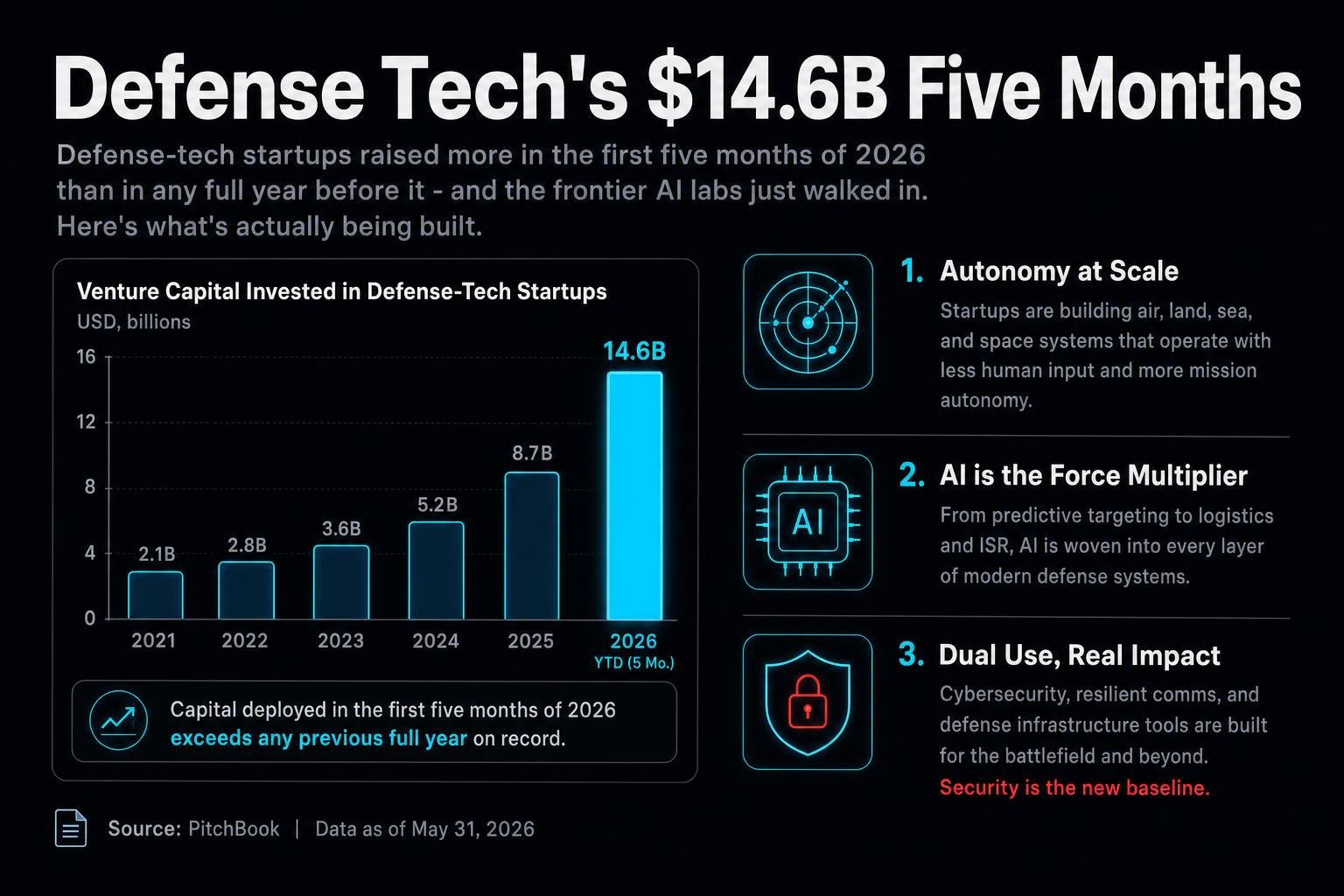
Every so often a number stops me mid-scroll. This week it was this one: defense-tech startups raised $14.6 billion in just the first five months of 2026 - already past the full-year 2025 record of $9.6 billion. Five months beat twelve. That's not a trend line; that's a hockey stick.
If you've been treating "defense tech" as a niche corner of the startup world, this is the moment to recalibrate. The money, the talent, and now the biggest AI labs are all pointing the same direction at the same time.
The money got loud
The headline check came from Anduril, which closed a $5 billion Series H on May 13 at a roughly $61 billion valuation. Shield AI and Saronic were close behind. To put $61 billion in perspective: that's a private startup valued like a mature, publicly-traded industrial giant - except it mostly makes autonomous systems and software.
Think of it like the early cloud era. For years, "infrastructure" was unglamorous plumbing nobody wanted to fund. Then suddenly everyone realized the plumbing was the business, and the capital arrived all at once. Defense tech is having that moment now.
Five months of 2026 raised $14.6B - more than the entire record-setting year before it. The category didn't grow. It changed phase.
The Pentagon is consolidating - and the AI labs are arriving
Money is only half the story. The other half is that the buyer is getting organized. The U.S. Army folded 120+ Anduril contracts and 75 Palantir contracts into enterprise agreements - an 88% reduction in contract vehicles. In plain terms: instead of a thousand tiny, separate purchase orders, the government is signing a few big platform deals and building on top of them.
That matters because it tells you where the value is pooling. When a buyer standardizes on a platform, the opportunity shifts from "sell them one gadget" to "plug into their ecosystem."
And the frontier labs noticed. There's now an OpenAI-Pentagon military-AI agreement, and Palantir won a $480 million contract for an AI-system prototype. When the same companies racing to build your chatbot are also signing defense contracts, the line between "consumer AI" and "national-security AI" has officially blurred.
What's actually being built (and it's not what the movies show)
Here's the part that surprised me most, and the part worth paying attention to if you build software: the most interesting work isn't autonomous weapons. It's the confirmation and evidence layer around them.
Take counter-drone defense. A reference architecture making the rounds - VisionWave's Argus system - fuses radio-frequency detection with AI video confirmation. An RF sensor flags a possible threat, and then a computer-vision camera has to visually confirm it before anything escalates. VisionWave even acquired the xClibre AI video platform in April 2026 to bring that vision capability in-house, with a proof-of-concept targeted for the second half of 2026.
Notice the design: "the radio says maybe, the camera confirms, and a human stays in the loop." That's not a sci-fi kill-bot. That's a smoke detector that double-checks with a security camera before calling the fire department. The valuable, responsible engineering is in the fusion, confirmation, and audit trail - and that exact pattern is just as useful for airports, stadiums, and critical infrastructure as it is for the battlefield. The context for all this: the Pentagon's Drone Dominance Program is targeting 200,000+ autonomous systems.
The boring, learnable on-ramp: maps
If the funding numbers feel out of reach, here's the encouraging part. A lot of the foundational layer is being built on open standards anyone can learn. Defense digital twins are consolidating on Cesium's 3D Tiles and glTF formats - the same tech that powers NVIDIA's Earth-2. A Blackshark.ai and Microsoft project even used geospatial data to build a digital twin for AI-driven water-level prediction.
The pattern is open and interoperable, not locked-down and proprietary. Which means the skills - 3D terrain, geospatial overlays, mapping no-go zones - are learnable with public tools, and they transfer cleanly to logistics, real estate, and infrastructure. The terrain map under a defense dashboard and the one under a delivery-routing app are closer cousins than you'd think.
Why this matters even if you never touch defense
Three things are worth carrying out of this. First, capital is institutionalizing a category that was fringe eighteen months ago - and institutional money brings demand for an entire surrounding software economy. Second, the frontier AI labs entering means the tools you already use are converging with this world. Third, the durable, fundable work keeps landing on the unglamorous layers: confirmation pipelines, audit logging, geospatial overlays, sim-test harnesses - dual-use software that never has to go near a weapon.
Booms make headlines on the biggest checks. They get built on the boring layers underneath. That's usually where I'd put my attention.
One signal a day. No noise.
A 3-minute read when something genuinely shifts in AI, automation, or defense tech. Free, most weekdays.
Free, most weekdays. No spam, unsubscribe anytime.Sources
- TechTimes - Defense Tech Funding Smashes Records: $14.6B Raised - https://www.techtimes.com/articles/318372/20260615/defense-tech-funding-smashes-records-autonomous-weapons-startups-raise-146b.htm
- Augment - Anduril at $61B and Defense Tech's 2026 Reset - https://augment.market/pulse/anduril-at-61b-and-defense-techs-2026-reset
- tech-insider - OpenAI-Pentagon Military AI Deal 2026 - https://tech-insider.org/openai-pentagon-military-ai-deal-2026/
- Seeking Alpha - Palantir Wins $480M Defense Contract for AI System Prototype - https://seekingalpha.com/news/4111377-palantir-wins-480m-defense-contract-for-ai-system-prototype
- PRNewswire - Sensor Fusion Is the New Defense Frontier: AI Video Joins RF - https://www.prnewswire.com/news-releases/sensor-fusion-is-the-new-defense-frontier-ai-video-joins-rf-in-the-race-to-counter-drones-302740367.html
- The Droning Company - Sensor Fusion Is the New Defense Frontier - https://thedroningcompany.com/blog/sensor-fusion-is-the-new-defense-frontier
- Cesium - Digital Twins for Defense - https://cesium.com/use-cases/digital-twins-for-defense/
Quick answers
How much did defense-tech startups raise in early 2026?
They raised $14.6 billion in the first five months of 2026, already surpassing the full-year 2025 record of $9.6 billion.
What was the biggest defense-tech raise?
Anduril's $5 billion Series H, closed on May 13, valuing the company at roughly $61 billion. Shield AI and Saronic were also major raisers.
Are the big AI labs involved in defense now?
Yes. There is an OpenAI-Pentagon military-AI agreement, and Palantir won a $480 million contract for an AI-system prototype.
What kind of defense software is actually being built?
Much of the work is in dual-use, human-in-the-loop layers: sensor fusion and confirmation (like RF detection confirmed by AI video), audit logging, and open-standard geospatial digital twins built on Cesium's 3D Tiles and glTF.