AI Governance Just Split Into Two Blocs
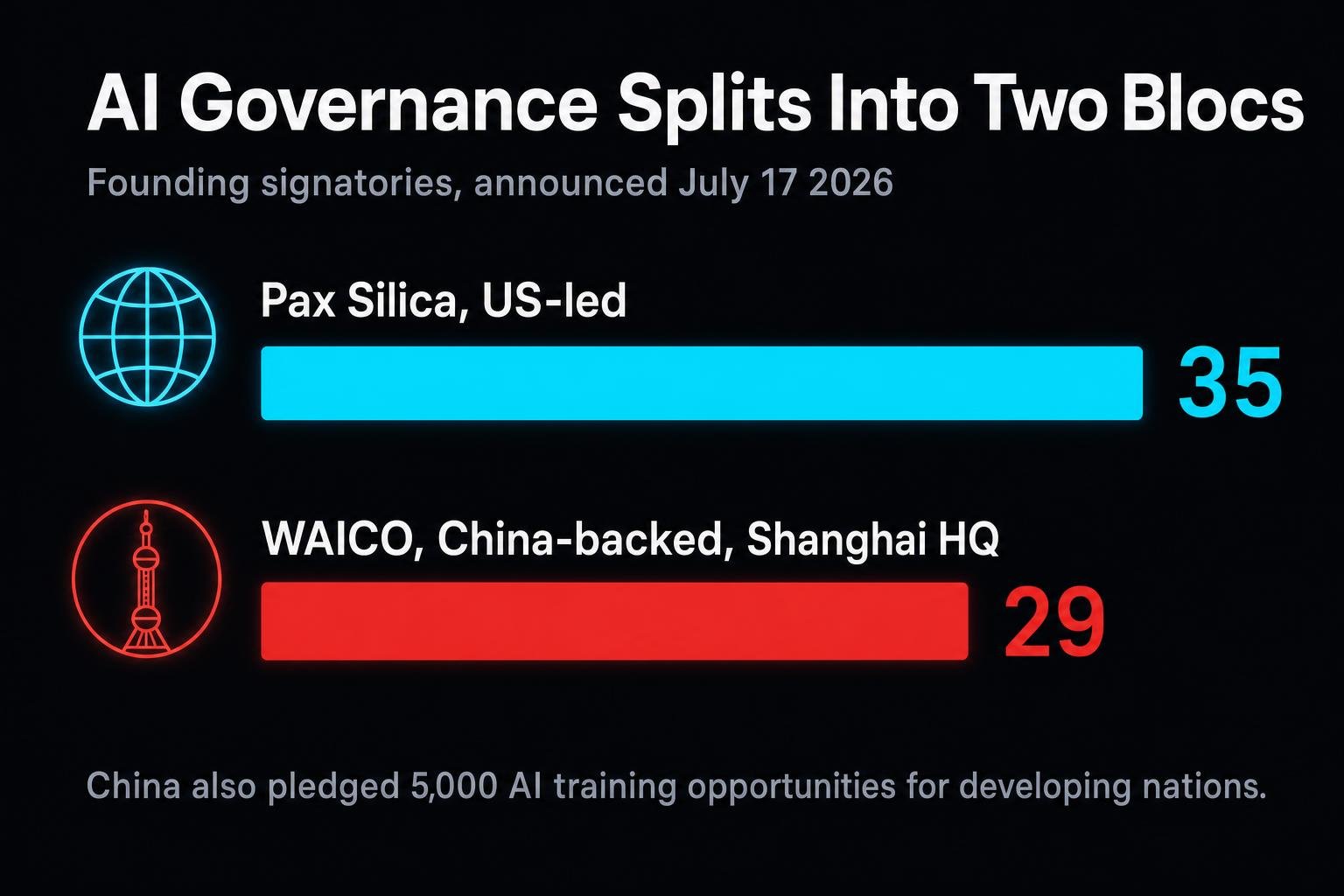
On July 17, China launched WAICO, a 29-nation AI-governance body headquartered in Shanghai, against the US-led Pax Silica's 35. The rulebook for AI now has rival authors.
For a couple of years, the fight over who gets to write the rules for artificial intelligence felt like a debate. Brussels had its AI Act, Washington leaned toward deregulation, and everyone else watched. On July 17, 2026, that debate turned into something more concrete: a map with lines drawn on it.
At the opening of the World Artificial Intelligence Conference in Shanghai, Xi Jinping keynoted the event for the first time and announced that 29 countries had signed the founding agreement for the World Artificial Intelligence Cooperation Organization, or WAICO. It is a China-backed intergovernmental body, headquartered in Shanghai, and its charter members read like a specific geography: Russia, Brazil, Indonesia, Pakistan, Cuba, Venezuela. Not a single major Western democracy is on the list.
The reason that absence matters is that there is now a rival on the other side. Coverage of the launch names a US-led initiative called Pax Silica, which has 35 signatories to WAICO's 29. For the first time, AI governance is not one messy global conversation. It is two organized blocs, each building its own institution, each trying to set the standard the rest of the world adopts.
Two operating systems for one technology
Think of it like the old format wars, VHS against Betamax, or the plug on the wall that changes when you cross a border. Underneath the plastic, the electricity is the same. What differs is the standard wrapped around it, and standards are sticky. Once a country builds its hospitals, its schools, and its courts on one set of rules for how AI can be used, switching later is painful and expensive.
That is the game being played here. Xi did not pitch WAICO as a walled garden. He pitched it as generosity. He framed China's open-source models as a global public good, warned against any single country dominating the technology, and pledged 5,000 AI training opportunities for developing nations. It is a smart move. If you cannot outspend a rival, you can out-give them, and free, capable, open models are a powerful gift to a country that cannot afford to build its own.
The wedge is not the model. The wedge is who teaches the next billion people how to use it.
Why a non-specialist should care
You might reasonably ask why a summit in Shanghai should matter to someone who just wants their tools to work. Here is the honest answer: the bloc a technology is governed under eventually shows up in your daily life, usually without you noticing.
The clearest analogy is data. A decade ago, almost nobody outside a legal department thought about where their information physically lived. Then privacy rules hardened into blocs of their own, and suddenly "which country is your data stored in" became a question every business had to answer. The same thing is starting to happen with AI models. Before long, the question will not only be "is this model any good" but "whose rulebook was it built under."
There is also a price story hiding inside the politics. When a government treats open-source models as a strategic asset and something worth subsidizing, the floor on what capable AI costs keeps dropping. Cheap, powerful models flowing out with state backing behind them means the whole world gets access faster. That is genuinely good for anyone who wants to build. It also means the models carrying the most reach may increasingly come with a flag attached.
The part nobody can predict yet
Here is where I will be honest about the limits of the moment. A signing ceremony is not a standard. The real test of WAICO is not how many countries showed up in Shanghai. It is whether the organization ever publishes something technical, an actual interoperability or safety document that engineers have to follow, or whether it stays diplomatic theater with a nice logo.
The same skepticism applies to Pax Silica's 35. A bigger number on a press release is not the same as a working institution. Both blocs are, right now, mostly ambition. But ambition is how these things start, and the fact that two rival organizations exist at all changes the shape of the next decade. We have moved from arguing about the rules to competing over who writes them.
My read: the most interesting variable is Europe. Brussels has been building its own approach and, so far, has joined neither bloc. If the EU quietly drifts toward the US-led side, that effectively sets the compliance line for a huge share of the global economy. If it holds out as a genuine third pole, we are not looking at two blocs. We are looking at three.
Either way, the era of a single global conversation about AI is over. What replaced it, on a Saturday in Shanghai, is a competition. And competitions, unlike debates, tend to produce winners.
FAQ
- What is WAICO? The World Artificial Intelligence Cooperation Organization, a China-backed intergovernmental body launched July 17, 2026 at the WAIC summit in Shanghai, with 29 founding member countries.
- Which countries joined? Charter members include Russia, Brazil, Indonesia, Pakistan, Cuba, and Venezuela. No major Western democracy signed the founding agreement.
- What is Pax Silica? The US-led AI initiative cited as WAICO's direct rival, reported to have 35 signatories compared with WAICO's 29.
- Why does it matter? It is the first time AI governance has organized into competing intergovernmental blocs, with China positioning open-source models as a global public good to win influence across the developing world.
One signal a day. No noise.
A 3-minute read when something genuinely shifts in AI, automation, or defense tech. Free, most weekdays.
Free, most weekdays. No spam, unsubscribe anytime.Sources
- Al Jazeera - China's Xi Jinping launches new AI alliance: What is it? - https://www.aljazeera.com/news/2026/7/17/chinas-xi-jinping-launches-new-ai-alliance-what-is-it
- IBTimes - Xi unveils WAICO: China builds 29-nation AI alliance - https://www.ibtimes.sg/xi-unveils-waico-china-builds-29-nation-ai-alliance-shape-global-rules-provide-affordable-models-89952
- TechTimes - China launches rival AI governance bloc as WAIC 2026 opens - https://www.techtimes.com/articles/320812/20260717/china-launches-rival-ai-governance-bloc-waic-2026-opens-300-product-debuts.htm
- France 24 - China's Xi urges global cooperation on AI, warns against single-country dominance - https://www.france24.com/en/asia-pacific/20260717-china-s-xi-urges-global-cooperation-on-ai-warns-against-single-country-dominance
- Rappler - Xi Jinping, China, World AI Cooperation Organization - https://www.rappler.com/technology/xi-jinping-china-world-ai-coperation-organization/
Quick answers
What is WAICO?
The World Artificial Intelligence Cooperation Organization, a China-backed intergovernmental body launched July 17, 2026 at the WAIC summit in Shanghai, with 29 founding member countries.
Which countries joined WAICO?
Charter members include Russia, Brazil, Indonesia, Pakistan, Cuba, and Venezuela. No major Western democracy signed the founding agreement.
What is Pax Silica?
The US-led AI initiative cited as WAICO's direct rival, reported to have 35 signatories compared with WAICO's 29.
Why does this matter?
It is the first time AI governance has organized into competing intergovernmental blocs, with China positioning open-source models as a global public good to win influence across the developing world.