The EU Wants Your Cancel Button to Actually Work
On 11 Nov the European Commission proposed the Digital Fairness Act. It would ban fake scarcity, require reminders before a free trial converts, and guarantee you can reach a human instead of only a chatbot. It is still a proposal, but product teams should read it like a spec.

Most digital products have a room they never show guests. It's usually the cancel flow, sometimes the checkout timer, sometimes the little banner that says a hotel is "almost sold out" when nobody is really sure it is. On 11 November in Brussels, the European Commission walked straight into that room with the Digital Fairness Act (DFA), and it wants the lights left on.
The DFA is a proposal. Parliament and Council still have to pass it. But you can read it as a list of what regulators think is broken in online products today, and almost every item on that list is a product decision, not a legal one.
What Brussels actually proposed
Here is what the Commission presented, together with a reform of the Consumer Protection Cooperation (CPC) Regulation, according to Euronews:
- A ban on dark patterns. The example it names is the fake-scarcity message "almost sold out."
- Clear pricing, including real-time display when prices are dynamic.
- An off switch for addictive features such as endless scroll and autoplay, controlled by the consumer.
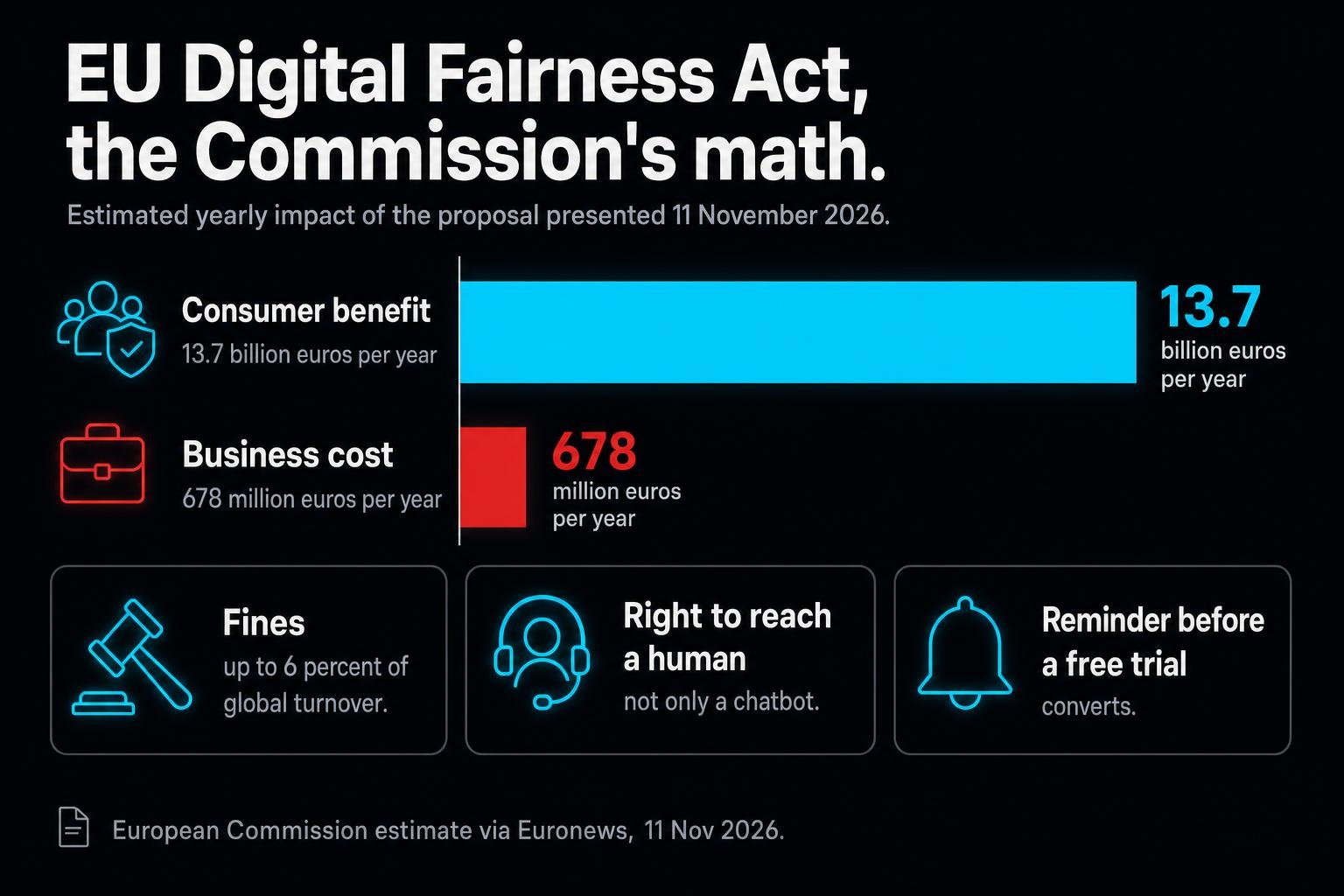
- Subscriptions that are easier to cancel, a reminder before a free trial converts to paid, and auto-renewal only when the customer has consciously chosen it.
- A right to reach a human in customer service, not only a chatbot.
- The EU's first rules on influencer disclosure.
- A ban on unfair personalised ads and pricing aimed at minors or vulnerable people.
A leaked draft had been circulating two days earlier, on 9 November, so the industry saw this coming. What's new is that it is now an official proposal with an enforcement plan attached.
The chatbot clause matters most for AI
Most of the list looks like old consumer-protection business: fake timers, sneaky renewals, hidden fees. One line is new for this decade: the right to reach a human in customer service rather than only a chatbot.
That is aimed squarely at the AI support wave. Many companies have rolled out AI agents in support because they are fast, cheap and never off shift. Nothing in the proposal bans them. What it bans is the locked door: a support experience where the bot is the only way in and there is no exit to a person.
Think of it like an automated parking garage. Nobody objects to the ticket machine. People object when the machine jams, the barrier stays down, and there's no intercom. The DFA basically requires the intercom.
For anyone building AI customer experiences, the design question shifts. "Can the bot handle this?" stops being enough. You also need to answer "how fast can a frustrated customer get past the bot, and does the bot ever stand in their way?"
Why the math favours the regulator
The Commission estimates that the package would deliver €13.7 billion a year in benefit to consumers, against €678 million a year in cost to businesses. By the Commission's own numbers, consumers come out ahead by roughly twenty to one.
When a regulator can say the benefit is about twenty times the cost, the argument in Parliament is no longer whether to act. It's how fast.
You can argue with any impact estimate, and industry groups surely will. But a ratio that lopsided makes this a hard fight for anyone lobbying against it.
The enforcement has teeth, and it reaches outside the EU
The CPC reform is the enforcement half, and it is the part that should get the attention of companies outside Europe. Under it, the Commission could fine up to 6% of global turnover in large cross-border cases. Non-EU firms selling to EU consumers would also have to appoint a legal representative in the EU.
So a US or Asian subscription app with European customers would not be a bystander. It would need someone in the EU who answers for it, and the potential fine is a share of its global revenue, not just its European sales.
It's a proposal, not a law (yet)
Parliament and Council must still pass the DFA, and the text can change on the way. Specific definitions, thresholds and timelines may move. That is a good reason not to panic, and a bad reason to do nothing. The direction is clear: subscription traps, fake urgency and chatbot-only support are being treated as harms, not as growth tactics.
What this means if you build products
The interesting thing about the DFA is that it reads like a product requirements document. "Send a reminder before the trial converts" is a feature. "Let the user turn off autoplay" is a settings toggle. "Offer a human" is a routing rule in your support stack. None of these are hard to build. They are hard to choose, because each one can cost a bit of short-term conversion.
That trade-off is what the Commission is really pricing. Its bet is that trust is worth more than the conversions these tricks capture. In my experience, the teams that make that trade on their own, before a regulator forces it, end up with products that customers recommend instead of products customers escape.
What I'd audit before Brussels does
If I ran a product that sells to anyone in the EU, I wouldn't wait for the final text. I'd do this audit in this order, because it goes from cheapest to fix to hardest.
- Walk the cancel flow yourself. Count the clicks from "I want out" to "you're out." If it takes longer than signing up did, that's your first ticket.
- Check every free trial for a reminder before it converts, and make sure auto-renewal is something the customer actively chose.
- Search your copy for urgency claims. Every "almost sold out" or countdown should be backed by real inventory or a real deadline. If it isn't, delete it.
- Test your AI support as an angry customer. Time how long it takes to reach a human. Then ask your support vendor plainly: what's the escalation path, and can we prove it exists?
None of these fixes requires a lawyer. They need someone willing to give up a little conversion in exchange for a lot of trust.
One signal a day. No noise.
A 3-minute read when something genuinely shifts in AI, automation, or defense tech. Free, most weekdays.
Free, most weekdays. No spam, unsubscribe anytime.Sources
- Euronews via Yahoo News - EU targets subscription traps and addictive design - https://au.news.yahoo.com/eu-targets-subscription-traps-addictive-152249789.html
- Euronews - EU to blacklist manipulative online design traps, leaked draft shows - https://euronews.com/2026/11/09/eu-to-blacklist-ten-manipulative-online-design-traps-leaked-draft-shows
Quick answers
What is the EU Digital Fairness Act?
It is a European Commission proposal presented on 11 November 2026 that would ban dark patterns such as fake scarcity, require clear and real-time dynamic pricing, make subscriptions easier to cancel, require reminders before free trials convert, and give consumers the right to reach a human in customer service. Parliament and Council must still pass it.
Does the Digital Fairness Act ban AI chatbots in customer service?
No. As reported, it gives consumers the right to reach a human in customer service rather than only a chatbot. Chatbots can still be used, but they cannot be the only way to get help.
How big are the fines under the Digital Fairness Act package?
The parallel reform of the Consumer Protection Cooperation Regulation would let the Commission fine up to 6% of global turnover in large cross-border cases.
Does the Digital Fairness Act apply to companies outside the EU?
Under the CPC reform, non-EU firms would have to appoint a legal representative in the EU, so companies selling to EU consumers from abroad would be covered by enforcement.