Everyone Bought AI Search. Few Can Prove It.
New research shows nearly nine in ten marketing leaders raised AI search spend, but only 24% can show what it returns. Meanwhile the engines quietly changed what they cite.

Picture a company that rents billboards along a highway, but nobody can count the cars driving past. It keeps renting more boards because everyone else is. That's roughly where AI search budgets stand at the end of 2026.
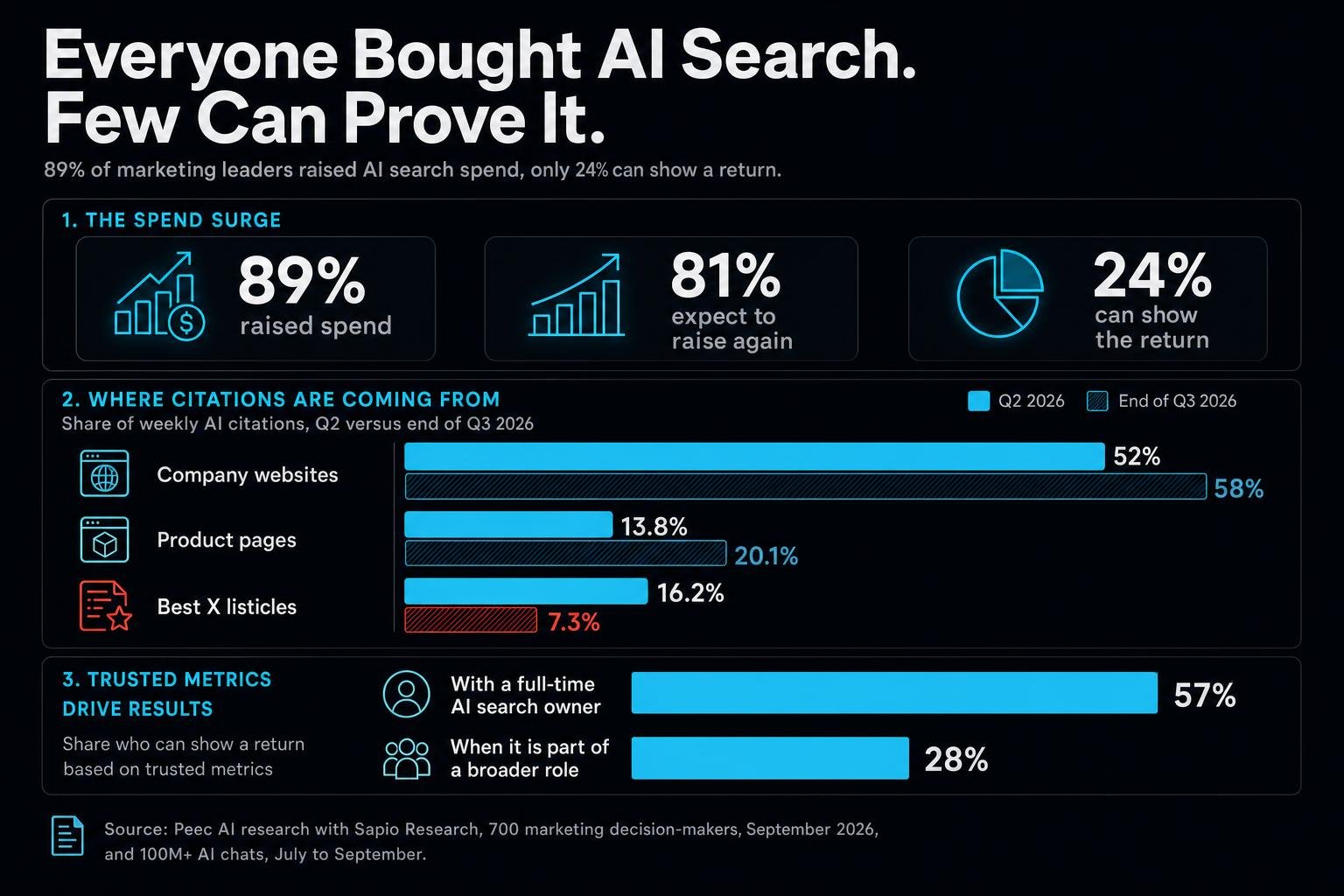
On 11 November, Peec AI, a Berlin AI-search analytics vendor, launched a quarterly research series. The headline numbers: 89% of marketing decision-makers raised their AI search spend over the past year, 81% expect to raise it again, and only 24% can show what the channel returns.
Money is going in and the proof isn't coming back. Read with the platform data from the same report, the problem gets clearer. It isn't just that teams can't measure. What they're trying to measure kept moving.
What the survey found
The survey half was run by Sapio Research. It covered 700 marketing decision-makers at manager level or above, at companies with 100 or more employees: 300 in the US, 200 in the UK and 200 in Germany. It was fielded in September 2026.
Proof of return varied by market. In the US, 31% could show it. In the UK the figure was 19%, and in Germany 18%. Even among those who raised spend significantly, 64% cannot prove a return. Spending more didn't produce more confidence.
The ground moved under the spend
The second half of the report draws on more than 100 million AI chats across ChatGPT, Google AI Overviews, AI Mode, Gemini and Claude, from July to September. The shifts in what gets cited are big.
- Company websites rose from 52% to 58% of weekly citations between Q2 and the end of Q3.
- Product pages rose from 13.8% to 20.1%.
- "Best X" listicles fell from 16.2% to 7.3%.
Then there's ChatGPT. After it switched its default model on 8 August, Reddit citations fell from 59 per 100 Q2-week citations in late July to 9 by mid-September. Conversations that used a single search fell from 98% to 39%, and the number of sources per answer rose from 11 to 19.
Here's the analogy. The old behavior was like asking one librarian a question and taking their first recommendation. The new behavior is closer to a researcher who walks the stacks, pulls a pile of books, and cross-checks them before answering. Each source gets less of the spotlight, and which sources make the pile is up for grabs.
When the engine changes how it reads the web, last quarter's winning tactic can turn into this quarter's blind spot overnight.
For brands, the direction is encouraging. Answer engines are leaning more on first-party sources, meaning a company's own site and especially its product pages, and less on third-party roundups. Work on pages you control appears to count for more than it did in the spring.
Why proof is so hard right now
The pressure to show results isn't coming only from marketing. On the same day, Validity published a survey of more than 250 marketers. It found that 61% face C-suite pressure to prove AI gains. AI tools and agents ranked second on the mid-year cut list at 16%, behind paid media at 20%. Validity didn't disclose field dates or geography, so treat it as a directional read, but the message lines up with Peec's: leadership wants receipts.
Vendors are also offering bigger claims about the opportunity. Profound says commercial ChatGPT conversations grew 119% from June 2025 to June 2026, and that AI-started journeys reach purchase in a median 5.2 days. That's vendor data with a sample described only as "thousands" of conversations. It may well be directionally true, but it doesn't help a marketer prove their own return. It's a reason to spend, not evidence that the spend works.
That's the trap. The case for investing is loud. The case that a given investment worked is often missing, and the platforms keep reshuffling what they cite.
The owner effect
One finding in the Peec report stands out. Companies with a full-time AI search owner report trusted metrics at 57%. Where AI search is part of a broader role, it's 28%.
That gap says something simple. Measurement doesn't come with the budget. It comes from someone whose job is to define the questions, run them consistently, and notice when the ground shifts. A channel that changes this fast needs someone watching it full time.
What this means for operators
- Measure the answer, not the activity. Content shipped and tools bought are inputs. The output is whether you get cited when a buyer asks the question that matters.
- Put weight on pages you own. The citation share for company websites and product pages went up while listicles fell. Clear, specific product pages are now more likely to be the source.
- Log platform changes next to your numbers. A swing like the one after ChatGPT's 8 August default model switch can look like your team's failure when it's really the engine's change.
- Give it an owner. On this data, teams with dedicated ownership report trusted metrics about twice as often.
AI search is a real channel, and the money flowing into it says leaders believe that. But belief isn't a metric. The teams that come out ahead in 2027 will be the ones that can point to a number and explain why it moved.
What a citation baseline taught me
I built a measurement harness that runs a fixed set of buyer questions against ChatGPT, Perplexity and Gemini, detects whether a target brand or domain is cited, and tracks the citation rate over time. The goal was to turn answer-engine optimization from opinion into a baseline and a trend.
That's the gap this survey exposes. When only 24% of marketers can show what the channel returns, the missing piece usually isn't budget. It's a fixed ruler. If the questions change every time you check, you're measuring your mood, not your visibility.
The Peec data adds a second lesson: the engines shift under you, as ChatGPT's default model switch showed. A baseline is what lets you tell "we got worse" apart from "the engine changed." Without one, every swing looks like a verdict on your team, and the next budget review turns into an argument about opinions instead of a look at a trend line.
One signal a day. No noise.
A 3-minute read when something genuinely shifts in AI, automation, or defense tech. Free, most weekdays.
Free, most weekdays. No spam, unsubscribe anytime.Sources
- GlobeNewswire - AI Search Is Changing Faster Than Marketing Teams Can Keep Up, Despite Increased Spend - https://www.globenewswire.com/news-release/2026/11/11/3400710/0/en/ai-search-is-changing-faster-than-marketing-teams-can-keep-up-despite-increased-spend.html
- Agile Brand Guide - Yesterday's Marketing Technology and AI News, November 12, 2026 - https://agilebrandguide.com/yesterdays-marketing-technology-ai-news-november-12-2026
- PR Newswire - 61% of Marketers Face C-Suite Pressure to Prove ROI as AI Gets a Bigger Share of 2027 Budgets, Validity Research Finds - https://www.prnewswire.com/news-releases/61-of-marketers-face-c-suite-pressure-to-prove-roi-as-ai-gets-a-bigger-share-of-2027-budgets-validity-research-finds-302936213.html
Quick answers
How many marketers can prove a return on AI search spend?
In Peec AI's survey of 700 marketing decision-makers, run by Sapio Research in September 2026, 24% said they can show what AI search returns, even though 89% raised spend over the past year.
What sources do AI answer engines cite most now?
Across more than 100 million AI chats from July to September, company websites rose from 52% to 58% of weekly citations and product pages from 13.8% to 20.1%, while "Best X" listicles fell from 16.2% to 7.3%.
How did ChatGPT's 8 August model change affect citations?
Per Peec AI's data, Reddit citations fell from 59 per 100 Q2-week citations in late July to 9 by mid-September, single-search conversations fell from 98% to 39%, and sources per answer rose from 11 to 19.
Does having a dedicated AI search owner help?
Yes, on this data. Companies with a full-time AI search owner report trusted metrics at 57%, compared with 28% where AI search is part of a broader role.