The Agent Economy Is a Budget Line Now
Gartner says companies will spend $206.5B on AI agent software in 2026, up 139%. And the place buyers meet those agents is shifting again, from the chatbot to the browser itself.

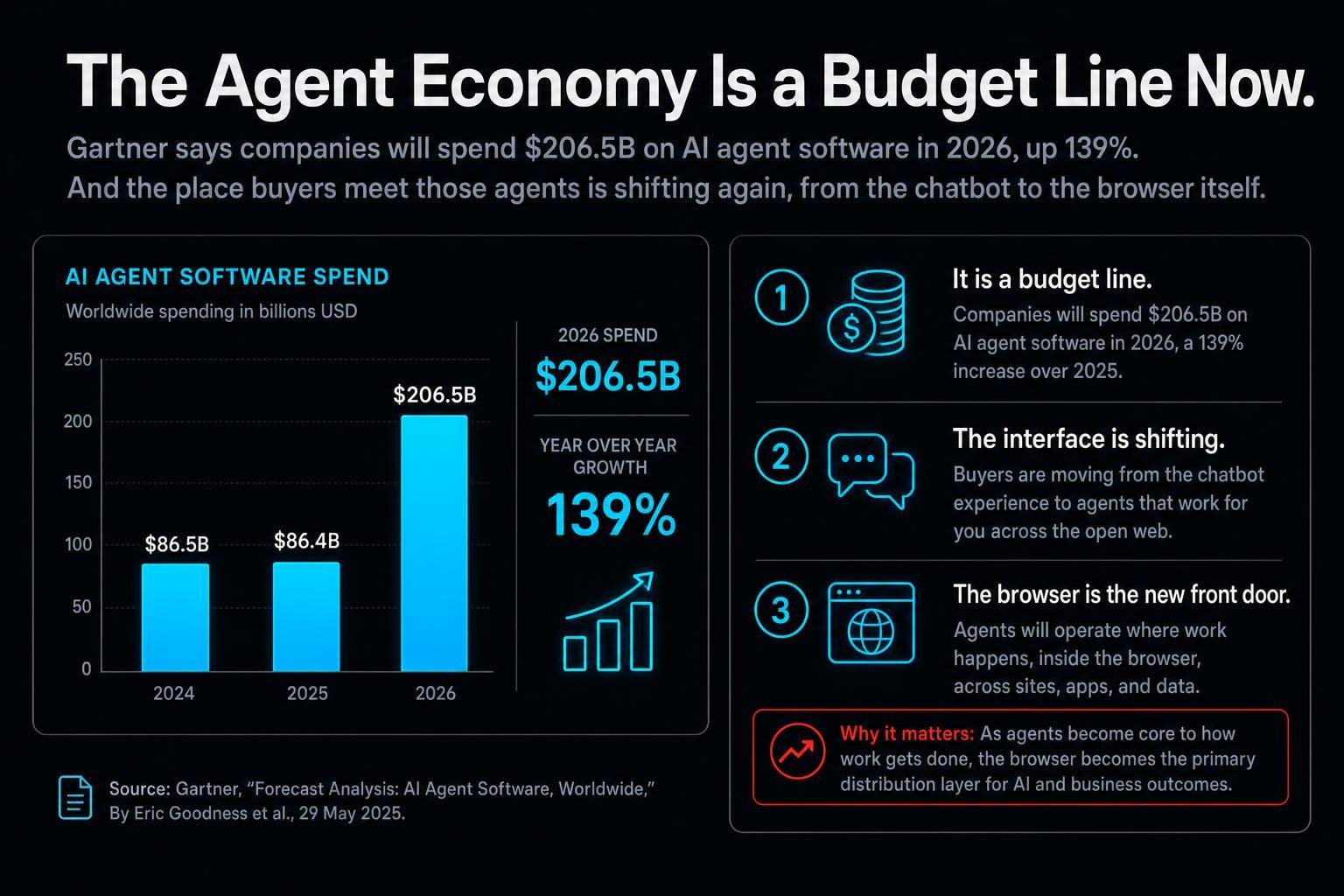
For a couple of years, "AI agents" lived in the part of the budget reserved for experiments. The line item you fund when a VP gets curious, the thing you pilot in one team and quietly forget. That era just ended. Gartner now forecasts that enterprises will spend roughly $206.5 billion on AI agent software in 2026, up 139% from $86.4 billion in 2025. That is not a science project. That is a budget line.
When spending more than doubles in a single year, it usually means a thing crossed an invisible threshold: from "would this work?" to "how much of it do we buy?" Agents are now in that second column.
The number behind the number
Here is the detail that makes the headline interesting. The same period shows a much smaller figure for what you might call pure agent products, the standalone bots and copilots sold as their own thing, at roughly $10.9 billion, up about 45% year over year. So you have a $206 billion figure and an $11 billion figure sitting side by side, both about agents, both for the same year.
The gap is the whole story. Most agent money is not flowing into shiny new agent apps. It is flowing into software companies already own, getting smarter. Think of it like electricity. There was a brief moment when "electric" was a product category you bought on purpose, an electric fan, an electric toaster. Then electricity just became the thing inside everything, and nobody bought "an electricity." Agents are speed-running that same path. The buyer is not shopping for an agent. The buyer's existing tools are sprouting them.
The money is not in selling a bot that competes with your customer's software. It is in making the software they already pay for do more of the work.
The new front door: your browser
If agents are becoming infrastructure, the next question is where humans actually touch them. For a while the answer was the chatbot window. Now there is a second answer, and it is hiding in plain sight: the web browser.
Perplexity's agentic browser, Comet, went free across Mac, Windows, iOS and Android, and the company raised roughly $200 million at about a $20 billion valuation, pitching the browser as the front door to the agent economy. OpenAI's ChatGPT Atlas has a similar Agent Mode, though as of June it is still Mac only. Both can do the thing that sounds like sci-fi until you watch it happen: research a purchase, add items to a cart, and move toward checkout on their own.
This is not a niche behavior anymore. Adobe Analytics measured a roughly 4,700% year-over-year jump in AI-agent traffic to US retail sites. That is not a typo and it is not a rounding artifact. It is a category going from basically zero to a measurable slice of who, or what, is visiting online stores.
Why this changes the plumbing
Here is the part that should make every web team sit up. The chatbot superapps and structured commerce protocols need the store to expose clean, machine-readable data. The AI browser needs none of that. It just drives the real storefront the way a person would, clicking the actual buttons on the actual page.
Which means your front end quietly became a conversion variable for a customer that does not have eyes. Researchers note that agent checkout works best when prices, add-to-cart buttons, and shipping options sit in stable, predictable spots in the page. A site with shifting layouts, prices that load in late, or a login wall before the cart will get fewer agent-completed purchases than a clean one. Picture a delivery driver who is brilliant but cannot read your handwriting. If your address is smudged, the package does not arrive, no matter how smart the driver is.
So "agent-readable storefront" is becoming a real discipline, a measurable thing you can be good or bad at, before anyone has settled on a name for it.
The open question: welcome or block?
None of this is settled. There is already legal friction, including a dispute involving Amazon and Comet over agents shopping on a retailer's site. That tension matters because it forks the future. If retailers welcome agent traffic, the smart move is to optimize for it. If they decide autonomous shoppers are a threat to be filtered out, the smart move is to defend against it. A Windows build of Atlas, or a published merchant guide for "agent-friendly" stores, would tip the balance toward welcome and widen the shopping base overnight.
Either way, the direction of travel is hard to miss. Agents went from a bet to a budget. The interface went from a chat box to the browser. And the next time you wonder who is visiting your website, the honest answer is increasingly: not entirely a who.
One signal a day. No noise.
A 3-minute read when something genuinely shifts in AI, automation, or defense tech. Free, most weekdays.
Free, most weekdays. No spam, unsubscribe anytime.Sources
- blog.mean.ceo - AI agents news, June 2026 - https://blog.mean.ceo/ai-agents-news-june-2026/
- Crescendo AI - Latest VC investment deals in AI startups - https://www.crescendo.ai/news/latest-vc-investment-deals-in-ai-startups
- 8seneca - Vertical AI agents for enterprise 2026 - https://www.8seneca.com/en/blog/technology/vertical-ai-agents-enterprise-2026
- TechTimes - Perplexity raises $200M for Comet AI browser - https://www.techtimes.com/articles/318028/20260608/perplexity-raises-200-million-comet-ai-browser-agent-economy-front-door.htm
- HUMAN Security - ChatGPT Atlas vs Perplexity Comet agentic browsers - https://www.humansecurity.com/learn/blog/chatgpt-atlas-vs-perplexity-comet-agentic-browsers/
- No Hacks - The agentic browser landscape 2026 - https://nohacks.co/blog/agentic-browser-landscape-2026
Quick answers
How much will companies spend on AI agent software in 2026?
Gartner forecasts roughly $206.5 billion in 2026, up 139% from $86.4 billion in 2025, making it one of the fastest-growing slices of enterprise software.
Why is the 'agent software' number so much bigger than the 'agent products' number?
A parallel read puts pure standalone agent products at about $10.9 billion in 2026. The gap shows most agent spending flows through software companies already own, which is gaining agent features, rather than into brand-new agent apps.
What is an AI browser?
An agentic browser like Perplexity's Comet or OpenAI's ChatGPT Atlas can act on the web for you, researching, adding items to a cart, and moving toward checkout autonomously by driving the real storefront like a human user.
How should online stores prepare for agent shoppers?
Reports indicate agent checkout works best when prices, add-to-cart buttons, and shipping options sit in stable, predictable page positions, with no login wall before the cart and fast page loads.