The Ad Channel Just Became Programmable
Pinterest and Microsoft shipped official advertising MCP servers, letting AI agents read and operate ad accounts through a standard protocol. The quiet part is that marketing channels are turning into software you can talk to.

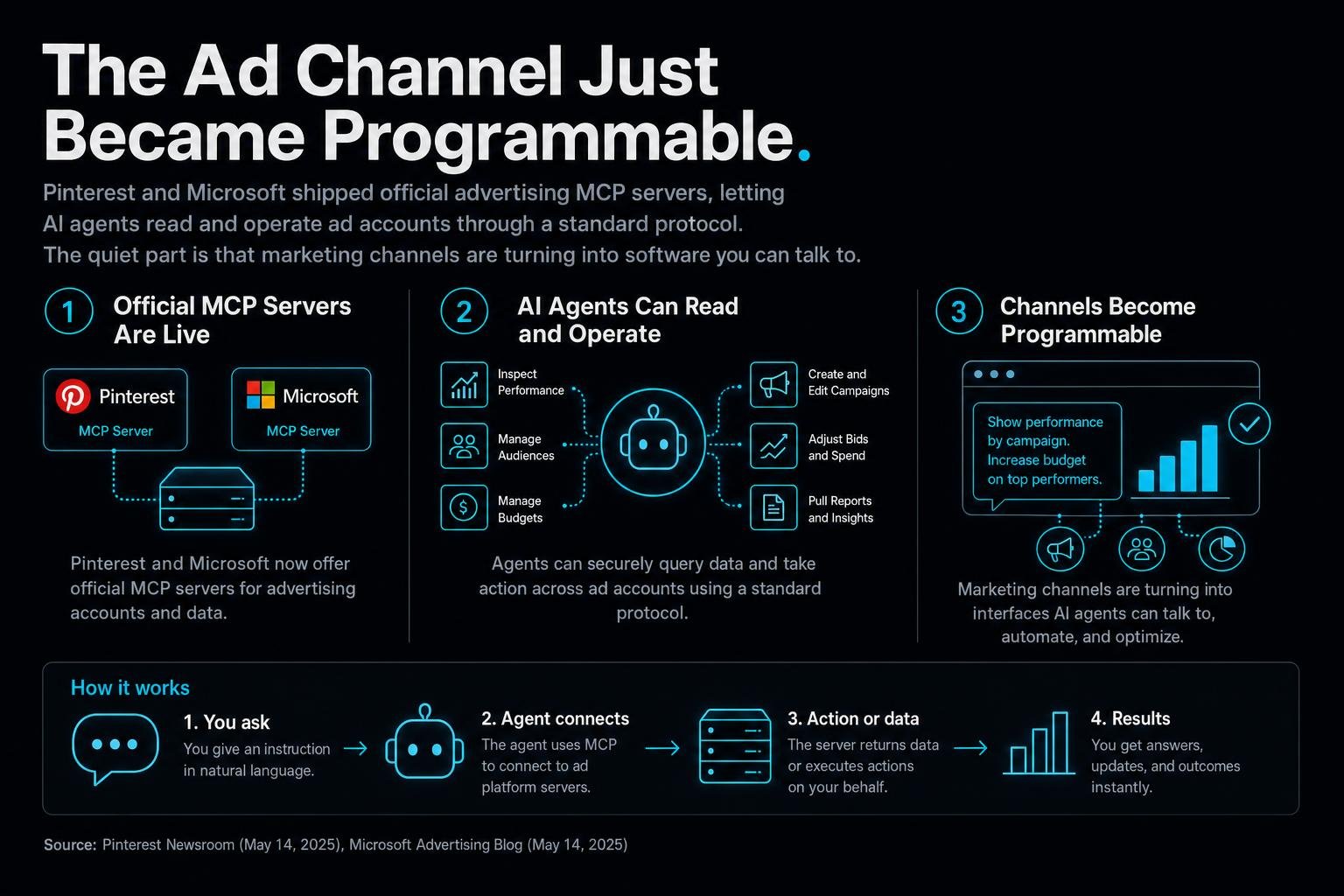
Most platform announcements are forgettable. A new dashboard, a renamed feature, another button. But every so often a launch lands that changes the shape of how work gets done, even though the headline sounds dull. This week we got one of those. In June 2026, Pinterest and Microsoft both shipped official advertising MCP servers.
Translation: an AI agent can now read and operate ad accounts on those platforms through a standard protocol, instead of a brittle scraper or a pile of one-off API glue. That is a bigger deal than it looks, so let me explain why.
What an "ad MCP server" actually is
Think of MCP (the Model Context Protocol) as a universal power outlet for AI agents. Before standard outlets existed, every appliance needed its own custom wiring to the wall. It worked, barely, and it broke constantly. Once everyone agreed on the shape of the plug, you could build appliances without thinking about the wall at all.
That is what Pinterest and Microsoft just did for their ad platforms. They put a standard socket on the wall. An agent that knows the protocol can now plug in and pull performance data, and potentially make changes, without anyone reverse-engineering a private interface that might vanish in the next update.
The platforms didn't just add agent features. They shipped the agent interface. The channel itself is becoming something you can operate with code.
The whole marketing suite is sprouting agents
The MCP servers are not happening in isolation. The big marketing-tech players are turning their automations into named, addressable agents at the same time:
- Salesforce has marketing agents that qualify leads, create content, and launch and optimize campaigns.
- Attentive shipped agentic features that read engagement signals across channels to generate and time campaigns.
- Creatify Agent is a video-production agent that builds on past ad-performance data.
And this all sits on top of where the largest spender is heading. Meta is testing full URL-to-campaign automation with select advertisers, where you hand over a link and the system builds the campaign. For scale, Meta's Advantage+ is already running at roughly $60 billion annualized. That is not a science experiment. That is a freight train.
Why this raises the floor and moves the value
Here is the honest tension. When ad platforms expose standard agent interfaces, two things happen at once, and they pull in opposite directions.
First, the floor rises for everyone. Once Pinterest and Microsoft have official MCP servers, anybody can wire up an agent that watches spend and performance across multiple platforms and proposes where to move money, instead of a human logging into three separate dashboards and squinting at three different charts. The plumbing that used to be a competitive edge becomes a commodity. Everyone eventually gets the same outlet on the same wall.
Second, and this is the part that matters if you do this for a living, the value does not disappear. It moves up. When the platforms themselves ship campaign agents that can launch and optimize, the routine button-pushing gets cheaper and cheaper. What the platform's own agent cannot see is the thing that was always the actual job: the strategy, the offer, the creative angle, and the cross-platform picture that no single platform has a view into. Meta's agent does not know what is working on Pinterest. Pinterest's agent does not know your Microsoft numbers. The judgment that connects them is the part a machine inside one walled garden structurally cannot do.
So this is less "the robots took the marketing job" and more "the boring half of the job is being automated, and the interesting half just got more valuable." That is usually how these shifts actually play out.
What I'm watching next
Two signals tell you when this goes from interesting to decisive.
- An official ad MCP server from Meta or Google. Those are the two biggest spend channels by a mile. The moment either ships a standard agent interface, a true cross-platform orchestrator stops being a partial tool and becomes a complete one.
- Whether these servers allow write actions, not just reads. A read-only server is a reporting helper. A server that lets an agent create, edit, and pause campaigns, ideally behind a human approval step, is something else entirely. Read tells you what happened. Write lets the agent actually steer.
The pattern underneath all of this is worth sitting with. For years, "AI in marketing" mostly meant better autocomplete and prettier reports. The agent interface is a different category. It means the channel becomes programmable infrastructure, the same way payments or cloud compute became programmable, and a whole layer of tools gets built on top that we cannot fully picture yet. The dull-sounding launches are often the ones that quietly rearrange the furniture.
One signal a day. No noise.
A 3-minute read when something genuinely shifts in AI, automation, or defense tech. Free, most weekdays.
Free, most weekdays. No spam, unsubscribe anytime.Sources
- MarTech - The latest AI-powered martech news and releases - https://martech.org/the-latest-ai-powered-martech-news-and-releases/
- Adtaxi - Meta's AI advertising plans: what to expect in 2026 - https://www.adtaxi.com/blog/metas-ai-advertising-plans-what-to-expect-in-2026-and-how-to-prepare/
- VXTX - Meta AI ad automation 2026 - https://www.vxtx.co.uk/blog/meta-ai-ad-automation-2026
Quick answers
What is an ad MCP server?
MCP (Model Context Protocol) is a standard way for AI agents to connect to a service. An ad MCP server lets an agent read and operate an ad account through that standard protocol, instead of using a fragile scraper or custom API workaround. Pinterest and Microsoft shipped official ones in June 2026.
Does this mean AI now runs ad campaigns by itself?
Not entirely. Platforms like Salesforce, Attentive, and Meta are shipping agents that qualify leads, build, and optimize campaigns, and Meta is testing URL-to-campaign automation with select advertisers. But the strategy, offer, creative angle, and cross-platform view still depend on human judgment that no single platform's agent can see.
Why does an MCP interface matter more than a normal API?
Because it is standardized. A standard protocol is like a universal power outlet: agents can plug into many platforms the same way, instead of needing custom wiring for each one. That makes cross-platform tools far easier and more durable to build.
What should I watch next?
Two things: whether Meta or Google ship official ad MCP servers (the two largest spend channels), and whether these servers allow write actions like create, edit, and pause, not just read-only reporting. Write access is what lets an agent actually steer a campaign.