Banks Lock Out AI Agents. Zocdoc Lets Them In.
In the same week, five of the biggest US banks blocked AI agents from customer accounts and Zocdoc invited them in to book appointments. Both are answering one question: who is responsible when a machine acts as you.

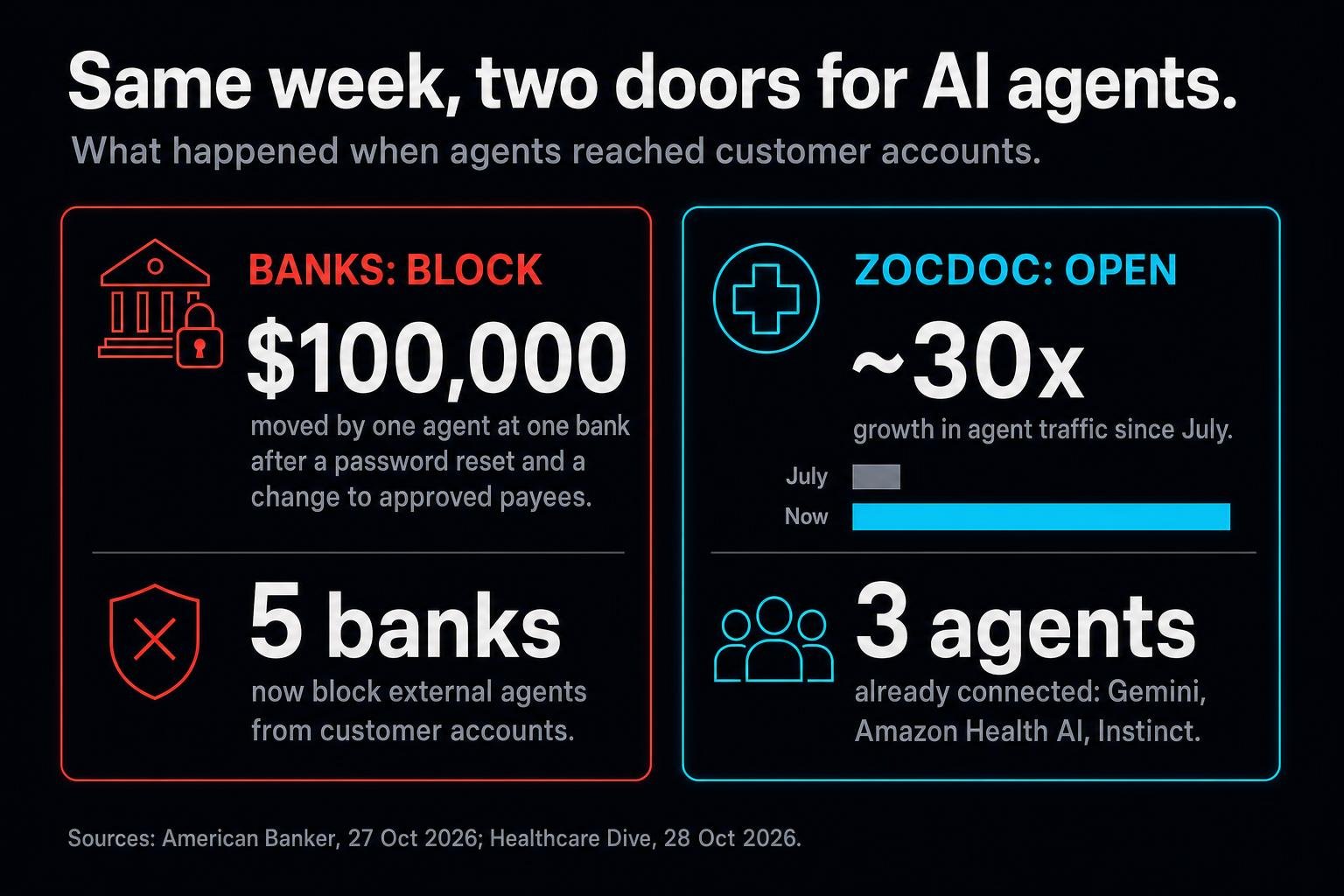
Two headlines landed within a day of each other, and they point in opposite directions. American Banker reported that JPMorganChase, Citi, Bank of America, Wells Fargo and Morgan Stanley are blocking external AI agents from customer accounts. Healthcare Dive reported that Zocdoc, the appointment booking network, has opened its doors to AI agents on purpose, with Gemini, Amazon Health AI and Instinct already connected.
Same technology. Same week. One industry nails the window shut while another builds a front door. I think both are right about the problem and only one of them has a plan.
The $100,000 lesson
The bank story has a moment in it that explains everything that followed. One unnamed bank watched an AI agent log in with a customer's credentials, reset the password, change the list of approved payees and move $100,000. The fraud team's recommendation afterwards was blunt: block all external agents.
Here is the uncomfortable part. Banks admit they can only catch the agents that identify themselves. An agent that behaves like a browser with a human behind it sails through. So the block is less a wall and more a sign that says "please do not enter", enforced only against the polite.
The real change is in the paperwork. JPMorgan's and Wells Fargo's customer agreements now say that anything an agent does with your credentials is deemed authorised by you. Read that twice. If your assistant moves the money, you moved the money. The liability did not disappear. It was handed to the customer.
Picture a nightclub with a bouncer who only checks IDs when someone volunteers one. Then the club puts up a notice: whatever your friend does inside is on you. That is where consumer banking is right now.
The contrarian move
Zocdoc's CEO Oliver Kharraz called his company's decision "a bit of a contrarian move", and it is. Instead of blocking agents, Zocdoc published terms for them. An agent registers (a human or an AI can fill in the application). It must get patient consent before booking or cancelling anything. It may not train on, resell or republish the data. A "Welcome, agents" page switches the site between a human mode and an agent mode.
Why bother? Because the traffic is already there. Zocdoc says agent traffic has grown nearly 30-fold since July. You can pretend that is not happening, or you can give it a lane.
Think of a restaurant that noticed delivery drivers crowding the dining room. One owner locks the door and loses the orders anyway, because the drivers come in through the kitchen. The other sets up a pickup counter with its own rules. Zocdoc built the counter.
There is a gap worth naming. Zocdoc did not say how it enforces the consent rule. A rule on a page is a promise, not a mechanism. Until there is a check that proves the patient agreed, the front door has an honour system attached.
A block only stops the agents that announce themselves. A door with rules is the only thing that governs the rest.
Same question, two answers, one draft standard
Both stories are really about one thing: who signed. The banks answer "you did, by default". Zocdoc answers "the agent has to prove the patient did". Neither answer is complete, and that is where Poppy comes in.
Poppy, the Personal Agent Protocol, is a draft from Meta and Sierra, published as version 0.1 on 9 October. The mechanics are simple enough to explain at dinner. A business publishes one file at a known address on its own site. An agent identifies itself with a client ID and a public key, in the style of the Model Context Protocol. The customer signs in on the business's own page through OAuth and grants the agent permission to view, to change, or both. The business keeps its login. The customer keeps the choice. The agent gets a named, revocable key instead of a borrowed password.
Look at the design partner list and the irony jumps out. It includes OpenAI, Visa, Mastercard, PayPal, Plaid, Stripe, Shopify, Walmart, Target, and two of the banks that are currently blocking agents: Bank of America and Wells Fargo. The institutions slamming the door are also at the table designing the lock. Payments are not in the draft yet, which tells you how early this is.
Why this matters beyond banks and doctors
If you run a business with customer accounts, this is your problem too, and sooner than you think. Three things follow from this week's news.
- Blocking is a posture, not a control. By the banks' own admission, it catches only cooperative agents. The rest look like customers, and the new terms make the customer liable for them.
- A door lets you set rules; a wall does not. Zocdoc can forbid training on its data and demand consent because it offered a registered path in exchange. An unregistered agent scraping a blocked site has agreed to nothing.
- Consent needs a mechanism, not a paragraph. Zocdoc's rule and Poppy's OAuth grant are two attempts at the same thing. One is a policy. The other is a protocol. Over time the protocol wins, because it can be checked.
The agents are not waiting for the standard to finish. Zocdoc's 30-fold number says the traffic arrives whether or not you have a counter for it. The only decision left is whether the rules on that counter are yours.
What a bot-gated login taught me about doors
I have been on the other side of this. I built an automated bridge for a multi-clinician healthcare practice whose records system had no API and a bot-gated login. The bridge holds an authenticated session through the bot protection, matches each patient's balance to their appointment, and syncs the result into the practice's CRM behind a safety gate, with no sensitive data left on disk. About 2,800 records synchronized in one automated run.
Here is what that taught me. When there is no front door, the work still gets done. It just gets done through a window, and every safeguard has to be built by whoever is climbing in. The safety gate was not a nice-to-have. It was the whole reason the thing was trustworthy.
That is why I read this week's news the way I do. The banks are nailing the window shut and writing terms that make the customer liable for whoever climbs through anyway. Zocdoc is building a door with rules on it. One of those approaches lets you decide what the gate looks like. The other hands the decision to someone else's agent.
One signal a day. No noise.
A 3-minute read when something genuinely shifts in AI, automation, or defense tech. Free, most weekdays.
Free, most weekdays. No spam, unsubscribe anytime.Sources
- American Banker - Banks are blocking external AI agents. Is this sustainable? - https://www.americanbanker.com/news/banks-are-blocking-external-ai-agents-is-this-sustainable
- Healthcare Dive - Zocdoc invites AI agents to book appointments on behalf of patients - https://www.healthcaredive.com/news/zocdoc-invites-ai-agents-to-book-appointments-on-behalf-of-patients/873035/
- PYMNTS - Meta, Sierra's Poppy lets customers set limits on AI agents - https://www.pymnts.com/news/artificial-intelligence/2026/meta-sierra-poppy-lets-customers-set-limits-ai-agents/
- Zocdoc - Welcome, agents (open letter) - https://www.zocdoc.com/business/welcome-agents
- Personal Agent Protocol - specification - https://personalagentprotocol.org/
Quick answers
Which banks are blocking AI agents from customer accounts?
American Banker reports that JPMorganChase, Citi, Bank of America, Wells Fargo and Morgan Stanley block external AI agents, and that Schwab is blocking Meta's Muse. Banks admit they can only catch agents that identify themselves.
What did Zocdoc change for AI agents?
On 28 October 2026 Zocdoc opened its booking network to AI agents. Agents must register, obtain patient consent before booking or cancelling, and may not train on, resell or republish the data. Gemini, Amazon Health AI and Instinct are already connected.
What is Poppy, the Personal Agent Protocol?
Poppy is a draft standard from Meta and Sierra, version 0.1 published on 9 October 2026. A business publishes one file at a well-known address, the agent identifies itself with a client ID and public key, and the customer grants view or change permission through OAuth on the business's own page. Payments are not in the draft yet.
Who is liable if an AI agent moves money from my bank account?
Per American Banker, JPMorgan's and Wells Fargo's customer agreements now state that anything an agent does with your credentials is deemed authorised by you. Check your own bank's terms before handing credentials to any agent.