The Default AI Everyone Uses Just Became an Agent
In one week, the AI that hundreds of millions of people get for free quietly became agentic, and the model answering your Google searches changed underneath you.

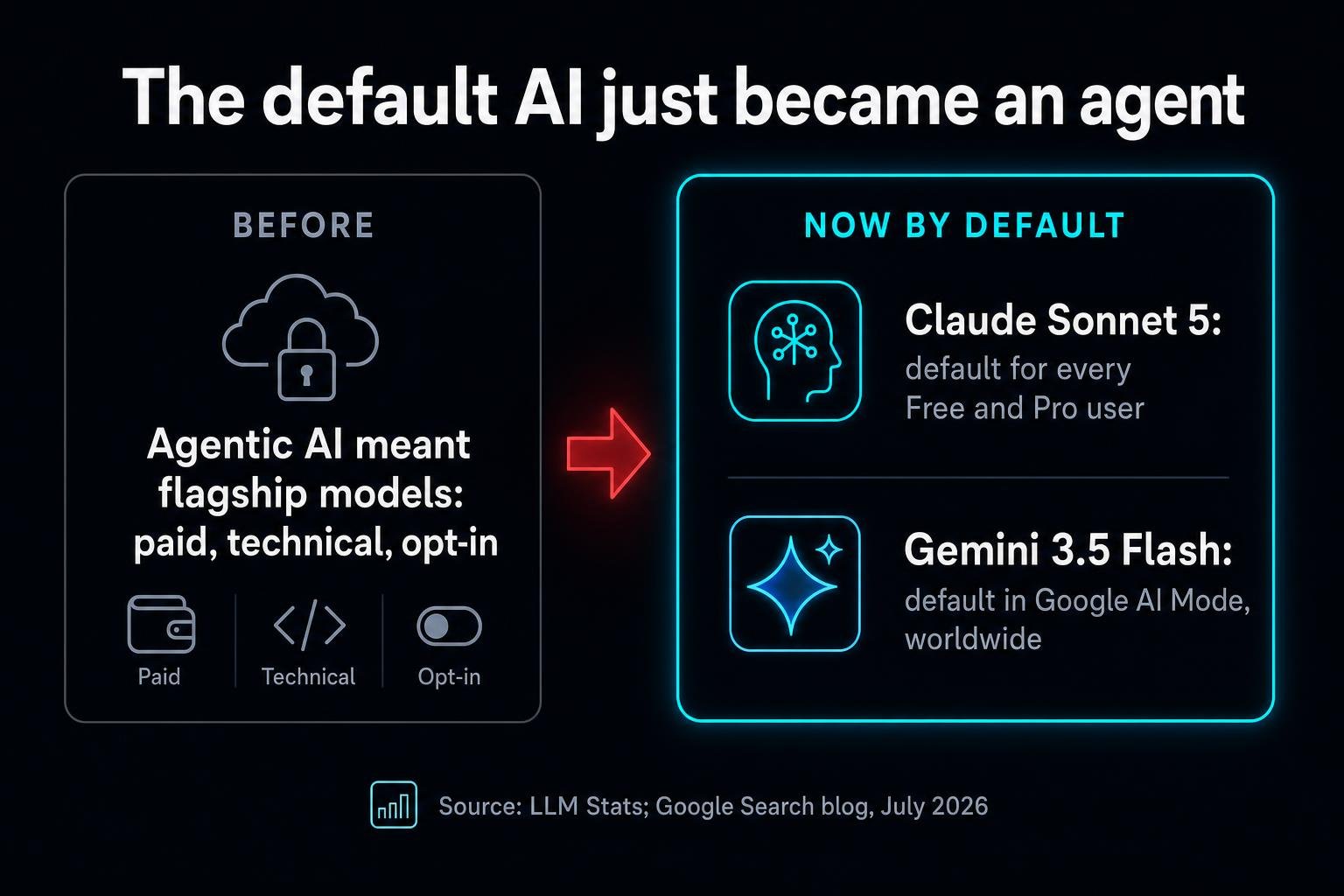
For most of the last two years, the smartest AI was something you had to go and get. You paid for the top tier, you knew which model to pick, and you understood enough to prompt it well. The powerful stuff lived behind a choice.
Around the first of July, that quietly stopped being true. The most capable, most autonomous AI is now simply the default that hundreds of millions of ordinary people get, without choosing anything at all.
What actually happened
Two changes landed within days of each other. Anthropic made Claude Sonnet 5 the default model for every Free and Pro user. It is the most agentic Sonnet yet, able to drive browsers and terminals on its own at a level that, only months ago, needed a company's flagship model. Google, meanwhile, began rolling out Gemini 3.5 Flash as the new default model in AI Mode for everyone, globally, describing it as sustained frontier performance for agents and coding.
Neither was sold as a big deal. Both are the kind of change that shows up as a slightly better answer, not a headline. That is exactly why they matter.
Distribution, not capability
Here is the shift in one sentence. The news is not that a smarter model exists. The news is that the smart, agentic model is now what you get by default.
The frontier did not move. It moved into everyone's hands.
Think of the day cruise control stopped being a luxury add-on and started coming standard on every car. The technology was not new. What changed was that a whole generation of drivers suddenly had it without asking, and the baseline expectation of what a car does reset overnight. That is what just happened to AI. The person who has never paid for a subscription, never compared models, and never written a careful prompt now holds an agent that can take multi-step actions on their behalf.
For anyone building products, selling services, or hiring, this resets the water line. The question "can AI really do that" is being answered, for a mass audience, by the default tool they already have open.
The quiet part for anyone with a website
There is a second consequence that is easy to miss. When Google swaps the model that answers AI Mode, it changes the thing that reads the web and decides which sources to cite. The answer engine that a growing share of searches now flows through just got a new brain.
So the sources an AI answer points to can reshuffle, even if your page never changed. Being cited by AI is not a trophy you win once. It moves when the model moves. If any of your traffic quietly depends on showing up inside AI answers, the model behind those answers changing is the kind of thing you want to notice, not discover three months later.
What to do with this
You do not need to chase every release. Two habits cover most of it. First, assume the person on the other end of your product or your pitch already has a capable agent, and design for that reality instead of explaining what AI is. Second, treat your visibility inside AI answers as something to watch over time, because the ground under it now shifts on someone else's schedule.
The platforms are leaning in too. The same week, X shipped a hosted connector that lets AI tools act through a user's own account, a sign that the big services expect you to show up with an agent and want to give it a safe door in. The default is an agent now. The smart move is to build and write as if everyone you are trying to reach already has one, because more and more, they do.
One signal a day. No noise.
A 3-minute read when something genuinely shifts in AI, automation, or defense tech. Free, most weekdays.
Free, most weekdays. No spam, unsubscribe anytime.Sources
- LLM Stats, AI news - https://llm-stats.com/ai-news
- Google, Search I/O 2026 - https://blog.google/products-and-platforms/products/search/search-io-2026/
- TechCrunch, X now offers an MCP server - https://techcrunch.com/2026/06/30/x-now-offers-an-mcp-server-to-make-its-platform-easier-for-ai-tools-to-use/
Quick answers
What changed with Claude Sonnet 5?
Anthropic made it the default model for every Free and Pro user. It is the most agentic Sonnet yet, able to run browsers and terminals autonomously at a level that recently required flagship models.
What is Gemini 3.5 Flash?
It is Google's new default model in AI Mode, rolling out to everyone globally, positioned as sustained frontier performance for agents and coding.
Why does the default model matter more than a new flagship?
Because it changes what hundreds of millions of non-technical people can do without buying or choosing anything, which resets everyone's expectations of AI at once.
Can a change to Google's AI Mode model affect my website?
Yes. When the model answering AI searches changes, the sources it cites can shift, so visibility inside AI answers is worth monitoring rather than treating as a one-time fix.