Microsoft Just Bet $2.5B That AI Is a Services Business
The world's biggest software company just committed $2.5 billion and 6,000 people to installing AI inside other companies' workflows. That tells you where the real money in AI actually is.

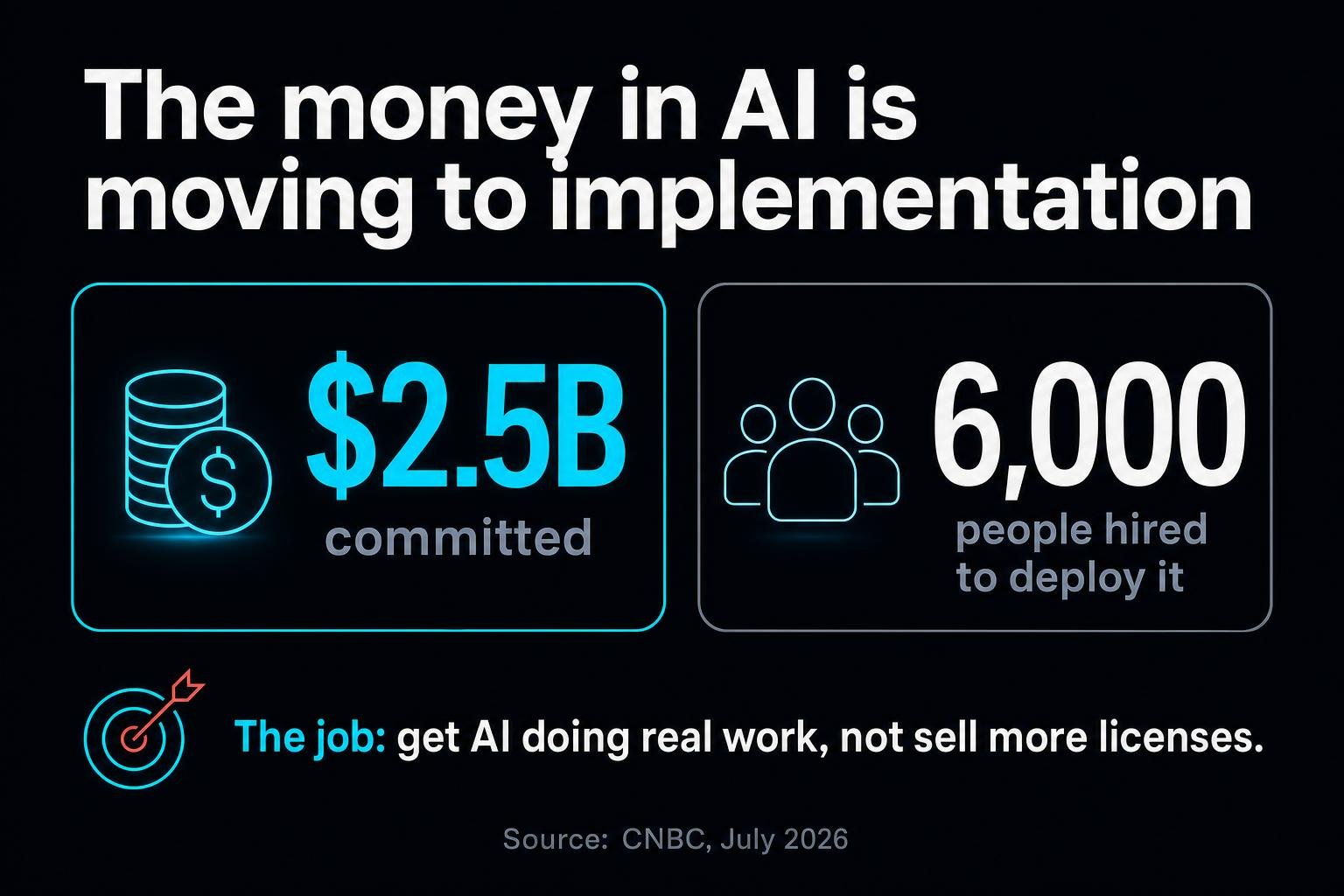
For two years, the AI story has been about the models: bigger, smarter, cheaper, faster. So it is worth noticing that the most important AI news this week was not a model at all. It was Microsoft, the largest software company on earth, deciding to hire six thousand people to go install AI inside other companies.
That one move says more about where AI value is heading than any benchmark.
What happened
Microsoft committed $2.5 billion and 6,000 employees to a new AI implementation unit. Its job is not to sell more software licenses. It is to deploy AI into customers' actual workflows, the messy day-to-day of how real teams operate.
Read that twice, because on the surface it is a little strange.
Why a software company is acting like a consultancy
Microsoft makes its money selling licenses. Copilot is a seat you pay for every month, and the obvious play would be to sell more seats. Instead, the company with the biggest software distribution machine in the world concluded that licenses do not deploy themselves, and that the gap between "we bought AI" and "AI is doing real work here" is a people-and-process problem, not a software one.
The model is the easy part. Getting it to change how work actually happens is the whole job.
The gap nobody prices in
Think about a gym membership. Signing up is easy and it feels like progress. But the membership is not the result. The result comes from the unglamorous work of showing up and changing your routine, and that is exactly where most people stall.
Companies are in the same spot with AI right now. They adopt it quickly, then stall, because buying the tool and rewiring how the team works are two completely different things. Microsoft just put a $2.5 billion price tag on closing that gap. When the biggest vendor in the market spends that kind of money on implementation rather than on more product, it is telling you the product was never the hard part.
What it means for the rest of us
The lesson travels down to every company and every career. The value in AI is quietly moving away from the model, which is commoditizing fast, and toward the work of turning it into shipped, running outcomes inside a specific business.
If you run a company, the takeaway is blunt: budgeting for the license and nothing else is how AI becomes expensive shelfware. If you are building a career, the durable skill is not having access to the smartest model, because soon everyone will. It is being the person who can make it actually do the job. Microsoft just bet two and a half billion dollars that this skill is the scarce one, and that is a good bet to be on the right side of.
One signal a day. No noise.
A 3-minute read when something genuinely shifts in AI, automation, or defense tech. Free, most weekdays.
Free, most weekdays. No spam, unsubscribe anytime.Sources
- CNBC, Microsoft commits $2.5 billion and 6,000 employees to AI implementation unit - https://www.cnbc.com/2026/07/02/microsoft-commits-2point5-billion-6000-employees-ai-implementation-unit.html
- Tech Startups, top tech news today July 3 2026 - https://techstartups.com/2026/07/03/top-tech-news-today-july-3-2026/
Quick answers
What did Microsoft actually announce?
It committed $2.5 billion and 6,000 employees to a new unit focused on deploying AI into customers' real workflows, rather than just selling them software licenses.
Why is that surprising for a software company?
Microsoft earns its money on licenses, so selling more seats would be the obvious move. Building a large services unit signals that the hard part of AI is implementation, not the software itself.
What is the 'implementation gap'?
It is the distance between buying an AI tool and having it actually change how work gets done. Companies adopt AI fast and often stall there, because tools and process change are different problems.
What does this mean for my business or career?
Value is shifting from the model, which is commoditizing, to the ability to turn AI into real, running outcomes in a specific context. That implementation skill is becoming the scarce and valuable one.