Meta Is Testing an AI Page That Replaces Your Website
A new test feature in Meta ad accounts can send some ad clicks to a page Meta generates and hosts instead of your site. Your analytics may never see those visitors, and the responsibility for the page's words stays with you.

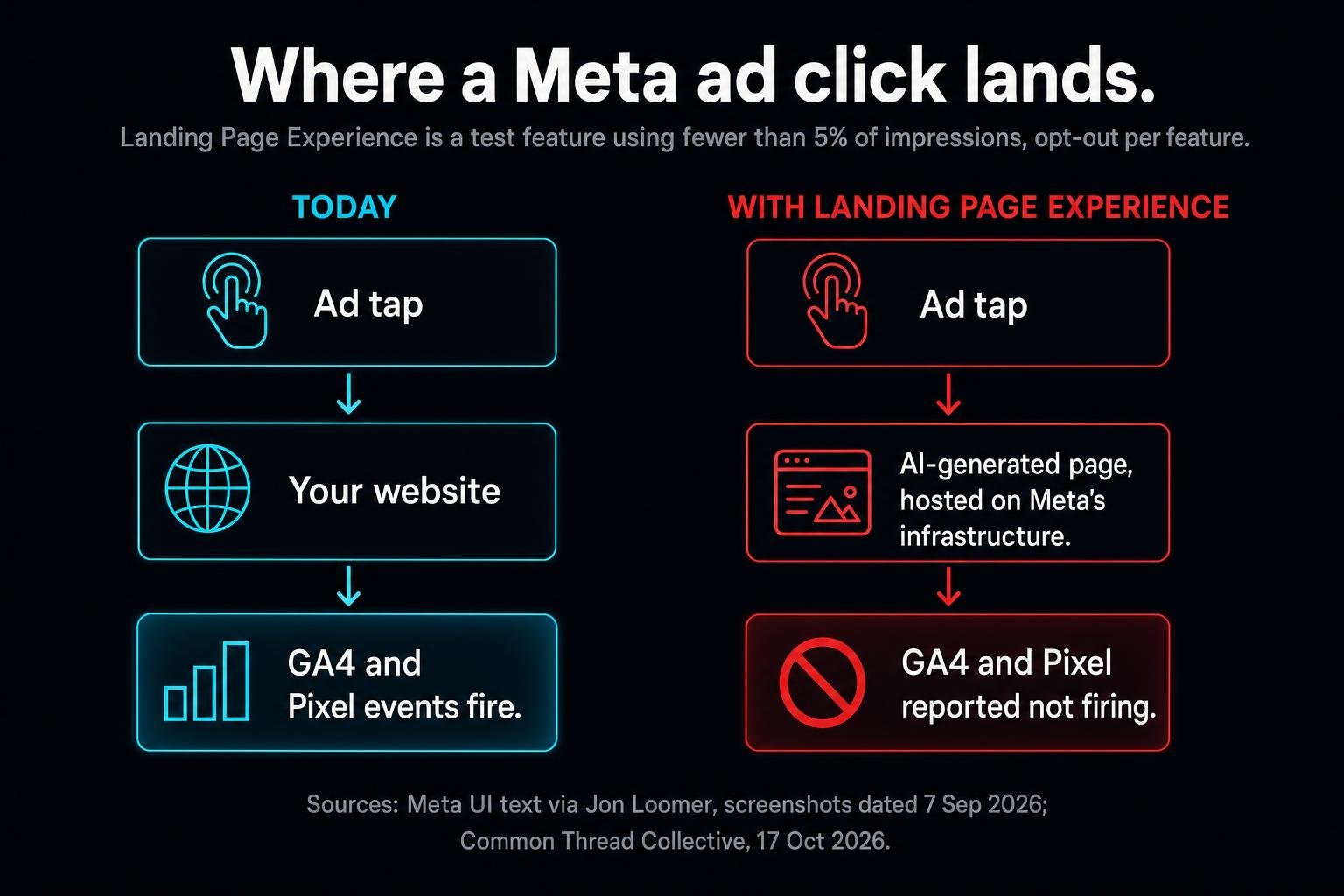
Imagine paying for a billboard that points to your shop. When someone follows the sign, they arrive at a replica of your shop that the billboard company built overnight. Same products, same logo, roughly your words. But it is their building, their door counter, and your staff never see the customer walk in. That is the shape of a feature Meta is now testing in ad accounts, and it is worth understanding before the holiday ad season starts.
What Meta is testing
Inside Ad Account Settings, the switch for testing new AI generation features now lists an enhancement called Landing Page Experience. Meta's own description, as quoted by Jon Loomer, reads: "We'll use AI to generate a visual landing page from your website, highlighting your key services and calls to action. When enabled, people who tap your ad may see this instead of your website."
Three details matter. Test features of this kind use fewer than 5% of impressions. Each one can be switched off individually. And the page is generated from your site rather than written from scratch, so it will look familiar at a glance. Loomer's screenshots are dated 7 September, so the option has been sitting quietly in accounts for weeks.
Common Thread Collective reports that a wider rollout began on 14 October, and that brands are seeing a side effect: Google Analytics 4 and browser Pixel events are not firing on these pages. The explanation is mechanical. The AI page lives on Meta's infrastructure, not yours, so your tags never load. I have not tested this myself, and the rollout date comes from a single source, so treat both as reports rather than settled fact. The mechanism, though, is hard to argue with.
Why a prettier page can be a problem
Most advertisers would be happy to have Meta tidy up a landing page for free. The catch is not the design. It is two things that sit underneath it.
First, measurement. If a slice of your clicks lands on a page your analytics cannot see, those visitors vanish from your reports while Meta still counts them. Your numbers and Meta's numbers drift apart, and nobody can say which is right. For a store that lives on its conversion data, blind spots are expensive even when they are small.
Second, the words. An AI page that highlights your key services is restating your copy. Businesses in categories with strict rules about what they can claim, such as health, finance or anything regulated, could have a page in circulation that no human on their side approved. Meta's updated advertiser terms, which take effect on 30 October, put responsibility for AI-generated content on the advertiser. The page is Meta's. The risk is yours.
The page is generated by Meta, hosted by Meta and measured by Meta. The accountability for what it says stays with you.
The assistant is learning to move the budget
The landing page is one piece of a wider October release. According to a status table compiled by GoodMorning, Customer Lifecycle Strategy is now live for all advertisers. It lets an ad set declare that it wants new customers only, with Meta excluding known buyers using Pixel, server-side and list data. CTC describes a 180-day window for that exclusion. The two sources disagree on the date it opened to everyone, 6 October versus 11 October, which tells you how fast these releases move.
Further down the same table: the Meta assistant creating campaigns and changing targeting and budget is in test, with every action staged for human approval. Direct checkout inside Meta AI and Business Agent is also in test. Meta says assistant adopters see 5% more conversions at the same cost per conversion, with no methodology published.
Put the pieces side by side and the direction is clear. Meta wants to write the page, host the page, pick the audience, set the budget and, eventually, take the payment. The shopper never leaves. For Meta that is a tidy, fully measurable loop. For the business, each step moved inside the platform is one less step you can see.
Where the approval gate matters
The one reassuring design choice in all of this is the staged approval. The assistant proposes, a person accepts. That is the right pattern, and it only works if someone is actually looking. The landing page feature has the same shape in reverse: it is on unless you turn it off, inside a settings panel most people open once.
So the practical response is simple and a little boring. Open Ad Account Settings and read the list of test features. Decide, feature by feature, whether you want each one. If your purchase tracking depends on a browser event on your own domain, add a server-side signal from your order system as well, so a sale still counts when the click never touched your site. And if you switch on the new-customer setting, write down your current acquisition cost first, because blended results will look worse before they look honest.
The holidays are coming. Spend ten minutes in the settings before Meta spends your budget on a page you have never seen.
One signal a day. No noise.
A 3-minute read when something genuinely shifts in AI, automation, or defense tech. Free, most weekdays.
Free, most weekdays. No spam, unsubscribe anytime.Sources
- Jon Loomer - Landing Page Experience enhancement - https://www.jonloomer.com/qvt/landing-page-experience-enhancement/
- Common Thread Collective - Meta AI-generated landing pages and the tracking risk for ecommerce - https://commonthreadco.com/blogs/coachs-corner/meta-ai-generated-landing-pages-tracking-risk-ecommerce-2026
- GoodMorning - Meta Ads update, October 2026 - https://goodmorningco.com/blog/meta-ads-update-october-2026
- Common Thread Collective - Meta Ads changes 2026 hub - https://commonthreadco.com/blogs/coachs-corner/meta-ads-changes-2026
Quick answers
What is Meta's Landing Page Experience?
It is a test feature inside Meta's Ad Account Settings, under the switch for new AI generation features. When enabled, Meta uses AI to generate a visual landing page from your website, and some people who tap your ad may see that page instead of your site.
How many ad impressions does the test affect?
According to Meta's own UI text, quoted by Jon Loomer, test features of this kind use fewer than 5% of impressions, and each feature can be turned off individually.
Why might GA4 and the Meta Pixel not fire on these pages?
Common Thread Collective reports that brands are seeing GA4 and browser Pixel events fail on the AI-generated pages. The page is hosted on Meta's infrastructure rather than the advertiser's domain, so the advertiser's tags do not load. This is a report, not something independently tested here.
Can the Meta assistant change my budget on its own?
Not yet. As of October 2026 the assistant creating campaigns and changing targeting and budget is in test, with every action staged for human approval, according to a status table compiled by GoodMorning.