The Machine That Makes AI Cheaper
TSMC just posted a blowout quarter and raised its spending plans again. The quiet takeaway: the falling price of AI is not a promotion, it is the shape of the road ahead.

Every few weeks a new AI model shows up cheaper than the one before it, and it is tempting to read that as a marketing move, a temporary discount to grab users before the real prices arrive. This week the company that actually builds the hardware underneath all of it gave us a reason to think otherwise.
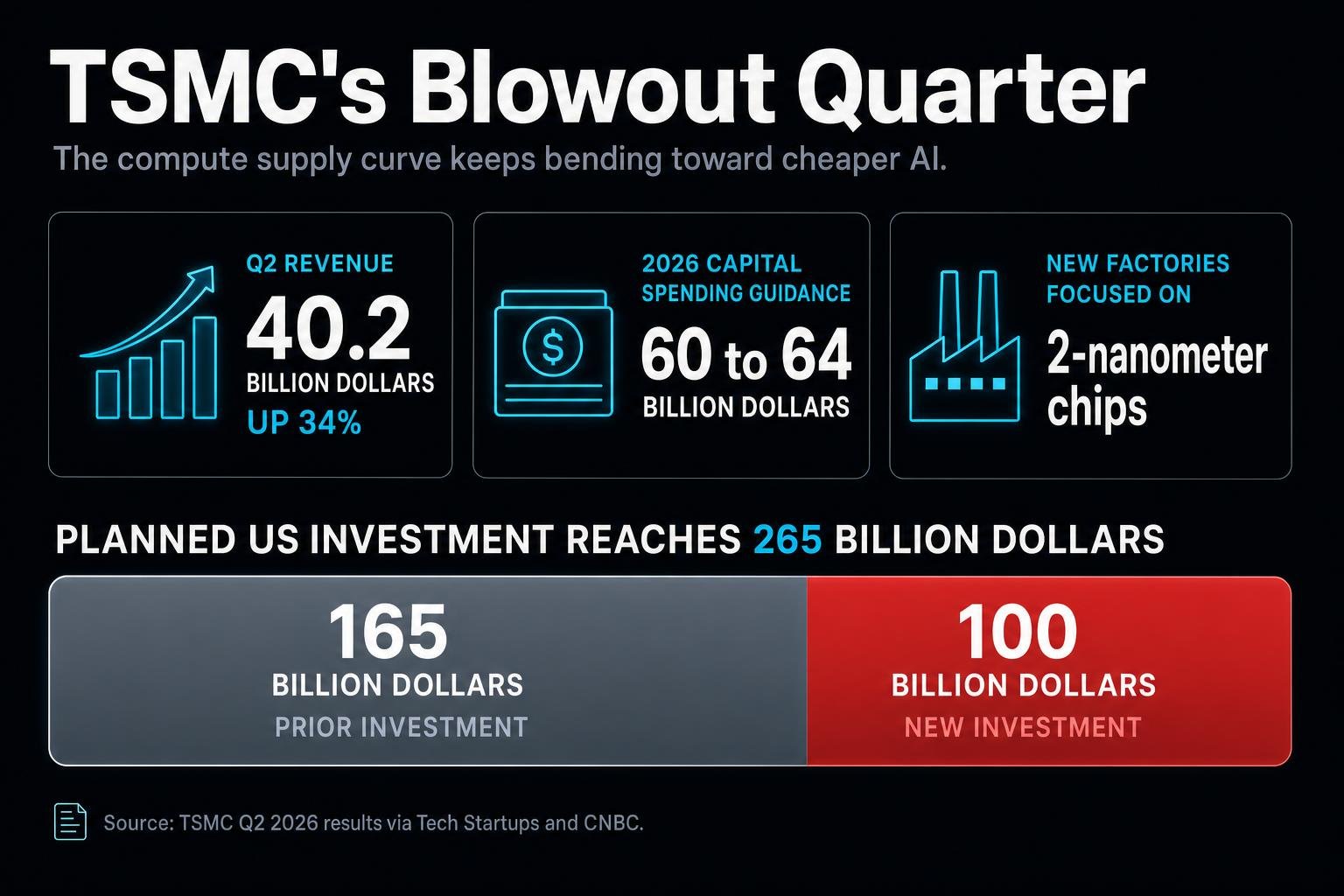
TSMC, the Taiwanese company that manufactures the advanced chips powering nearly every serious AI system, posted second-quarter revenue up 34% to $40.2 billion. It raised its 2026 spending guidance to between $60 and $64 billion. And it announced another $100 billion for its Arizona operations, bringing planned US investment to $265 billion, with up to four more factories focused on its most advanced 2-nanometer process.
Those are big numbers on their own. What they really describe is a supply curve, and the direction it is bending.
The world's chip kitchen is doubling its ovens
Think of TSMC as the kitchen that cooks for almost every restaurant in town. The AI companies you have heard of design the recipes, but TSMC does the actual cooking, and it does it at a scale no one else can match. When that kitchen tells you it is buying more ovens, hiring more staff, and building new locations across the world, it is telling you it expects to cook a lot more food, and to cook it more efficiently per dollar.
That is what a $60-plus billion spending plan and a $265 billion US buildout signal. TSMC is not betting that AI demand fades. It is betting the opposite, and it is putting a quarter of a trillion dollars behind that bet in a single country.
Falling inference cost is not a windfall to be enjoyed once. It is a standing condition of the market, and it compounds.
Why cheaper hardware means cheaper answers
Here is the chain, simplified. Better manufacturing means more computing power per dollar. More computing power per dollar means the cost of running an AI model, what the industry calls inference, keeps dropping. And when inference gets cheaper, the price of asking an AI a question drops with it.
We are already seeing the frontier of that price war settle below $2 for a large batch of AI usage, a tier that would have sounded absurd a year or two ago. The reason it is possible is not that any single company decided to be generous. It is that the compute underneath keeps getting cheaper, and TSMC just committed to accelerating that trend through 2027 and beyond.
This is the part worth internalizing if you run a business, manage a budget, or just try to reason about where technology is heading: treat falling AI costs as the default assumption, not a lucky break. Anyone telling you that AI is fundamentally expensive and always will be is selling against the direction of the entire supply chain.
The geography is a story too
The $265 billion US figure is not only an economics headline. It is also an answer to a nervous question a lot of people have been asking quietly: what happens if the chips that power AI are all made in one vulnerable place?
By spreading advanced manufacturing across geographies, including a massive Arizona footprint, the industry is duplicating its most critical capacity at historic scale. That does not make supply risk disappear. But it does mean the single most important input to modern AI is being built in more than one basket, and that is a meaningful shift from where things stood only a few years ago.
What this means for the rest of us
If you are a small business or an individual, the practical read is encouraging. The AI tools you use should get cheaper and more capable at the same time, quarter after quarter, without you having to renegotiate anything. The capability curve rises while the cost curve falls, and both are being underwritten by physical factories going up in real places.
If you are a builder or a decision-maker, the lesson is about pricing and planning. Services and products priced on today's AI costs will quietly gain margin over time as those costs fall, as long as the price to the customer holds. That is a rare and pleasant dynamic, and it exists precisely because a company most people have never thought about is spending like the future depends on it.
The flashy AI launches get the headlines. But the most important AI news this week came from a chipmaker's earnings report, and it said something simple and durable: the road keeps bending toward cheaper, and it is paved in concrete and silicon.
One signal a day. No noise.
A 3-minute read when something genuinely shifts in AI, automation, or defense tech. Free, most weekdays.
Free, most weekdays. No spam, unsubscribe anytime.Sources
- Tech Startups - Top tech news today - https://techstartups.com/2026/07/16/top-tech-news-today-july-15-2026/
- CNBC - AI / Artificial Intelligence - https://www.cnbc.com/ai-artificial-intelligence/
Quick answers
What did TSMC report?
Second-quarter revenue rose 34% to $40.2 billion, driven by AI datacenter demand. The company raised its 2026 capital spending guidance to $60-64 billion and announced another $100 billion for Arizona, bringing planned US investment to $265 billion.
Why does a chipmaker's earnings affect AI prices?
TSMC manufactures the advanced chips that run AI systems. More efficient, higher-volume manufacturing lowers the cost of computing power per dollar, which lowers the cost of running AI models, which pushes the price of AI usage down over time.
Is cheaper AI just a temporary discount?
The signal from TSMC suggests it is structural, not promotional. The company is spending record amounts to expand capacity through 2027 and beyond, which keeps compute costs falling as a standing condition of the market rather than a one-off deal.
Why does the Arizona investment matter beyond economics?
Building advanced chip capacity in multiple geographies duplicates the most critical input to modern AI at large scale, which reduces the risk of all production being concentrated in a single vulnerable location.