AI's Provenance Problem Just Went to the White House
A top US science official publicly accused a Chinese lab of copying Anthropic's model to build Kimi K3, days before its weights go free. Suddenly, where a model comes from matters as much as how good it is.

For the last two years, the questions we asked about an AI model were simple. How smart is it? How fast? How cheap? This week a senior US official added a fourth question nobody was quite ready for: where did it actually come from?
On July 22, White House OSTP Director Michael Kratsios said publicly that Moonshot AI distilled Anthropic's Fable model to build its new Kimi K3, calling it large-scale covert industrial distillation. In a separate charge, he alleged Moonshot accessed export-restricted Nvidia GB300 chips through Thailand to train its models. It is, as far as the public record shows, the first time a senior US official has accused a specific Chinese lab of copying a specific American model. And it landed four days before K3's open weights ship to the world for free on July 27.
What distillation means, and why it's slippery
Think of distillation like a student copying a brilliant classmate's exam answers, then studying those answers so hard the student can reproduce the reasoning without ever having taken the same class. In AI terms, you feed one model's outputs into the training of another, so the cheaper model inherits the expensive model's behavior. It is fast, it is cheap, and it is very hard to prove.
The evidence so far is suggestive, not conclusive. K3 identifies itself as Claude disproportionately often, which is a strange thing for a model to do unless Claude's fingerprints are somewhere in its training. A cross-entropy analysis from Redwood Research found the pattern hard to explain away as random noise. But there is an innocent explanation too: the open web is full of Claude transcripts, and scraping them accidentally is not the same as deliberately siphoning a competitor's model. Moonshot has not conceded anything. No court has ruled. This is an accusation with statistics behind it, not a verdict.
The questions changed overnight. It is no longer just how good is this model, but whose model is it really, whose chips trained it, and can you prove it.
The clean contrast arriving the same week
Here is what makes the timing remarkable. The very same week the provenance fight broke out, a second major open model shipped with none of the drama. DeepSeek V4's stable release landed today, July 24, and its origin story is uncontested.
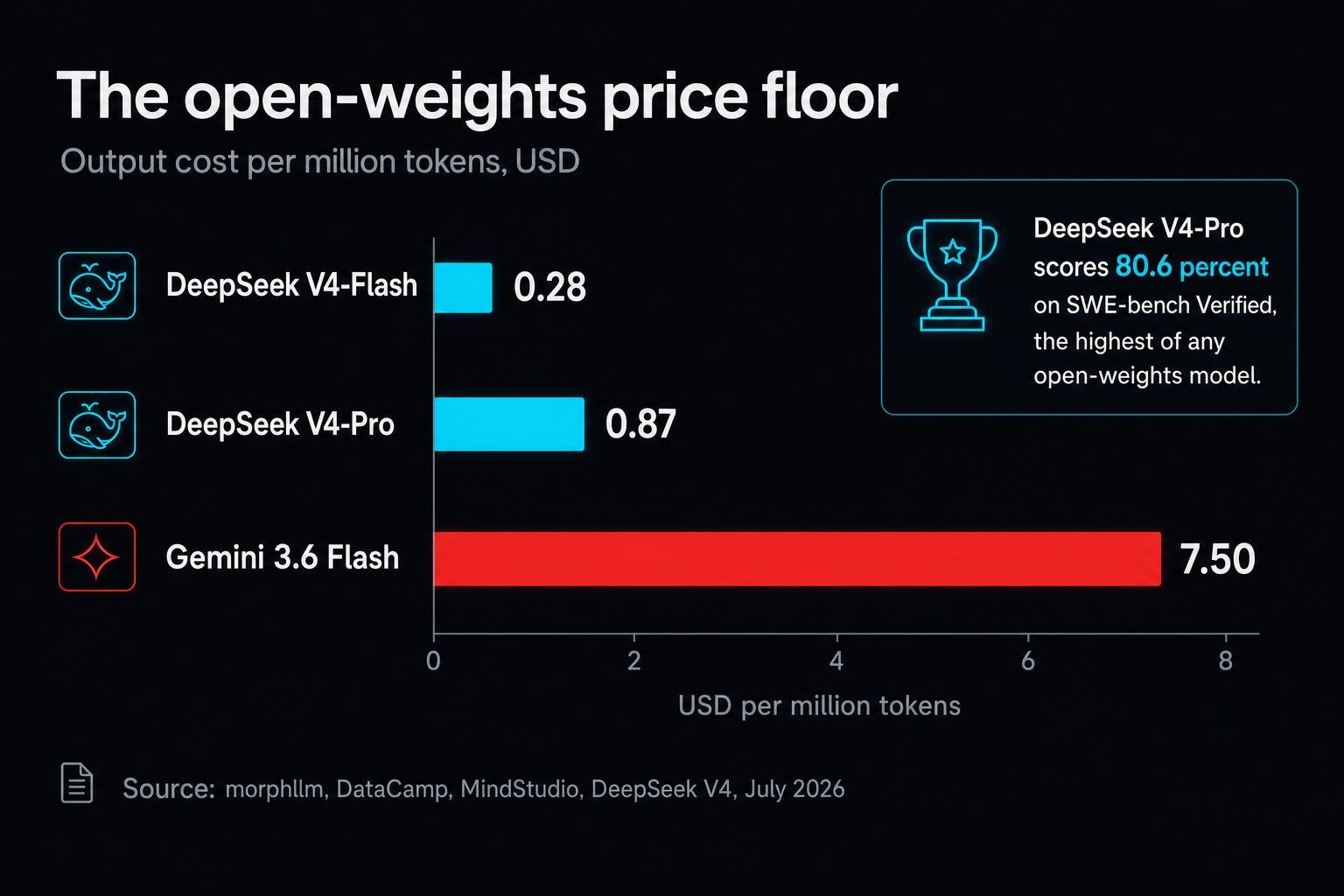
The numbers are genuinely impressive. V4 comes in two sizes: V4-Pro, a 1.6-trillion-parameter model with 49 billion active parameters priced at 0.87 dollars per million output tokens, and V4-Flash at 284 billion parameters with 13 billion active for just 0.28 dollars per million. Both carry a one-million-token context window, both are MIT-licensed open weights you can download from HuggingFace, and V4-Pro scores 80.6 percent on SWE-bench Verified, the highest of any open-weights model and tied with Gemini 3.1 Pro. For comparison, Gemini 3.6 Flash's newer pricing runs 1.50 dollars in and 7.50 dollars out per million tokens.
So in a single week, the industry saw its largest concentration of open-weight releases ever, with two very different provenance profiles sitting side by side. One is frontier-adjacent, self-hostable, and cheap, with a clean lineage. The other is arguably just as capable but now carries a cloud over where it came from.
Why this matters even if you never touch a model
The obvious reaction is that this is a geopolitics story, and it is. But the deeper shift is about trust becoming a feature you can measure. Until now, provenance was a footnote. Now it is a column on the spreadsheet, right next to speed and price.
Expect adoption to split down a predictable line. Individual builders and hobbyists will grab K3 the moment the weights drop, because for them the only cost of contested provenance is a shrug. Enterprises, hospitals, banks, anyone with intellectual property or regulatory exposure, will pause. For them, running a model that a US official has publicly linked to industrial copying is a documented risk, not a bargain. Choosing it deliberately, with the risk written down, becomes a real decision rather than a default.
There is also a quiet lesson about not marrying any single provider. If a model can go from cost-saver to compliance-headache in the span of one press conference, the smart architecture is one that lets you swap models the way you swap a supplier: quickly, and without rebuilding everything downstream. The best argument for that flexibility used to be price. Now it is politics.
Watch the calendar too. A White House frontier-AI framework is expected before August 1, and the questions it answers will shape the next year. Does it formalize a pre-release review for frontier models? Do know-your-customer rules for compute reach cloud providers in Southeast Asia, closing the export-control gap the Thailand allegation exposed? Does any US platform restrict K3 downloads, setting the first real precedent for governing open weights? Any one of those would turn this week's accusation from a headline into a rulebook.
The takeaway
We spent two years optimizing AI on a single axis: capability per dollar. This week reminded everyone there is a second axis that was always there, just invisible. Provenance. Where the model came from, what trained it, and whether you can stand behind that answer in front of a regulator. The models did not change. The questions did.
One signal a day. No noise.
A 3-minute read when something genuinely shifts in AI, automation, or defense tech. Free, most weekdays.
Free, most weekdays. No spam, unsubscribe anytime.Sources
- Build Fast With AI - AI News Today - https://www.buildfastwithai.com/blogs/ai-news-today-july-23-2026
- AOL - China's Moonshot tapped Anthropic's Fable - https://www.aol.com/articles/chinas-moonshot-tapped-anthropics-fable-143659000.html
- Glitchwire - Statistical analysis suggests Kimi K3 was distilled from Anthropic's Fable - https://glitchwire.com/news/new-statistical-analysis-suggests-kimi-k3-was-distilled-from-anthropics-fable-ad/
- morphllm - DeepSeek V4 - https://www.morphllm.com/deepseek-v4
- DataCamp - DeepSeek V4 - https://www.datacamp.com/blog/deepseek-v4
- MindStudio - DeepSeek V4 launch specs, open weight - https://www.mindstudio.ai/blog/deepseek-v4-launch-specs-open-weight-2026
- DeepSeek API docs - model alias retirement - https://api-docs.deepseek.com/news/news260424/
Quick answers
What did the White House accuse Moonshot AI of?
OSTP Director Michael Kratsios said publicly on July 22 that Moonshot distilled Anthropic's Fable model to build Kimi K3, calling it large-scale covert industrial distillation, and separately alleged Moonshot accessed export-restricted Nvidia GB300 chips through Thailand. No legal finding exists and Moonshot has not conceded.
What is model distillation?
Distillation is training a cheaper model on the outputs of a more capable one so it inherits that model's behavior. It is fast and inexpensive, but hard to prove, because outputs scraped innocently from the open web can look similar to outputs copied deliberately.
How is DeepSeek V4 different from Kimi K3?
DeepSeek V4's stable release landed July 24 with uncontested provenance. It ships MIT-licensed open weights, with V4-Flash at 0.28 dollars and V4-Pro at 0.87 dollars per million output tokens, and V4-Pro scores 80.6 percent on SWE-bench Verified, the highest of any open-weights model.
Why does model provenance suddenly matter?
Provenance is becoming a measurable factor alongside speed and price. Individual builders may adopt contested models quickly, but enterprises with IP or regulatory exposure now treat where a model came from as a documented risk, which favors flexible architectures that can swap providers when circumstances change.