Black Friday's Pickiest Shopper Was a Bot
US shoppers spent a record 7.1 billion dollars online on Thanksgiving, and the visitors who converted best did not come from a search box or a feed. They were sent by AI, and they had already read the fine print.

Picture this: it is Thanksgiving evening, the dishes are stacked, and one shopper in the house is not on the couch. It does not get tired, it does not get distracted by a video of a dog, and it reads every word on a product page before it buys anything. The dimensions. The materials. The shipping terms. It does not care that the hero image is beautiful. It wants to know whether the thing fits in the cupboard.
That shopper is an AI agent, and according to Adobe's Thanksgiving Day read, there were a lot more of them this year.
The record nobody was surprised by
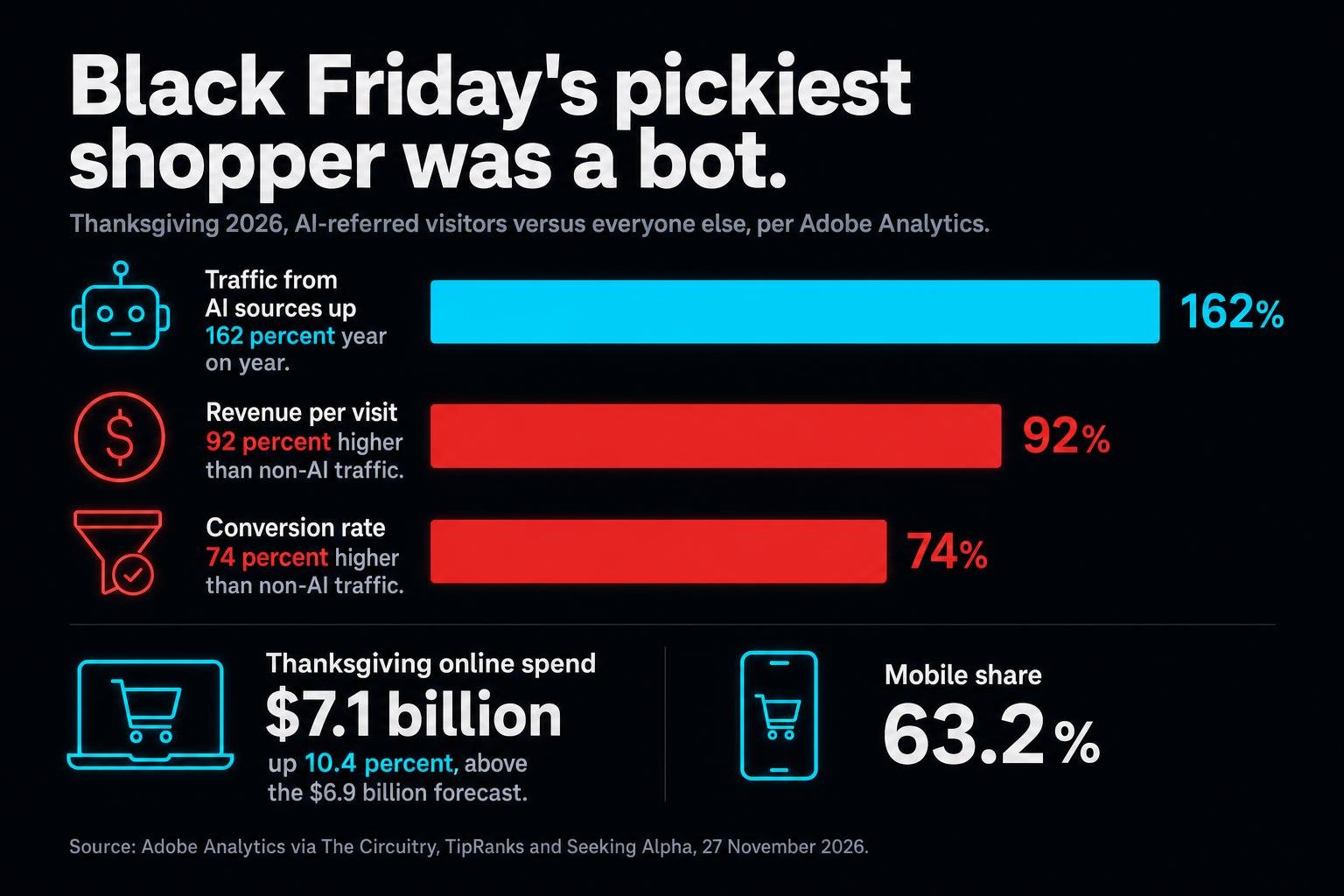
Adobe's figures, relayed on 27 November by The Circuitry, TipRanks and Seeking Alpha, put US online spending on Thanksgiving at about 7.1 billion dollars, up 10.4 percent on last year and above Adobe's own forecast of 6.9 billion. Mobile took a record 63.2 percent of the day's spend. Adobe left its forward numbers alone: 12.9 billion for Black Friday, 15.1 billion for Cyber Monday and 47.5 billion for Cyber Week, all records if they land.
A record in the busiest shopping week of the year is not the story. The story is who was doing the shopping.
The visitors who arrived from a chatbot
Traffic to US retail sites from AI sources rose 162 percent year on year on Thanksgiving. Those visitors converted 74 percent more often than everyone else, and one relay added that they generated 92 percent more revenue per visit.
Think about what an AI referral actually is. Someone asked an assistant which air fryer fits under a low cabinet and ships before Sunday, got an answer, and clicked through. They did not browse. They arrived already knowing what they wanted and why. Of course they convert better. The agent did the dithering for them, somewhere in a data centre, before the pie was served.
One caveat worth keeping: Adobe's pre-season reports had AI-referred visitors converting around 90 percent better over multi-week windows. A 74 percent gap on the single biggest deal day is a narrowing, not a widening. The most likely reading is boring and reassuring. On Thanksgiving everyone converts well, because everyone showed up to buy. The bot's lead shrank because the humans finally caught up.
Shopify's president says the quiet part out loud
On Black Friday morning, Shopify president Harley Finkelstein went on CNBC's Squawk Pod with a snapshot: about 2.3 million dollars a minute in sales across Shopify merchants, about 27,000 orders a minute, about 74,000 items a minute, and 26,000 merchants already having their best day ever by mid-morning. The average cart sat at about 115 dollars against about 113 last year. Later in the day a live dashboard had the run rate above 5 million dollars a minute, closing in on last year's peak of 5.1 million.
Then he got to the agents. Agent-sourced sales inside the Shop app were running about 3.3 times last year's level. Tin Can, a children's phone brand, was seeing 4 times. He called it "the first real Black Friday where Agentic is playing a real role". And he said the one line any store owner should pin above the desk:
"These agentic agents reward specificity."
A product page with exact dimensions, materials, compatibility and shipping terms gets picked. A vague one does not. This is the reverse of how a lot of ecommerce copy has been written for twenty years, where the job was to make a human feel something and sort out the details later. The agent does not feel. It compares. (It is the brother-in-law who reads the manual before he opens the box, except this one sends you customers.)
Finkelstein also cited Adobe's audit finding that retailer homepages average 63 percent AI "readability", an Adobe-defined score whose methodology has not been published, and a claim that AI-assisted purchases are 69 percent less likely to be returned. That last one makes intuitive sense. If the buyer knew the exact dimensions before paying, the box is less likely to come back.
What the numbers do not say
Three things are worth holding apart. Adobe measures US retail sites through its analytics tag. Salesforce measures its own Commerce Cloud customers and models the rest, and its headline of 75.8 billion dollars of "AI-influenced" Cyber Week spend is an attribution model, not a count of orders an agent placed. Salesforce's own traffic line was more modest than Adobe's: AI tool traffic up 104 percent, and AI-referred shoppers more than twice as likely to buy. Different thermometers in different rooms, all reading warm.
Shopify's 3.3x is a growth multiple on a base nobody disclosed. It could be a large number or a surprisingly small one. And the question Finkelstein himself called unresolved is the one hanging over the whole story: when an agent hosted by Amazon or Meta buys from a Shopify merchant, who pays whom? Nobody has an answer yet, and the Black Friday tape was still running when I wrote this.
Meanwhile, out in the physical world, pass_by counted about 330 million store visits by 1pm, down 2 percent. The humans stayed home. Something else went shopping.
Why I stopped guessing what the agents see
Finkelstein's line about specificity sounds like advice, but underneath it is a measurement problem. You cannot watch the agent read your page. You only see the sale it sends or does not send, and on a day when everything is up 10 percent, the sales you did not get never appear on any dashboard.
The way I learned to deal with that was to stop arguing about it. I built a harness that runs a fixed set of buyer questions against ChatGPT, Perplexity and Gemini, detects whether a target brand or domain gets cited in the answer, and tracks that citation rate over time. One run tells you almost nothing. A series of runs gives you a baseline and a trend, and a change to a product page either moves the line or it does not.
That is the whole trick with this new shopper. It will not tell you why it skipped you. It will, if you ask it the same questions on a schedule, show you whether it has started to notice.
If a shopping agent chose your competitor tonight because their page said one more thing than yours, would you ever find out?
One signal a day. No noise.
A 3-minute read when something genuinely shifts in AI, automation, or defense tech. Free, most weekdays.
Free, most weekdays. No spam, unsubscribe anytime.Sources
- The Circuitry - US Thanksgiving online spending hits a record 7.1 billion, up 10.4% - https://thecircuitry.to/article/us-thanksgiving-online-spending-hits-a-record-71-billion-up-104-mwzno420
- TipRanks (The Fly) - Adobe data shows AI traffic soaring as Thanksgiving online sales reach 7.1B - https://www.tipranks.com/news/the-fly/adobe-data-shows-ai-traffic-soaring-as-thanksgiving-online-sales-reach-7-1b-thefly-news
- Seeking Alpha - Black Friday came early for retailers as Thanksgiving delivered record 7.1B in sales - https://seekingalpha.com/news/4677049-black-friday-came-early-for-retailers-as-thanksgiving-delivered-record-71b-in-sales
Quick answers
How much did US shoppers spend online on Thanksgiving 2026?
About 7.1 billion dollars, according to Adobe Analytics figures relayed on 27 November 2026. That is up 10.4 percent year on year and above Adobe's own forecast of 6.9 billion. Mobile accounted for a record 63.2 percent of the day's online spend.
How did AI-referred shoppers perform on Thanksgiving?
Adobe reported that traffic to US retail sites from AI sources rose 162 percent year on year on the day, and that those visitors converted 74 percent more often than non-AI traffic. One relay added that they generated 92 percent more revenue per visit. Adobe's pre-season reports had shown a conversion gap of around 90 percent over multi-week windows.
What did Shopify say about AI agents on Black Friday 2026?
Shopify president Harley Finkelstein said agent-sourced sales inside the Shop app were running about 3.3 times last year's level, and that the children's phone brand Tin Can was seeing 4 times. No dollar figure for agent-sourced sales was given, so the multiple is on an undisclosed base. He also said the question of who pays whom when an Amazon-hosted or Meta-hosted agent buys from a Shopify merchant is unresolved.
Are the Adobe and Salesforce holiday numbers comparable?
Not directly. Adobe measures US retail sites through its analytics tag, which it describes as a sample of about one trillion visits. Salesforce measures its own Commerce Cloud customers and models the rest, and its 75.8 billion dollar figure for AI-influenced Cyber Week spend comes from an attribution model rather than a count of orders placed by agents.