AI agents just got a wallet, and a spending cap
On 17 November, Google, Anthropic and a Booking Holdings startup each let AI agents spend real money. Each one also gave a person a way to cap that spending, and where the cap lives matters more than the model behind it.

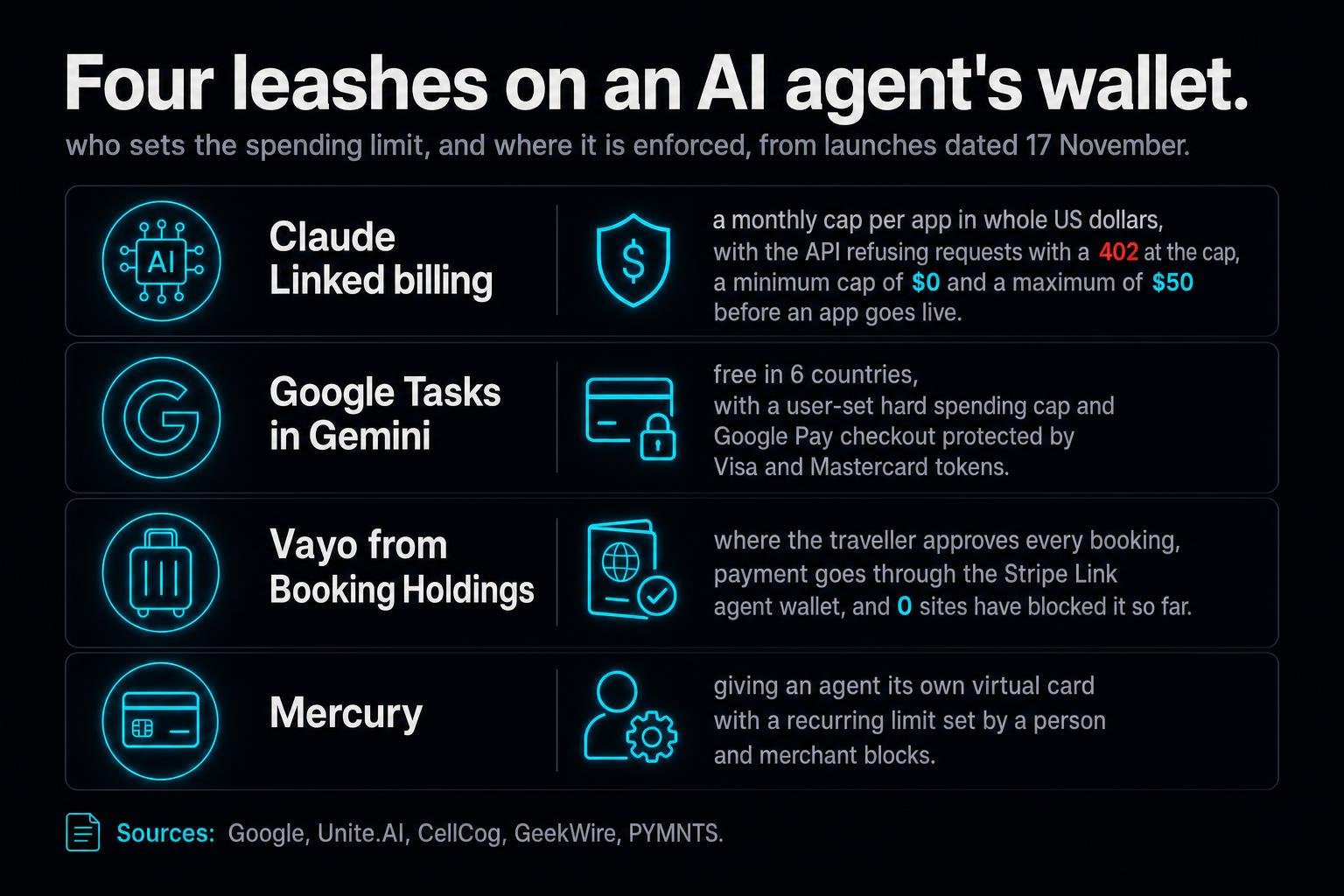
For two years, AI agents have mostly been good at talking about doing things. On 17 November they started paying for things. Three separate launches gave agents a way to spend real money. Each one also gave a human a way to say "this much, and no more."
The wallet makes the headline. To me the limit is the more important part, and it's the part most people will skip over.
Gemini can now call, book and pay
Google made Tasks in Gemini, the agent it first showed in May as Spark, free in the US, Canada, Australia, India, Japan and Korea for users 18 and over. It runs on Gemini 4 Hydrogen. In the US it can find nearby businesses through Maps, call several of them at once, book an appointment and put it on your Google Calendar. Unite.AI reports that in Google's example Gemini said it was an AI on the call, and that businesses can opt out.
It can also check out through Google Pay, with receipts and tracking sent to Wallet. Users can set a hard spending cap, and Unite.AI paraphrases Gemini as "designed to stay within it." Google says it is working with Visa and Mastercard, with American Express "coming soon," to protect purchases with digital tokens on supported cards.
Google is also open about the limits. Tasks can still fail or miss the goal, and on some websites Gemini hands the screen back to you for the final click.
The cap moves into the plumbing
The same day, Anthropic launched Linked billing in beta. In plain terms, an app built on Claude can now let its customers pay for their own usage through their own Claude organization, without sharing an API key. The customer clicks a button, signs in, picks an organization and sets a monthly spend limit in whole US dollars for that one app.
The details are worth reading:
- The per-app cap is separate from the organization's overall limit.
- When spending hits the cap, the API refuses the request with a 402 until 00:00 UTC on the first of the next month, or until the customer raises or removes the cap.
- The smallest cap is $0. Until an app is live, the cap must be $50 or less.
- Early adopters named are Factory, Linear and Ramp.
Think of it like the circuit breaker in your house. It doesn't ask the toaster to use less power. It cuts the power when the line is overloaded, whatever the toaster wants.
The approve button and the virtual card
The third launch is Vayo, the Seattle travel startup Booking Holdings launched last month. In its invite-only beta, its agents now book flights, hotels, rental cars and activities on sites including Expedia, Booking.com, OpenTable, SeatGeek and Alaska Airlines. Vayo confirmed to GeekWire that its agents book on Expedia by moving through Expedia's website, with no integration or partnership.
Vayo's guardrails are a different kind. Every booking needs the traveller's approval. It signs in with 1Password and, on sites other than Booking.com, pays through Stripe's Link agent wallet, without seeing passwords or card details. Vayo is not the merchant of record. So far, no site has blocked its bookings.
Around it, the same pattern keeps showing up. PYMNTS describes Mercury giving an agent its own virtual card with a recurring limit set by a person, plus merchant blocks. CNBC reports JPMorgan and Hyundai Card ran a proof of concept in which agents carried out simulated foreign-exchange transactions without a human stepping in.
Two kinds of limits
An analogy helps here. Handing an agent your card is like handing a teenager your credit card and asking them to be sensible. Handing it a capped wallet is like giving them a prepaid card with the balance already set. They may make the same choices either way. What changes is the worst that can happen.
A cap the model promises to respect and a cap the system enforces can look the same in a demo. They stop looking the same the day something goes wrong.
Look at where each limit lives:
- Anthropic's cap sits in the billing layer. Once it's hit, the API refuses. The model never gets a vote.
- Vayo's and Mercury's limits are outside the agent too: a human approval on every booking, a virtual card with its own limit and merchant blocks.
- Gemini's cap is described from the user's side. The public reporting says it is "designed to stay within" the limit. That may well be enforced in the payment rails, but nothing I read spells out how.
None of this means one approach is safe and another reckless. It means "has a spending cap" isn't enough of an answer anymore. The useful question is who sets the cap, and who enforces it?
What is still unclear
Plenty is still open. Google didn't describe how a business opts out of Gemini's calls. Vayo's "no site has blocked us" comes with an obvious "so far," since it books on sites it has no deal with. The JPMorgan test used simulated transactions. And Linked billing is a beta that I read about through a third-party explainer linking Anthropic's docs.
Still, the direction is clear. Agents are moving from answering to buying, and the companies shipping them have decided the leash ships on day one. For anyone buying, building or approving one of these tools, the leash is the first thing to check.
What unattended routines taught me about limits
I run a dozen-plus scheduled routines that pull from ad, commerce and CRM APIs, reconcile them, write to reporting sheets and post structured digests unattended, behind hard guardrails. Separately, I built an automated bridge that syncs a healthcare practice's records into its CRM behind a safety gate.
Both taught me the same thing. When software acts while nobody is watching, the limit has to live outside the thing doing the work, and it has to be decided before the run starts. A guardrail that depends on the worker behaving well isn't really a guardrail.
That's why Anthropic's 402 caught my attention more than any benchmark that day. A refusal from the billing layer holds even when the agent gets confused. A model "designed to stay within" a cap may hold too, but you should know which one you're relying on.
Before you give an agent a card, ask: who enforces this limit, and what happens when it trips?
One signal a day. No noise.
A 3-minute read when something genuinely shifts in AI, automation, or defense tech. Free, most weekdays.
Free, most weekdays. No spam, unsubscribe anytime.Sources
- Google - Tasks in Gemini is now free, with new features - https://blog.google/innovation-and-ai/products/gemini-app/tasks-in-gemini-free-new-features/
- Unite.AI - Google makes Tasks in Gemini free and adds calls and payments - https://www.unite.ai/google-makes-tasks-in-gemini-free-and-adds-calls-and-payments/
- Neowin - Google makes its always-on AI agent free - https://www.neowin.net/news/google-makes-its-always-on-ai-agent-free-adds-phone-calls-shopping-and-more/
- CellCog - Claude Linked billing explained - https://cellcog.ai/blog/claude-linked-billing/
- Anthropic - Organization billing connections guide - https://platform.claude.com/docs/en/manage-claude/oauth-apps/organization-billing-connections
- GeekWire - Booking Holdings travel startup Vayo starts booking trips with AI agents - https://www.geekwire.com/2026/booking-holdings-travel-startup-vayo-starts-booking-trips-with-ai-agents-even-on-rival-expedia/
- PYMNTS - AI agents put corporate card spending rules to the test - https://www.pymnts.com/news/b2b-payments/2026/ai-agents-put-corporate-card-spending-rules-to-the-test/
- CNBC - JPMorgan and Hyundai Card test AI agent payments - https://www.cnbc.com/2026/11/18/jpmorgan-hyundai-card-ai-agents-payments.html
Quick answers
What is Tasks in Gemini?
It is Google's agent inside the Gemini app, first shown in May as Spark. As of 17 November it is free for users 18 and over in the US, Canada, Australia, India, Japan and Korea. It can call businesses, book appointments and check out through Google Pay with a spending cap the user sets.
How does Anthropic's Linked billing spending limit work?
A customer connects their own Claude organization to an app and sets a monthly spend limit for that app in whole US dollars. When the cap is reached, the API refuses requests billed to that customer with a 402 until the first of the next month, or until the customer raises or removes the cap. The minimum cap is $0, and until an app is live the cap must be $50 or less.
Does Vayo need a partnership with Expedia to book there?
No. Vayo told GeekWire its agents book on Expedia by navigating Expedia's website, with no integration or partnership. Every booking needs the traveller's approval, and Vayo is not the merchant of record.
What should I check before letting an AI agent spend money?
Ask who sets the limit and where it is enforced. A cap enforced by the billing or payment layer, a separate virtual card, or a human approval step works regardless of what the model decides. Also check what happens when a task fails or hits the limit.
Part of: AI shopping agents · the running scoreboard