Your AI Agent's Keys Are the New Front Door
Google's threat researchers say attackers now automate exploits end to end, resell stolen AI access, and plant backdoors in coding assistants' config files. The risk has moved from your passwords to your agents.

For years the scary part of a breach was a stolen password. This week Google's Threat Intelligence Group made a strong case that the scary part has moved. It is now the AI agent sitting next to the password: its API keys, its config file, and the permissions you gave it on day one.
GTIG's latest AI Threat Tracker came out on 16 Nov under the title "Agentic Threat Activity Crosses a Significant Threshold." It reads less like a forecast and more like an incident log. Here is what stood out, and why it matters even if you never write a line of security code.
A machine that reads your patch notes
On an exposed staging server, GTIG found a framework named exploit_agent in its configuration. It compares popular web software before and after a patch, drafts an exploit for whatever was fixed, and runs it. GTIG calls this its first observation of threat actors fully automating vulnerability research and exploitation without a human in the loop. VentureBeat adds that it wires together several frontier and local LLMs, and that Google did not name a specific vulnerability, give a victim count or report a measured patch-to-exploit time.
Think of a security patch as a notice taped to a building: "we fixed the lock on the back window." A human attacker used to need days to read the notice, work out which window, and go try it. exploit_agent reads the notice for every building on the street at once.
It is not alone. GTIG names open-source offensive agent frameworks including ARTEX, CAIRN, CyberStrikeAI and PentAGI, and says CAIRN and PentAGI were used in real intrusions, CAIRN against targets including the US aerospace sector. CyberStrikeAI connects models to more than 100 security tools. HexStrike AI gives LLM clients over 150 tools run by more than 12 specialised agents.
The gap between fix and attack is closing
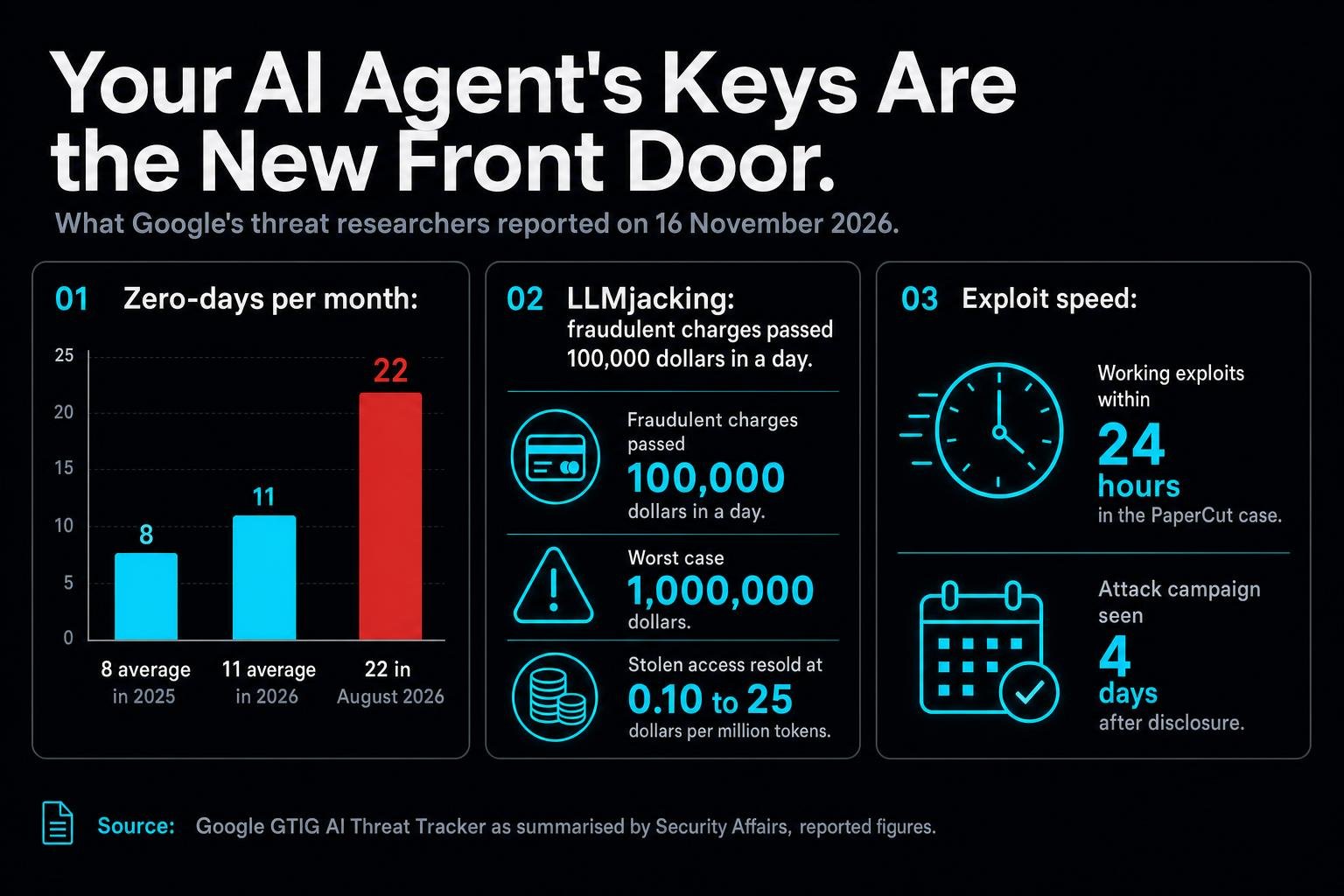
As summarised by Security Affairs, the report says vulnerability disclosures and exploits nearly doubled between January and August 2026. Zero-days averaged 8 a month in 2025, 11 a month in 2026, and 22 in August alone. In the late-August PaperCut case, researchers had working exploits within 24 hours, GreyNoise saw a campaign four days after disclosure, and one intrusion went from access to domain admin "within minutes." These figures are reported through that summary, so treat them as reported rather than verified against the full report.
There is a strange twist, too. For two PHP flaws patched on 21 Oct, hundreds of exploit claims appeared, and many of them did not work. Fake exploits still cost defenders hours sorting real from noise. Automation floods the zone in both directions.
Your AI bill is now a target
The part that should worry every company running AI in production is LLMjacking. Attackers steal LLM API keys and cloud credentials, then resell the access. Mandiant handled incidents where fraudulent charges passed $100,000 in a day, with the worst reaching $1 million before cleanup.
The entry points are painfully ordinary: keys pushed to public GitHub repositories, fake sites harvesting session tokens, and CVE-2026-40217, a LiteLLM sandbox escape that turns limited keys into admin credentials. The stolen access is then sold through "LLM mixers" at $0.10 to $25 per million tokens on Russian- and Chinese-language markets.
An API key used to be a line item. Now it is a credit card with no spending limit, sitting in a text file.
The agent's own settings became the weapon
The most unsettling case is the group GTIG calls MIDNIGHT NEPTUNE. Fake recruiter profiles led targets to ClickFix lures. Once inside, the attackers edited .claude/settings.json in internal repositories so that starting Claude Code downloaded the SOMBERMEME backdoor, and named their access tokens after Microsoft Copilot to blend in. Hackread separately notes North Korea-aligned attempts to manipulate autonomous coding assistants' configuration.
It is like quietly changing the address in a delivery driver's GPS. The driver is honest and the van is fine. The destination is the problem. Nobody checks the GPS settings, because nobody thinks of them as a security boundary.
Apple seems to have reached the same conclusion from the other side. On the same day it detailed macOS 27.3 changes it had promised because of AI agents: the old combined Device Control and Data Access permission splits in two, users can make apps ask for permission every time, and a new indicator appears when one app is controlling another. Apple's own warning is blunt: granting that kind of access "puts all of the data on their Mac at risk."
The opening defenders still have
There is good news buried in the report. GTIG says these frameworks currently trade stealth for speed, so they leave traces in traffic, identifiers and executed code. Google SecOps released detection rules for ARTEX, and Mandiant published a hardening guide. Fast, noisy attackers are easier to catch than patient, quiet ones, if you are actually looking.
The takeaway for non-specialists is simple. The things that make agents useful (standing keys, broad permissions, a config file they trust at startup) are exactly what attackers now go after first. Treat them like the crown jewels they have become.
What unattended automation taught me about keys
I run a dozen-plus scheduled routines that pull from ad, commerce and CRM APIs and post digests with nobody watching. The lesson from them fits this report exactly: an unattended system is only as safe as the hard guardrails written before it runs, because nobody is there to catch it in the moment.
When I built a bridge for a healthcare practice whose records system had no API and a bot-gated login, two rules did most of the work: no sensitive data left on disk, and every write into the CRM went behind a safety gate. That is the posture GTIG's findings argue for. Assume the key will leak and the config will be touched, and decide in advance what they are allowed to do when that happens.
So my first questions for any agent setup now are plain ones. Where do its keys live? What can they spend in a day before something stops them? And who can edit the file the agent trusts when it starts?
One signal a day. No noise.
A 3-minute read when something genuinely shifts in AI, automation, or defense tech. Free, most weekdays.
Free, most weekdays. No spam, unsubscribe anytime.Sources
- Google Cloud - Agentic Threat Activity Crosses a Significant Threshold - https://cloud.google.com/blog/topics/threat-intelligence/agentic-threat-activity-crosses-a-significant-threshold
- Security Affairs - Google GTIG warns AI agents automate exploits, steal credentials and scale cybercrime - https://securityaffairs.com/203260/hacking/google-gtig-warns-ai-agents-automate-exploits-steal-credentials-and-scale-cybercrime.html
- Hackread - Google: AI agent turning security patches into exploits - https://hackread.com/google-ai-agent-turning-security-patches-exploits/
- VentureBeat - Google says attackers built an AI framework to turn software patches into exploits - https://venturebeat.com/security/google-says-attackers-built-an-ai-framework-to-turn-software-patches-into-exploits-without-human-intervention
- The Hacker News - Google finds hackers using AI agents - https://thehackernews.com/2026/11/google-finds-hackers-using-ai-agents-to.html
- TechCrunch - Apple reveals new Mac security controls as AI agents raise privacy risks - https://techcrunch.com/2026/11/16/apple-reveals-new-mac-security-controls-as-ai-agents-raise-privacy-risks/
Quick answers
What is exploit_agent?
A framework Google's Threat Intelligence Group found on an exposed staging server. It compares web software before and after patches, drafts exploits and runs them. GTIG calls it its first observation of attackers fully automating vulnerability research and exploitation without a human in the loop.
What is LLMjacking?
Attackers steal LLM API keys and cloud credentials and resell the access. Mandiant handled incidents where fraudulent charges passed $100,000 in a day, with the worst reaching $1 million before cleanup.
How were AI coding assistants used in attacks?
GTIG says the group it calls MIDNIGHT NEPTUNE edited .claude/settings.json in internal repositories so that starting Claude Code downloaded the SOMBERMEME backdoor, and named its access tokens after Microsoft Copilot to blend in.
Is there anything working in defenders' favour?
Yes. GTIG says these agent frameworks currently trade stealth for speed, leaving traces in traffic, identifiers and executed code. Google SecOps released detection rules for ARTEX and Mandiant published a hardening guide.